Every walk in an Indian city is a scent obstacle course. Discarded vada pav, chicken bones outside a dhaba, a smear of something unidentifiable near the gate, your dog's nose finds all of it before your eyes do. A dog without a trained leave it cue is one lunge away from swallowing something that could cause a blockage, poisoning, or a vet visit you weren't planning.
Leave it is one of the most practically useful cues in everyday dog ownership, and it works through a simple learning principle: the dog learns that ignoring the thing on the ground produces something better than the thing on the ground. That is positive reinforcement paired with an incompatible behaviour. The dog cannot simultaneously lunge at the scrap and look at you for a reward.
Start indoors, not on the street
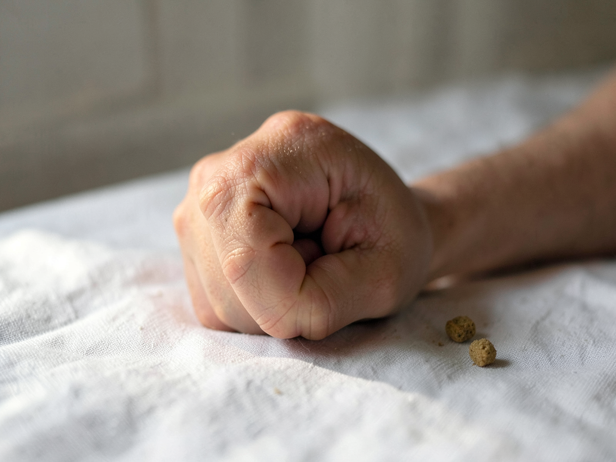
Begin in a low-distraction room with a treat the dog finds mildly interesting, a piece of dry kibble works well for the first stage. Hold it in a closed fist. Let the dog sniff, nudge, paw, and lick your hand. The moment the dog pulls back or pauses, mark the moment with a clear marker word, "yes" said once, crisply, and immediately give a different, better treat from your other hand. The treat from your fist never becomes the reward. That distinction is the whole lesson: the thing you leave alone is not what you get; what you get is something better from me.
Repeat this ten to fifteen times in a session. Keep sessions short, five minutes is enough. Dogs learn faster in brief, frequent repetitions than in long exhausting ones. Once the dog is pulling back from your fist reliably, add the verbal cue. Say "leave it" once, quietly, just before you present the fist. One repetition of the cue. Not "leave it, leave it, leave it", a cue repeated until the dog complies is a cue that has taught the dog to wait for the third one.
![Fist, Kibble, Morning Light]()
Fist, Kibble, Morning Light
Image credit : AI
Practicing 'leave it' with a single kibble. A test of restraint and focus.
Move to a treat on the floor
Place a piece of kibble on the floor and cover it with your foot. Say "leave it" once. The dog will try to get around your foot. Wait. The moment the dog backs off and glances at you, mark and reward from your hand, again, not the piece on the floor. The piece on the floor stays on the floor and gets picked up by you when the exercise is done.
When the dog is leaving the covered treat reliably, progress to placing it on the floor uncovered. Stand close enough to step on it if needed, but don't. Say the cue. If the dog moves toward it, step over it immediately, no scolding, no pulling the lead, just a quiet block. If the dog leaves it and looks at you, mark and reward. The dog is learning that the verbal cue alone predicts the outcome, not the foot or the lead.
This stage takes most dogs between three and seven days of consistent short sessions to consolidate. Some dogs move faster; some need two weeks. The variable is almost always the consistency of the handler, not the dog.
Generalise to real-world conditions
Generalisation is where most leave it training stalls. A dog that leaves a kibble on the living room floor has learned one very specific thing. The same dog on a street has a completely different arousal level, a nose full of competing smells, and no reason to believe the indoor lesson applies here.
Work through a hierarchy of difficulty before you need the cue on a real walk. Progress in order: a treat on the floor at home, a treat on the floor in the garden, a treat on the pavement outside your building with no other dogs around, a treat on the pavement with mild foot traffic, and finally a real walk where you carry high-value rewards, a small piece of boiled chicken or paneer works well, ready to pay out the moment the dog responds to the cue. The street scrap itself is never the reward. You are always competing with it by offering something better.
Keep the lead loose during practice. A tight lead adds pressure and arousal, which makes the cue harder to respond to, not easier. If the dog is already lunging, you have moved up the hierarchy too fast. Go back a step.
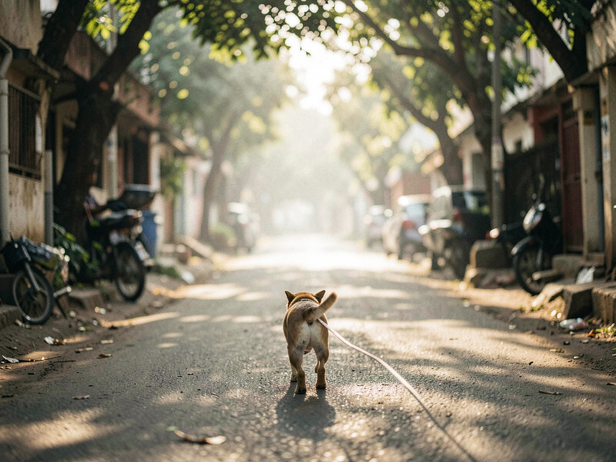
![Morning Dog Walk]()
Morning Dog Walk
Image credit : AI
Teaching my dog the 'leave it' command on a peaceful morning walk. Avoiding street food scraps is key.
When leave it breaks down
A cue that works nine times out of ten is not a reliable safety cue. Three things cause breakdown, and each has a different fix.
First, the dog has never been rewarded at a high enough rate in the real environment. Fix: go back to structured practice on the street with treats in hand, not just on walks where you hope the cue holds.
Second, the reward you are offering is not competing with what is on the ground. A chicken bone outside a restaurant is more interesting than a piece of dry kibble. Match or beat the distraction with your reward value. Boiled meat, a small piece of cheese, or whatever your dog finds irresistible is appropriate here.
Third, the dog is over threshold, too aroused, too close to the item, or too surprised to process the cue. Prevention is the only fix for this one: manage distance, keep your eyes ahead of your dog's nose on walks, and cross the road early when you see food debris ahead.
If your dog has a history of resource guarding around food on the ground, freezing, stiffening, or growling when you approach something it has found, leave it training alone is not the right tool. A qualified trainer or veterinary behaviourist should assess the behaviour before you work on it, because the wrong approach can escalate guarding rather than reduce it.
What leave it does not do
Leave it is a cue, not a guarantee. It works when the dog has been trained to a level that matches the difficulty of the environment. It fails when it has been trained indoors and expected to hold on a busy street, or when it has been used as a shout after the dog has already picked something up, at that point, a separate cue, drop it, is what you need, and it is trained differently.
The cue also does not replace management. Until leave it is solid across every environment your dog encounters, keep your eyes forward on walks, give food debris a wide berth, and carry rewards. The cue is a bridge; management is the structure it runs on.
Leave it and drop it together cover most of the real situations a street walk throws at a dog. Neither takes long to teach. Both take longer to generalise than most owners expect, and that gap between indoor reliability and street reliability is where the training work actually lives.