A rabbit's teeth grow throughout its life, and chewing is the mechanism that keeps them at a usable length. When a rabbit locks onto a power cord or the corner of a sofa, it is not being destructive, it is doing exactly what its biology expects it to do, in the absence of anything more appropriate. The fix is environmental, not disciplinary.
Understand why the chewing is happening
Rabbits chew for three overlapping reasons: dental maintenance, sensory exploration, and boredom. A rabbit that is under-stimulated, under-exercised, or confined for long stretches will escalate. Before changing anything, watch where and when the chewing happens. A rabbit that chews only when left alone for hours needs more free-roaming time. One that chews immediately after being let out is likely under-enriched. The pattern tells you which lever to pull first.
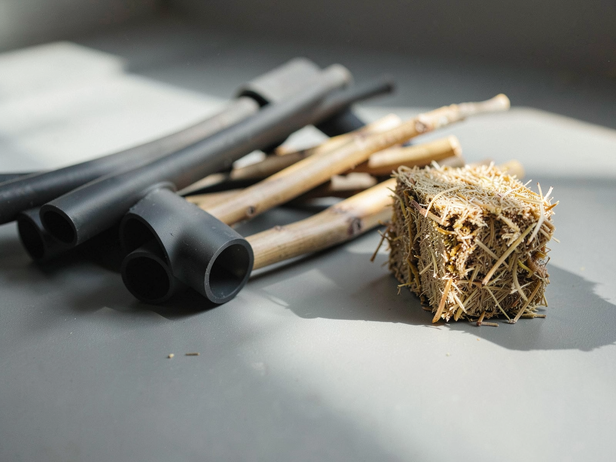
![Bunny's Chewables and Protection]()
Bunny's Chewables and Protection
Image credit : AI
Protecting furniture from rabbit chewing with conduit and willow sticks.
Remove access before training begins
Positive reinforcement works by rewarding the right choice, and the right choice needs to be available. While you are building the habit, take away the wrong choice. Run all exposed cables through split cable conduit, the flexible plastic tubing sold at hardware stores, or reroute them behind furniture. Baseboards and chair legs can be wrapped temporarily in cardboard, which the rabbit can chew harmlessly, or blocked with furniture guards. This is not a permanent solution; it is the scaffold that makes training possible. A rabbit that cannot reach the wire cannot rehearse the behaviour you are trying to replace.
Provide better alternatives and reinforce their use
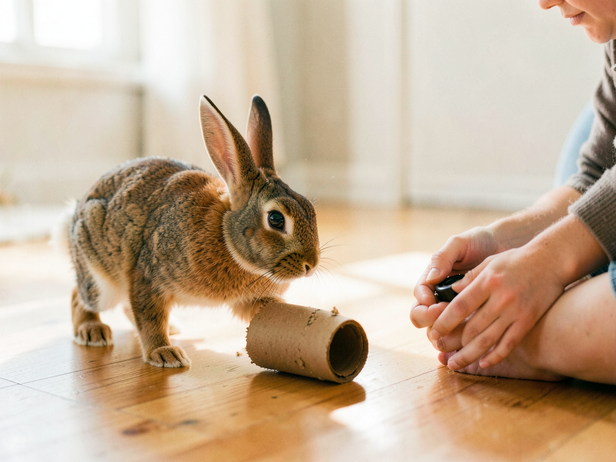
Place untreated willow sticks, apple wood branches, compressed hay cubes, or cardboard tubes in the areas where the rabbit roams. When the rabbit chews one of these, mark the moment with a calm, consistent sound, a small clicker or a short word like "yes", and immediately follow it with a small piece of a food it values: a fragment of fresh herb, a thin slice of apple, a leaf of leafy greens. The marker tells the rabbit precisely which action earned the reward. Repeat this every time you see appropriate chewing. Within days, the rabbit learns that the willow stick produces something good and the cable produces nothing. Timing is everything: the marker must land within one to two seconds of the behaviour, or the rabbit cannot connect the two.
![Rabbit reaches for toy]()
Rabbit reaches for toy
Image credit : AI
My focus is on this enrichment toy, a great way to stop rabbit chewing furniture. Training is key!
Interrupt and redirect, not punish
When you catch the rabbit approaching a wire or beginning to chew furniture, interrupt with a single neutral sound, a short clap, a gentle "ah", and immediately offer an approved chew item. The moment the rabbit takes it, mark and reward. This sequence, done consistently, builds a new association: the impulse to chew leads to the willow stick, not the cable. Shouting, tapping the rabbit's nose, or startling it does not teach an alternative and will make it more anxious and harder to handle. Punishment-based methods have no place in rabbit training.
Increase free-roaming time and enrichment
A rabbit that spends most of its day in a hutch or a small pen will chew more destructively during the time it is out, because it is compensating for hours of under-stimulation. Rabbits kept in Indian flats need at least three to four hours of supervised free-roaming daily, ideally split across morning and evening when they are naturally most active. Rotate enrichment items, cardboard boxes with entry holes, tunnels made from rolled newspaper, hay piled in a corner for digging, so the environment stays novel. A rabbit that is tired and satisfied from genuine activity is a rabbit that chews less.
Use taste deterrents as a short-term bridge
Bitter apple spray, available at pet stores, can be applied to furniture legs and baseboards. Most rabbits find the taste aversive and will avoid treated surfaces. This is a bridge, not a solution: it buys time while the rabbit is learning what it should chew. Reapply every few days, because the effect fades. Never apply deterrents to cables as a substitute for covering them, a rabbit that bites through a live wire despite a bitter coating is in danger.
When to involve a vet or a qualified trainer
If the chewing is accompanied by changes in eating, drooling, dropping food, or grinding teeth, the behaviour may have a dental component that no amount of enrichment will resolve. Overgrown molars and dental spurs in rabbits are painful and not visible without an examination. A rabbit that chews obsessively regardless of enrichment, or that shows signs of distress, needs a vet check before any training continues. For rabbits that also show aggression, lunging, biting, or thumping when approached, a veterinary behaviourist or a trainer with documented rabbit experience is the right next step, not escalated correction at home.
The chewing does not stop because the rabbit decides to stop. It stops because the environment gives it a better target, the reward history makes that target worth choosing, and the rabbit has enough space and activity to use its energy on something other than your furniture.