Most dogs in Indian homes with domestic staff face a situation no breed guide prepares them for: a rotating cast of adults who enter, leave, carry things, open doors and speak in different tones, on schedules that shift without warning. A dog that barks, lunges or hides every time the cook arrives at seven in the morning is not being difficult. It is doing exactly what its instincts trained it to do, flag the unfamiliar. The owner's job is to change what "unfamiliar" means.
Understand what your dog is actually reacting to
Barking at staff is almost never aggression in the clinical sense. It is arousal, a spike in alertness triggered by someone the dog has not learned to categorise as safe. The trigger is usually entry: the door opening, footsteps on the landing, a key in the lock. Some dogs react to specific cues: a particular uniform colour, the sound of a mop bucket, the smell of a cleaning product. Before training starts, watch two or three entries and note exactly when the barking begins. That moment, the threshold, is where the training targets.
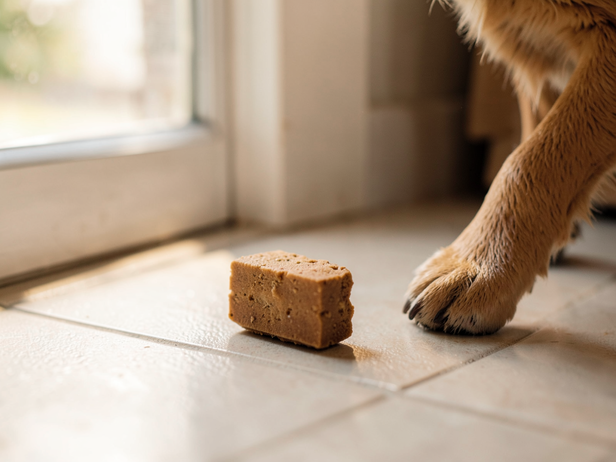
![Paw reaches for treat]()
Paw reaches for treat
Image credit : AI
My paw nears the treat, a reward for good behavior around the household staff. Training is key!
Set a clear entry protocol with every staff member
The most common mistake is inconsistency. One day the maid greets the dog warmly, the next she ignores it, the day after she shoos it away when it jumps. From the dog's point of view, this person is unpredictable, and unpredictable adults stay in the "not safe" column indefinitely. Ask each staff member to follow one simple sequence every time they enter: walk in calmly, stand still for five seconds, look slightly away from the dog, and wait. No reaching down, no loud greetings, no sudden movements. This alone reduces arousal faster than any treat protocol, because the dog's nervous system is reading body language before it reads intent. A still, side-facing adult reads as non-threatening across almost every dog breed.
Use counter-conditioning to change the association
Counter-conditioning pairs the trigger, the cook arriving, with something the dog already values, typically a high-value treat it does not get at other times. The sequence: staff member appears at the door, you immediately drop a treat on the floor near your dog. Not after the barking stops. At the moment of appearance. Over ten to twenty repetitions across several days, the dog begins to anticipate the treat when the door opens rather than scanning for threat. The learning principle is classical conditioning: the arrival predicts something good, so the emotional response to arrival shifts. Keep sessions short. One entry, one treat, done. Do not run five arrivals in a row in a single morning, the dog needs time between repetitions to consolidate the association.
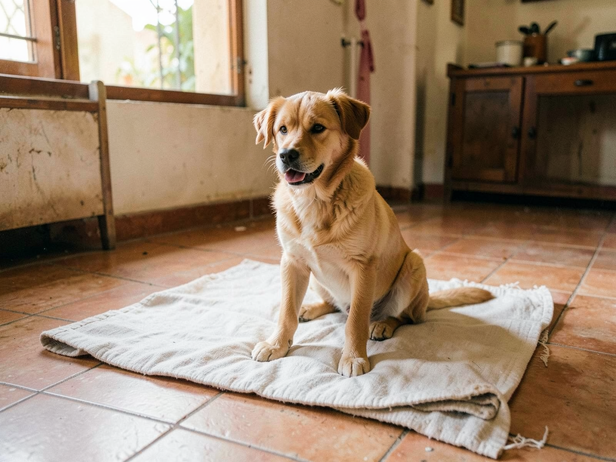
![Dog rests on Indian mat]()
Dog rests on Indian mat
Image credit : AI
My dog finds comfort on the mat, a peaceful moment in our Indian home. Training dog positive reinforcement unfamiliar people is key.
Build a place command the dog goes to on entry
Once the dog is no longer peaking at full arousal on entry, add a place command, a specific mat or bed it goes to when staff arrive. This gives the dog a job, which reduces the ambient stress of not knowing what to do with itself. Teach the place command separately, away from the entry situation, using standard shaping: lure the dog onto the mat, mark the moment all four paws are on it with a marker word or clicker, reward. Gradually add duration. Once the dog holds place reliably for thirty seconds in a calm setting, begin cueing it the moment you hear the staff member at the door, before the door opens. The dog on its mat cannot simultaneously be lunging at the entrance. Reward generously for staying on the mat while the staff member moves through the home.
Handle new staff and irregular visitors differently
A driver who comes three times a week is a different training problem from a plumber who appears once. For regular staff, the counter-conditioning above works because repetition is available. For irregular visitors, a new maid, a delivery person, a relative's driver, manage the environment rather than expecting trained behaviour. Put the dog behind a baby gate or in another room before the person enters. Let the dog observe from a distance where it is below threshold. If it is calm at that distance, allow a slow approach over several minutes. Never force an introduction. A dog pushed into proximity it has not chosen will either shut down or escalate, and neither outcome builds the trust you need.
When the behaviour needs more than home training
If your dog's reaction to staff includes growling, snapping, stiff posture with a fixed stare, or has already resulted in a bite, even a small one, home counter-conditioning is not the right starting point. These are signs the dog is working above threshold in a way that home training cannot safely address without professional guidance. A qualified trainer or veterinary behaviourist can assess whether the behaviour is fear-based, pain-related, or something else entirely, and design a protocol with the safety margins the situation needs. The six steps above are for a dog that barks and settles; they are not a substitute for professional assessment of a dog that has shown aggression.