Most dogs in apartment buildings learn to tolerate the elevator the way a person learns to tolerate a bad commute, through repetition, with low-grade dread still intact. That is not the goal here. A dog that sits calmly in a lift without panting, pulling, or lunging at the doors has been trained, not just habituated. The difference matters every morning when your neighbour steps in with a toddler.
Why elevators are hard for dogs
Every element of a lift works against a dog's nervous system. The space is small and escape is impossible, a core trigger for dogs already prone to anxiety. The floor vibrates and shifts underfoot, which reads as unstable ground. The doors open suddenly to reveal strangers at close range, with no warning scent trail because the air is sealed. For a dog that processes threat through smell and space, an elevator removes both. Add the sounds, the motor hum, the bell, the mechanical slide of doors, and you have a sensory package that many dogs find genuinely aversive the first time and increasingly alarming if they are pushed through it without preparation.
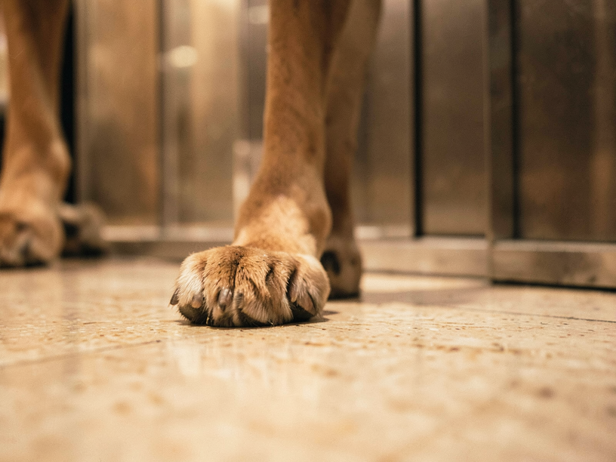
![Dog Paws by Elevator]()
Dog Paws by Elevator
Image credit : AI
Waiting patiently for the elevator. Practicing being calm in the elevator is key for apartment dog training.
The principle behind the training
This plan uses desensitisation paired with counter-conditioning. Desensitisation means exposing the dog to the trigger at a level below what causes a stress response, then raising the level gradually. Counter-conditioning means pairing each exposure with something the dog finds strongly rewarding, typically a high-value food treat, so the dog builds a new emotional association with the trigger. The marker matters: a clicker or a short verbal cue like "yes" the moment the dog does the right thing tells the dog exactly which behaviour earned the reward. Timing a marker half a second late is enough to reward the wrong thing. These are not abstract concepts. They are the mechanics of every step below.
The six-step plan
Work through each step only when the dog is relaxed at the current one. There is no fixed timeline. A confident dog may move through steps one to three in a week. A dog with existing anxiety may spend two weeks on step one alone. Rushing is the most common reason this training fails.
Step 1, The lobby, not the lift. Bring the dog to the elevator lobby and stop there. Let the dog sniff, look around, settle. Reward calm behaviour with the marker and a treat. Do this across several sessions until the dog arrives at the lobby with a loose lead and no visible stress, no lip licking, no yawning, no tail tucked.
Step 2, The closed doors. Walk the dog to the elevator doors while they are closed. Reward the dog for standing or sitting near them without reacting. If the bell sounds or the doors open, note whether the dog startles. A small flinch that the dog recovers from quickly is within threshold. A hard lunge or sustained freeze is above threshold, move back a step.
Step 3, The open door, dog outside. Call the lift, let the doors open, and stand at the threshold with the dog outside. Reward the dog for looking at the open lift without stepping forward. Repeat until the dog looks at the open door and then looks back at you, that eye contact is a signal the dog is choosing engagement over alarm.
Step 4, One paw in. Ask the dog to step one front paw into the lift. Mark and reward immediately. Step back out together. The dog does not need to enter fully. Repeat until the dog steps in with no hesitation.
Step 5, Full entry, doors open. Walk the dog fully into the lift. Ask for a sit. Mark and reward. Walk back out before the doors close. Repeat until the dog enters, sits, and holds the sit with a relaxed body, weight evenly distributed, ears neutral, tail loose.
Step 6, The full ride. Enter, ask for a sit, let the doors close, ride one floor, exit. Mark and reward when the dog exits calmly. Build to the full height of your building across several sessions. Keep the lead loose throughout, a tight lead communicates tension to the dog and undoes the calm you are building.
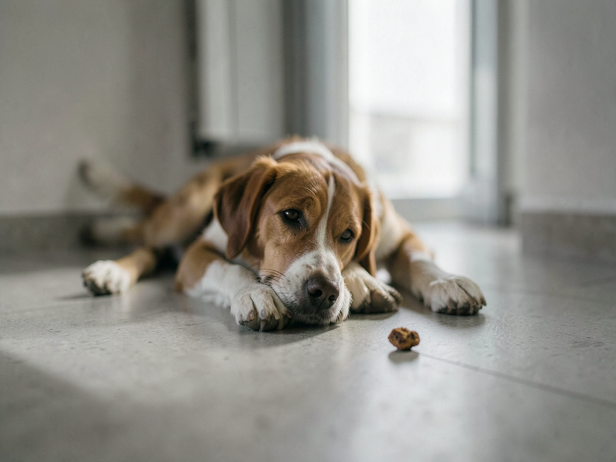
![Dog's Treat Awaits]()
Dog's Treat Awaits
Image credit : AI
A tempting treat for calm elevator training in Indian housing society.
What to do when it stops working
A dog that was progressing and then regresses has usually been pushed past threshold, by a bad experience in the lift, by a stranger crowding in, or simply by moving too fast through the steps. Go back two steps, not one. Reintroduce the trigger at a distance where the dog is visibly comfortable and rebuild from there. If the dog shows sustained reactivity, barking, lunging, freezing and refusing to move, or any sign of aggression toward people entering the lift, this is the point to bring in a qualified trainer or veterinary behaviourist. Reactivity that involves aggression toward people is not a training-pace problem; it needs professional assessment of what is driving it.