High arousal after play is not a behaviour problem. It is a dog doing exactly what its nervous system is built to do, and then struggling to reverse the process without help. The good news is that the off switch is trainable. The less good news is that it takes longer than the zoomies.
Why some dogs can't settle on their own
![Golden Hour Canine Joy]()
Golden Hour Canine Joy
Image credit : AI
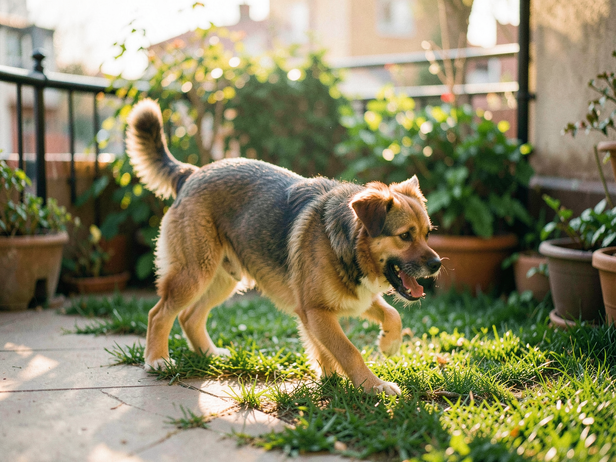
Pure canine exuberance in the golden hour. Teaching a dog to calm down after play is key for happy evenings.
Arousal is a physiological state, not a mood. During play, a dog's heart rate rises, stress hormones like cortisol and adrenaline flood the system, and the brain's reward circuits run hot. In a calm, well-regulated dog, these levels drop naturally within a few minutes once the trigger is gone. In a dog that has been under-exercised, over-stimulated, or simply wired that way by breed, the system stays elevated long after the ball has been put away.Terriers, working breeds, and dogs that were bred to sustain effort, herding dogs, hunting dogs, high-drive retrievers, often have a slower return to baseline. This is not a flaw. It is the trait that made them useful. In a Gurgaon flat with no field to run in, it just needs a different outlet and a deliberate wind-down.
What makes it worse
The most common owner mistake is trying to calm an excited dog by engaging with it. Talking to it, pushing it away, repeating commands, or offering another toy all count as interaction. To a dog at peak arousal, interaction is fuel. The arousal loop stays open.Rough play right before a rest period is a second problem. A game of tug that ends abruptly, or a chase session stopped mid-run, leaves the dog's system mid-spike with nowhere to go. The dog is not being difficult. It has been handed a half-finished sentence.
The wind-down sequence: six steps in order
![Dog's Focused Sniffing Session]()
Dog's Focused Sniffing Session
Image credit : AI
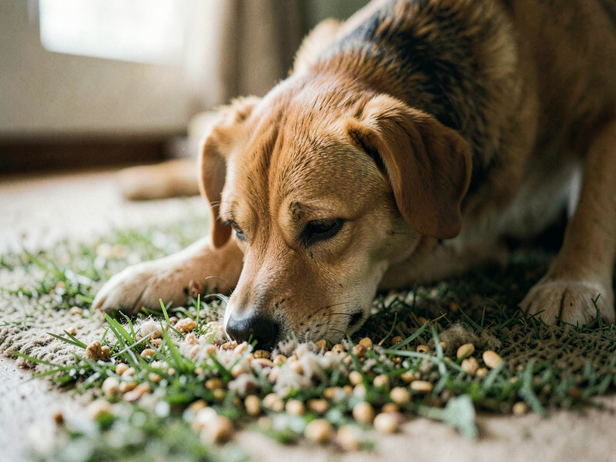
A moment of calm: teaching a dog to settle down after play with a rewarding sniff. This dog won't settle after exercise.
These steps work as a sequence. Skipping the early ones and going straight to a settle cue rarely works on a dog that is still in the red.**Step 1, Slow the play before you stop it.** In the last two to three minutes of a session, shift from high-intensity games to something lower: slow sniffing around the garden, a short on-leash walk, or scatter feeding on a mat. Let the nervous system begin its descent before you ask for stillness. Realistic timeline: most dogs respond within a week of consistent practice.**Step 2, End on your terms, not the dog's peak.** Stop the game before the dog is at maximum excitement. This is counter-intuitive. Ending while the dog still wants more is exactly the point, it means arousal is already on a downward slope when you stop.**Step 3, Remove yourself from the equation.** Once play ends, stop talking, stop touching, stop making eye contact. Stand still or turn away. You are not punishing the dog. You are removing the stimulus that keeps the loop running. Give it thirty to sixty seconds. For most dogs, the noise and movement reduce noticeably in this window.**Step 4, Introduce a sniff task.** Scatter a small amount of the dog's regular food on a mat, a snuffle mat, or a patch of grass. Sniffing is neurologically calming, it activates the parasympathetic nervous system and pulls focus inward. A dog with its nose in a mat is a dog whose heart rate is falling. Three to five minutes of sniff work does more than ten minutes of waiting.**Step 5, Teach a settle cue on a mat.** Separately from play sessions, train the dog to go to a specific mat and lie down on a verbal cue. Use positive reinforcement: mark the moment the dog's elbows touch the mat, and reward with a calm, quiet treat delivery. Build duration slowly, five seconds, then ten, then thirty. Once the behaviour is solid in a calm context, you can begin using it at the end of play sessions. Do not introduce the cue during peak arousal. It will not work, and you will teach the dog that the cue is optional.**Step 6, Reward the calm, not the quiet.** There is a difference. A dog that is lying down but vibrating, scanning the room, and waiting for the next thing is quiet but not calm. A dog whose muscles have softened, whose breathing has slowed, and who has stopped tracking your movement is calm. That is the state worth marking and rewarding. Over time, the dog learns that the settled state itself produces good things, and starts offering it.
When the sequence isn't working
If a dog is still unable to settle twenty to thirty minutes after play ends, or if the arousal tips into snapping, resource guarding, or redirected biting, this has moved past a training question. Pain can present as irritability and inability to rest. Thyroid dysfunction and other medical conditions can affect baseline arousal. A qualified trainer or veterinary behaviourist is the right next step, not because the dog is broken, but because the cause needs to be identified before the solution can be designed.
Building the habit over time
Consistency is the mechanism here, not the individual session. A dog that goes through the wind-down sequence every time, across weeks, begins to anticipate it. The mat becomes a cue in itself. The sniff task becomes a signal that the high-energy part of the day is closing. The dog is not learning to suppress excitement, it is learning that calm has its own rewards, and that the off switch leads somewhere worth going.The goal is not a dog that never gets excited. It is a dog that knows how to come back.