A cat that treats every door opening as a starting pistol is not being defiant. It is curious, opportunistic, and has learned that the door is where interesting things happen. The fix is not to outmanoeuvre it every time, it is to change what the door predicts.
Why cats door-dash in the first place
Cats are not trying to escape in the way a distressed animal does. Most indoor cats that rush doors are motivated by novelty: the smells from outside, the movement in the corridor, the simple fact that the door is a threshold they have never been allowed to cross. The behaviour gets reinforced every time the cat slips past and gets a few seconds of exploration before being retrieved. Even being picked up and carried back is a form of attention, and attention is rewarding. Understanding this matters because it tells you what you are actually training against: not aggression, not anxiety, just a habit that has been paying off.
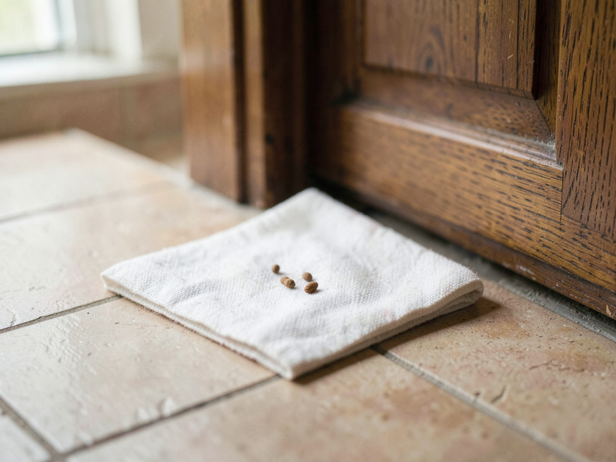
![Morning Treat Mat]()
Morning Treat Mat
Image credit : AI
I'm practicing my indoor cat boundary training with these tasty treats. Staying put when the door opens is key!
What you need before you start
Two things make this training work: a marker and high-value treats. A marker is a sound, a short click from a clicker, or a sharp word like "yes", that tells the cat the instant it does the right thing that a reward is coming. The marker has to be consistent and immediate; a half-second delay and the cat connects the reward to whatever it did in that half-second, not to what you intended. High-value treats are whatever your cat will reliably work for: a small piece of boiled chicken, a lick of tuna paste, a morsel it does not get at any other time. Dry kibble rarely cuts it for this kind of focused training. Keep sessions short, two to three minutes at most. Cats disengage fast, and a bored cat will not generalise what it learned.
Building the behaviour in stages
Step one is teaching a station. Pick a spot a metre or so from the door, a small mat, a cat bed, a folded towel. Lure the cat onto it with a treat, mark the moment all four paws are on it, and reward. Repeat until the cat moves to the mat when you gesture toward it. This is its "safe place" during door training, and it gives the cat something to do rather than simply suppressing the dash.
Step two is adding the door movement. With the cat on its mat, touch the door handle. Mark and reward for staying. Open the door one centimetre. Mark and reward. Close it. Open it further the next session. You are desensitising the cat to the door's movement so that it stops being a trigger. Go slowly, if the cat leaves the mat at any point, you moved too fast. Drop back a step.
Step three is the threshold rule. Once the cat holds its station while the door opens fully, begin stepping through yourself. If it stays, mark and reward immediately on your return. If it moves toward the door, close it calmly, wait a few seconds, and try again. Do not scold. The door closing is enough information, it tells the cat that moving ended the opportunity.
Step four is generalising across people and times of day. The cat has learned the pattern with one person. It has not learned a rule. Every person in the flat needs to run the same protocol, at least in the early weeks. A cat that holds its station for one person and bolts past another has simply learned two different situations.
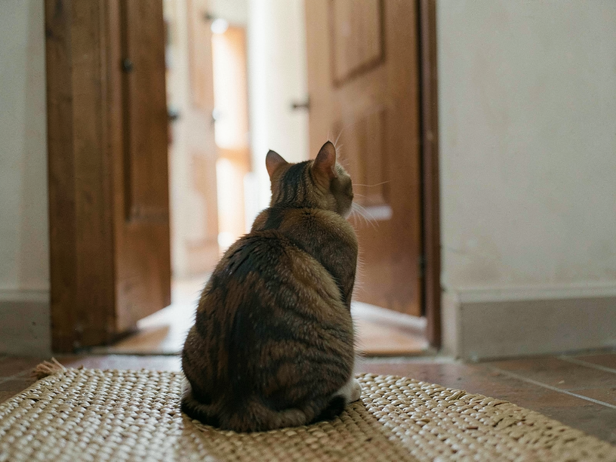
![Cat waits by the door]()
Cat waits by the door
Image credit : AI
My cat practices indoor cat boundary training, patiently waiting by the door.
Common points where training stalls
The most frequent stall is inconsistency, one family member lets the cat out into the corridor "just this once" and the variable reinforcement makes the behaviour more persistent, not less. A second stall is moving through stages too quickly. Three successful repetitions at one level is not enough; aim for ten to fifteen consistent responses before adding difficulty. A third is training when the cat is hungry and frantic rather than calm and curious. A cat that is fixated on food will not generalise the lesson; one that is calm and mildly interested will.
If the cat is also showing anxiety signs, hiding, not eating, vocalising, the door-dashing may be part of a larger stress picture rather than simple curiosity. A cat that is trying to escape an environment it finds distressing needs a different approach, and a veterinary behaviourist is the right next step.
Keeping the behaviour once it is learned
Maintenance is easier than the initial training but it cannot be zero. Reward the cat intermittently for holding its station even after the behaviour is solid, once every few sessions is enough. If the household changes (a new person moves in, a renovation starts, a new pet arrives), expect some regression and run a short refresher. The station cue remains useful for the cat's whole life: it can be used at any door, at the lift, or when a delivery arrives.