A cat does not need to eat a lily to be poisoned by one. Grooming pollen off its coat after brushing against a bloom is enough. That detail surprises most owners, and it is the detail that costs cats their lives, because by the time the signs are obvious, the kidneys are already in serious trouble.
Which lilies are dangerous, and which are not
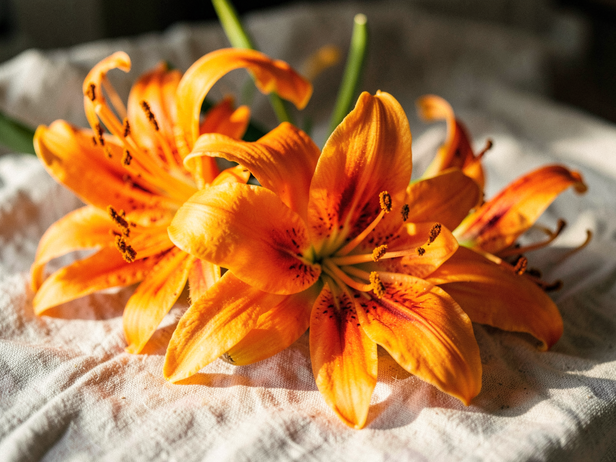
Not every plant called a lily is equally toxic to cats. The ones that cause acute kidney failure belong to the genus Lilium and Hemerocallis. Tiger lilies, Easter lilies, Asiatic lilies, stargazer lilies, daylilies, and Oriental lilies are all in this group. Every part of the plant is toxic: the petals, the leaves, the stem, the pollen, and the water in the vase the flowers sit in.
Plants that share the name but not the danger include peace lilies (Spathiphyllum) and calla lilies. These contain calcium oxalate crystals and cause mouth pain, drooling, and vomiting, which is serious but different in kind, they do not cause kidney failure. Lily of the valley (Convallaria) is toxic to the heart, not the kidneys. The distinction matters because the urgency and the treatment differ, but none of these plants belongs in a home with a cat.
![Vibrant Tiger Lily Still Life]()
Vibrant Tiger Lily Still Life
Image credit : AI
These tiger lilies showcase their beauty, but remember lily pollen can be dangerous for cats.
What the toxin does to the kidneys
The exact compound in true lilies that causes kidney damage has not been isolated with certainty. What is established is the pattern of injury: the toxin targets the epithelial cells lining the renal tubules, the structures inside the kidney responsible for filtering waste and reabsorbing water and nutrients back into the blood. When those cells die, the tubules can no longer do their job. Waste products accumulate in the blood, the kidneys stop producing urine, and the organ fails.
This process moves fast. Kidney injury can become irreversible within 18 to 36 hours of exposure. Cats that receive treatment, aggressive intravenous fluid therapy to flush the kidneys and support function, within the first six hours have a much better chance of recovery than those treated after 18 hours. After 72 hours without treatment, the prognosis is poor. The window is narrow, and it closes quietly.
What exposure actually looks like
A cat does not need to chew a leaf. Pollen falls. A cat walks past, the pollen settles on its coat, and the cat grooms it off. A cat that knocks a vase and drinks the water is exposed. A cat that bats at a flower head and licks its paw is exposed. Owners who bring cut lilies home for a table arrangement and then notice their cat has yellow-orange pollen on its face or chest should treat that as an emergency, not a possibility to watch.
The first signs appear within two hours of ingestion: vomiting, lethargy, and loss of appetite. These are easy to dismiss as an upset stomach. Over the next 12 to 24 hours the cat may appear to improve slightly, which is misleading, kidney damage is progressing silently. By 24 to 72 hours, signs of kidney failure appear: increased thirst and urination early, then a dangerous drop in urine output, tremors, seizures, and collapse.
![Lily Pollen Dusting Marble]()
Lily Pollen Dusting Marble
Image credit : AI
Delicate lily stems rest on marble, their pollen a subtle dusting. Be aware of lily poisoning in cats.
What to do if you suspect exposure
Do not wait for symptoms to develop. If you have any reason to think your cat has contacted a true lily, pollen on the fur, a chewed leaf, a knocked-over vase, call a vet immediately. Take the plant with you if you can, or photograph it clearly so the vet can confirm the species. Time is the only variable the owner controls at this point.
Do not try to induce vomiting at home. Do not give water to dilute the toxin. Do not wait until morning to see how the cat is doing. These are the delays that turn a treatable poisoning into a fatal one. A vet will assess whether decontamination is still possible, begin IV fluids, and monitor kidney function through blood tests. There is no antidote; supportive care is the treatment, and it works best when it starts early.
The simplest protection
The only reliable way to keep a cat safe from lily toxicity is to keep true lilies out of the home entirely. This includes cut flowers brought in as gifts, a common situation, because not every visitor knows the risk. If you receive lilies and have a cat, place them somewhere the cat cannot reach at all, which in a flat is harder than it sounds, or remove them from the house. Informing family members and anyone who visits regularly is not overcaution; it is the practical version of keeping the plant away.
Indian florists commonly stock Asiatic and Oriental lilies, particularly around festive and gifting seasons. They are popular, long-lasting, and fragrant. They are also among the most dangerous plants a cat can encounter. Knowing the plant's common name and what it looks like is the most useful thing a cat owner in a flat can carry.
Acute kidney failure from lily exposure is one of the few feline emergencies where the gap between early and late treatment is the difference between a cat that recovers fully and one that does not. The plant does not announce itself as dangerous. That job falls to the owner.