The gunk in the corner of your dog's eye in the morning is not all the same thing. Colour, texture, which eye, and whether the dog is bothered by it, these four details separate a normal biological process from an infection, a blocked duct, or the start of something that gets worse without treatment.
What normal discharge looks like, and what it is doing
Healthy eyes produce a small amount of watery or slightly mucoid fluid that keeps the surface lubricated and flushes out dust. After sleep, this collects in the inner corner and dries to a small, reddish-brown crust. In pale-coated dogs, white Labradors, Maltese, Bichons, Shih Tzus, the iron-containing proteins in this fluid oxidise on the fur and leave a rust-coloured stain below the eye. That stain is cosmetic. The underlying tear production is doing exactly what it should.
The stain deepens when tear volume is higher than the drainage system can handle. The drainage system is a pair of tiny ducts at the inner corner of each eye that channel tears down into the nasal cavity. When the ducts are narrowed, by breed anatomy, by a previous infection, or by a small blockage, tears overflow onto the face instead of draining internally. This is called epiphora. The dog is not sick, but the wet fur becomes a surface where bacteria and yeast settle, which is why the stained area sometimes smells and the skin underneath can get sore.
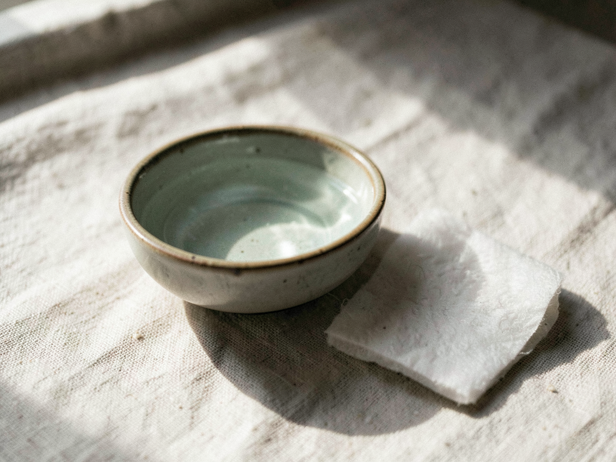
![Saline Solution & Cotton Pad]()
Saline Solution & Cotton Pad
Image credit : AI
Preparing to gently clean dog eye discharge with saline and a cotton pad. Essential for managing tear stains.
Discharge that needs a closer look
The colour and consistency of discharge are the most reliable home indicators of what is happening.
Watery, clear discharge from one eye, with the dog squinting or pawing at it, usually means something is in the eye, a grass seed, a speck of dust, an eyelash turned inward. Clear discharge that resolves in a few hours after the dog stops pawing is often self-clearing. Clear discharge that persists, or that comes with squinting that does not ease, is a reason to have the eye examined. Foreign bodies that sit on the cornea scratch it, and a corneal abrasion that goes untreated can ulcerate.
Yellow or green discharge is the sign most owners recognise as a problem, and they are right to. That colour means white blood cells, the discharge is purulent, which points to bacterial infection, whether conjunctivitis, a blocked and infected duct, or, in a dog that is also lethargic and off food, something systemic. Both eyes affected at once, with yellow-green discharge and a dog that looks unwell, is a more urgent picture than one eye with a small amount of yellow crust.
Thick white or grey mucoid discharge, the consistency of toothpaste rather than liquid, often accompanies dry eye, keratoconjunctivitis sicca, or KCS. In dry eye, the tear glands produce too little watery fluid, so the eye compensates with thicker mucus that does not lubricate properly. The cornea becomes dull rather than glossy, and the dog blinks more than usual. Certain breeds carry a higher predisposition to KCS: West Highland White Terriers, Cocker Spaniels, Bulldogs, and Pugs among them. KCS is managed, not cured, and the management, usually a cyclosporine or tacrolimus eye drop prescribed by a vet, needs to start before the cornea is damaged.
Redness: where it is matters as much as how red it is
Redness in the white of the eye (the sclera) is conjunctival inflammation. It looks dramatic but is not always serious, allergies, dust, smoke, and a long car ride with the window open can all cause it, and it often settles. Redness that comes with discharge, swelling of the tissue around the eye, or a dog that keeps the eye half-closed is conjunctivitis until proven otherwise, and a vet swab will tell you whether it is bacterial, viral, or allergic, because the treatment differs.
Redness deep inside the eye, a red or pink haze in the iris or the area around the pupil, is a different matter. This is uveitis, inflammation of the internal structures, and it is painful. Dogs with uveitis often hold the eye shut, are sensitive to light, and may have a pupil that is smaller than the other eye. Uveitis has causes that range from trauma to tick-borne disease to immune-mediated conditions, and it needs same-day veterinary attention. Untreated uveitis causes permanent damage to the eye's internal pressure system and can lead to blindness.
A third eyelid (the nictitating membrane) that has crept across the eye and is visible at the inner corner is another sign that something is wrong. It rises when the eye is painful, when the dog is unwell, or when a condition called cherry eye has caused the gland within it to prolapse. Cherry eye, a red, rounded mass at the inner corner, looks alarming but is not an emergency. It does need surgical correction, because leaving it exposed damages the gland's ability to produce tears.
![Dog's Quiet Moment Indoors]()
Dog's Quiet Moment Indoors
Image credit : AI
A gentle presence, this dog rests calmly, a quiet observer in its Indian home. Observing for any signs of dog eye infection.
What you can and cannot do at home
Cleaning the area around the eye is reasonable home care. Use a soft damp cloth or a cotton pad with plain saline, the same saline used for contact lenses, and wipe from the inner corner outward. Do not wipe toward the eye. Do not use hydrogen peroxide, diluted human antiseptic, or any product not formulated for use near eyes. For tear staining, keeping the fur trimmed short below the eye so it stays dry reduces the surface for bacteria and yeast to colonise.
What you cannot do at home is treat an eye infection with leftover antibiotic drops from a previous prescription, or with human eye drops. Antibiotic resistance is a real consequence of using the wrong drug or the wrong concentration, and some human eye preparations contain steroids that are dangerous if the dog has a corneal ulcer, steroids slow healing and can cause a small ulcer to perforate.
The signs that make this a same-day call
Go to a vet the same day if the dog has: yellow or green discharge that is not clearing; a visible scratch or clouding on the surface of the eye; the eye held shut or the dog pawing at it repeatedly; redness inside the eye rather than in the white; a third eyelid covering part of the eye; or any sudden change in the appearance of the eye in a dog that has had no previous eye issues. A dog that has knocked its eye on a branch, a fence, or a piece of furniture and is squinting needs to be seen that day, corneal injuries look minor and worsen quickly.
Tear staining alone, in a dog that is otherwise comfortable and whose eyes look clear, is not an emergency. But if the skin under the stain is red, raw, or smells strongly, the vet can check for a yeast overgrowth and advise on keeping the area clean and dry enough to prevent it recurring.
Eye problems in dogs sit on a spectrum from the entirely benign to the genuinely urgent, and the difference usually shows up in whether the dog is bothered. A dog ignoring its own eye discharge is almost always fine. A dog that cannot leave its eye alone is telling you something that deserves a professional look.