Canine distemper kills more unvaccinated puppies in India than most pet owners realise. It is not a rare disease or an imported one, it circulates in street-dog populations across every major city, and a puppy that has not completed its vaccination course has almost no defence against it.
What distemper actually does to a dog's body
![Alert Puppy on Tiled Floor]()
Alert Puppy on Tiled Floor
Image credit : AI
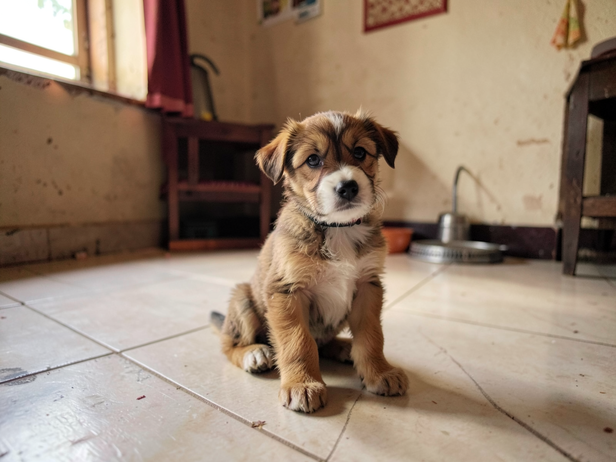
A young puppy, alert and curious, rests on a tiled floor. Early awareness is key to understanding potential canine distemper symptoms in puppies.
Distemper is caused by canine morbillivirus, a paramyxovirus closely related to the measles virus in humans. Once inhaled or ingested, the virus targets white blood cells first, which is why it suppresses the immune system so quickly. From there it spreads through the bloodstream to the respiratory tract, the gastrointestinal tract, the skin, and eventually the central nervous system. This multi-system attack is what makes distemper so dangerous: it does not stay in one place, and each system it reaches produces a different set of signs that can look like several different illnesses at once.
The virus is shed in almost every secretion, nasal discharge, saliva, urine, faeces, even exhaled air. A puppy does not need direct contact with a sick dog. Shared water bowls, a patch of grass where an infected dog has been, or even the air in a confined space where an infected animal has recently sat are enough.
Why Indian puppies are especially vulnerable
India has a large, dense street-dog population that acts as a persistent reservoir for the virus. Distemper circulates year-round in these populations, which means exposure risk does not drop in any season. A puppy born to a well-vaccinated mother carries some maternal antibodies, but those antibodies begin to fall after six to eight weeks. The window between maternal immunity fading and a puppy completing its own vaccination series, typically three doses finishing around sixteen weeks, is the period of highest vulnerability.
In Indian cities, this window often coincides with a puppy's first real exposure to the outside world: a walk in the park, a visit to a pet shop, contact with a neighbour's dog whose history is unknown. Many first-generation pet owners are not told that a single vaccine dose does not confer full protection, or that the series needs to be completed on schedule. A puppy that received one dose at eight weeks and was then not brought back for the second and third is not protected.
Recognising the signs early
![Medical Vial & Cloth Still Life]()
Medical Vial & Cloth Still Life
Image credit : AI
A sterile medical vial and cloth, hinting at health and care. Essential for understanding canine distemper in India.
Distemper does not announce itself with one clear symptom. In the first stage, which can look deceptively like a mild cold, a puppy may have watery eyes, a runny nose, a mild fever, and reduced appetite. Many owners wait, assuming it will pass. It often does not.
As the virus reaches the respiratory tract, the discharge thickens, coughing begins, and breathing can become laboured. Vomiting and diarrhoea follow as the gastrointestinal tract is affected. In some puppies, the footpads begin to harden and thicken, a sign specific enough to distemper that it has given the disease one of its older names, hardpad disease. When the virus reaches the nervous system, the signs shift again: muscle twitching, seizures, circling, head tilt, or a chewing-gum jaw movement that owners sometimes mistake for something stuck in the mouth. Neurological signs can appear weeks after the earlier stages seem to have resolved, which is one reason distemper is so difficult to manage even when it is caught.
If a puppy shows any combination of eye and nose discharge, coughing, vomiting, and changes in gait or behaviour, the right step is a vet visit the same day, not a wait-and-see approach.
Treatment and what it realistically involves
There is no antiviral drug that clears distemper the way an antibiotic clears a bacterial infection. Treatment is supportive: fluids to prevent dehydration, medications to control vomiting and diarrhoea, antibiotics to manage secondary bacterial infections that take hold because the immune system is suppressed, and anticonvulsants if neurological signs appear. The goal is to keep the puppy stable and strong enough for its own immune system to fight the virus.
Survival depends heavily on the puppy's age, its immune status before infection, how quickly treatment began, and whether neurological involvement has occurred. Puppies that develop severe neurological signs have a much lower chance of full recovery, and some that survive are left with permanent tics or seizure disorders. This is not said to frighten, but because it explains why prevention is not optional and why early presentation to a vet matters so much more than it does with many other illnesses.
Vaccination: the schedule that actually protects
The core vaccine against distemper is the DHPPi combination, distemper, hepatitis, parvovirus, and parainfluenza in a single injection. The WSAVA vaccination guidelines recommend a series beginning at six to eight weeks, with doses every two to four weeks until the puppy is at least sixteen weeks old, followed by a booster at one year and then regular adult boosters. The exact schedule a vet recommends may vary slightly based on the puppy's age at first presentation and the products available, but the principle is the same: one dose is not enough, and the series must be completed.
Adult dogs that were vaccinated as puppies and have received their boosters have strong protection. The dogs most at risk are unvaccinated puppies, puppies mid-series, and adult dogs whose vaccination history is unknown or lapsed, which describes a significant proportion of pet dogs in India, particularly those adopted from the street or from informal sources. If the vaccination history of an adult rescue dog is unknown, a vet can advise on re-starting the series as if the dog were unvaccinated.
Distemper is not a disease that rewards delay in either vaccination or treatment. The virus is present, the exposure routes are real, and the protection available through a completed vaccine series is one of the most reliable tools in veterinary medicine. A puppy that finishes its course on schedule faces a disease that, for it, effectively does not exist.