Eggs sit in almost every Indian kitchen, cost almost nothing, and dogs eat them eagerly. That combination makes them one of the most common things owners add to a dog's meal, sometimes on advice, sometimes on instinct. The biology mostly supports it, but the details matter: raw versus cooked is not a preference question, and the shell is not an afterthought.
What an egg actually gives a dog
Eggs are a complete protein source, meaning they carry all the essential amino acids a dog cannot synthesise on its own. The protein quality of egg is high enough that it is used as the reference standard against which other dietary proteins are measured, a fact that holds for dogs as it does for humans. Beyond protein, a whole egg contains fat-soluble vitamins A, D, E, and K, along with B12, riboflavin, and folate. The yolk carries most of the fat and most of the micronutrients; the white carries most of the protein.
One medium egg adds roughly 70 to 80 kilocalories. For a small dog, a Spitz, a Pomeranian, a Beagle, one egg a day pushes the calorie load meaningfully. For a Labrador or a German Shepherd, one egg is a modest addition. Neither number is a prescription; it is context for how much is reasonable given the rest of the diet.
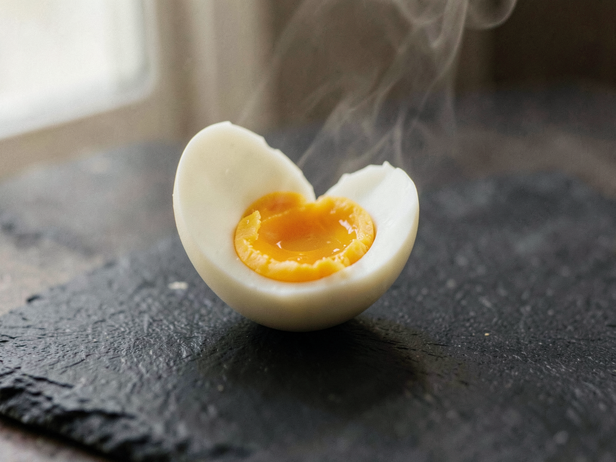
![Steaming Cracked Egg]()
Steaming Cracked Egg
Image credit : AI
A perfectly cooked egg, showcasing true-to-life texture. Ideal for understanding raw vs cooked eggs for dogs.
Cooked versus raw: why it is not just a preference
Raw egg white contains a protein called avidin. Avidin binds biotin, a B vitamin, in the gut and blocks its absorption. A dog eating raw egg whites regularly over weeks can develop a biotin deficiency, which shows up as a dull coat, skin flaking, and fatigue. Cooking denatures avidin and eliminates this problem entirely. Cooked egg white is safe; regular raw egg white is not.
Raw egg also carries the risk of Salmonella and Campylobacter contamination. Dogs are more resistant to these bacteria than humans, but not immune. A dog that eats a contaminated raw egg can become ill, and can also shed the bacteria in its stool, a relevant concern in a flat with children or elderly family members. The risk from a single raw egg on one occasion is low. The risk from raw eggs fed routinely is higher, and the household exposure argument applies regardless of whether the dog itself falls sick.
The yolk is safe raw in the sense that avidin is not present there, but the Salmonella risk applies to the whole egg. Cooking the whole egg, scrambled plain, hard-boiled, or poached, removes both concerns. Plain means no salt, no butter, no onion, no garlic, no seasoning. The egg a dog should eat looks nothing like the egg a person would want to eat.
What the shell does
Eggshell is roughly 94 percent calcium carbonate. Ground finely, it is a legitimate calcium supplement, one that veterinary nutritionists sometimes recommend for dogs eating home-prepared meals that would otherwise be calcium-deficient. One teaspoon of finely ground eggshell provides approximately 2,000 milligrams of calcium carbonate, which is a meaningful amount.
The shell is not useful whole or in large fragments. A dog that crunches a whole shell will get some calcium, but the sharp edges carry a small risk of irritating the oesophagus or gut lining. Ground to a fine powder in a clean dry grinder and stored in an airtight container, the shell becomes something genuinely useful rather than waste. It should not be added to a commercial diet without a vet's input, because commercial dog food is already formulated to meet calcium requirements, and excess calcium causes its own problems, particularly in large-breed puppies, where over-supplementation can interfere with bone development.
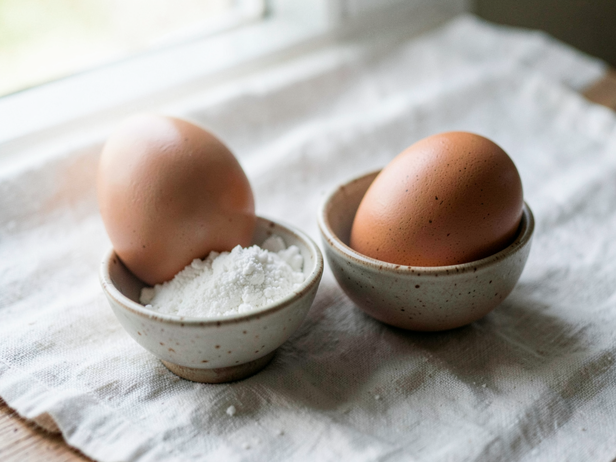
![Morning Egg Still Life]()
Morning Egg Still Life
Image credit : AI
I photograph a simple still life featuring eggs and powder, perfect for understanding raw vs cooked eggs for dogs.
How much is reasonable
There is no universal correct number. The right amount depends on the dog's size, its overall diet, and whether it has any existing health conditions. A small dog on a complete commercial diet does not need an egg every day; two or three times a week is a reasonable starting point for most medium to large dogs eating commercial food. For dogs on home-prepared diets, the egg's role in meeting protein and micronutrient needs is larger, and a vet or veterinary nutritionist should be part of that calculation.
Dogs with a history of pancreatitis should have egg yolk limited or avoided, because the fat content can trigger a flare. Dogs with known egg allergies, less common than grain or chicken allergies but real, will show skin or digestive reactions and should not be fed eggs at all.
If a dog develops loose stools, vomiting, skin changes, or itching after eggs are introduced, stop and speak to a vet before trying again.
The one thing that changes the calculation
The egg itself is not the problem in most cases. What surrounds it is. An egg fried in oil with a pinch of salt and a few curry leaves is not a dog-safe egg. Leftover egg bhurji with onion and garlic is not a dog-safe egg, thiosulphates in onion and garlic damage red blood cells in dogs, and the effect is cumulative. Plain, cooked, and given in a quantity that fits the rest of the day's food: those three conditions make eggs a useful, inexpensive addition to a dog's diet. Drop any one of them and the benefit disappears.