The dog who used to demand a walk before you'd finished your first cup of chai now sleeps through it. If your dog is seven or older, this is probably not cause for alarm, but it is worth understanding what is actually changing, and what would make the extra sleep mean something more.
What ageing does to a dog's sleep
Senior dogs sleep more because their bodies are doing more to maintain themselves. Cellular repair slows down, metabolism drops, and the nervous system becomes less efficient at regulating wakefulness. A young adult dog sleeps roughly 12 to 14 hours across a day. A dog in its senior years, generally from seven onwards for large breeds, a little later for small ones, commonly sleeps 16 to 18 hours, and some sleep more. That range is wide because individual variation is real. A 10-year-old Labrador who has always been active may sleep less than a 9-year-old Pug who was never particularly energetic. The baseline that matters is your dog's own baseline, not a chart.
![Senior Paw on Cushion]()
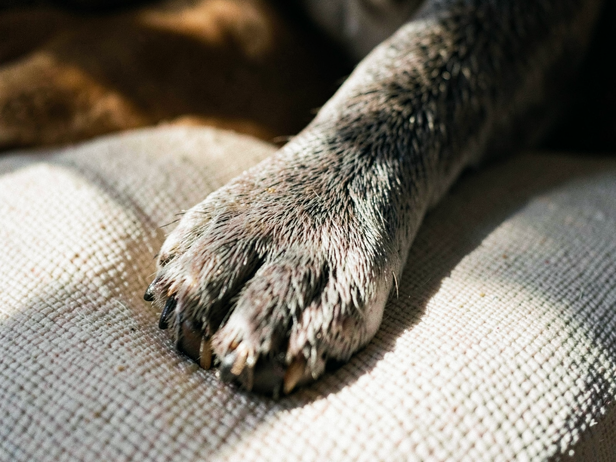
Senior Paw on Cushion
Image credit : AI
Observing the quiet rest of an older dog, I consider senior dog lethargy causes and changes with age.
What normal senior sleep looks like
Normal age-related sleep has a few consistent features. The dog settles easily, wakes up without obvious stiffness or confusion, and once up, engages with the world, sniffs the air, responds to your voice, shows interest in food. Sleep may be deeper than it once was, and the dog may be harder to rouse, but the quality of waking hours stays reasonable. Dreaming is more active in older dogs too; rapid eye movement, twitching, and soft vocalisations during sleep are not a concern on their own. A senior dog in an Indian flat with no garden may also sleep more simply because there is less environmental stimulation, fewer walks, less outdoor time, the heat of the afternoon keeping everyone indoors. That is a lifestyle factor, not a medical one, though it is worth addressing for the dog's quality of life regardless.
When the extra sleep is pointing at something else
Several medical conditions increase sleep or reduce activity in ways that look like normal ageing until they are looked at more carefully. Hypothyroidism, an underactive thyroid, is one of the more common ones in older dogs. The thyroid hormone regulates metabolism, and when production drops, dogs become lethargic, gain weight without eating more, and feel cold. The condition is manageable once diagnosed, but it requires a blood test to confirm; it cannot be identified from sleep alone. Anaemia, from any number of causes, reduces oxygen delivery to tissues and makes a dog tire quickly and rest more. Pain is another major driver. A dog with arthritis or an internal source of discomfort will move less and rest more, not because it is sleepy but because movement hurts. Dogs are skilled at hiding pain; reduced activity and more time lying down is often the first sign an owner notices. Canine cognitive dysfunction, the dog equivalent of dementia, disrupts the sleep-wake cycle rather than simply increasing sleep. Affected dogs may sleep heavily through the day and then be restless, confused, or vocal at night. This reversal of the normal pattern is a specific flag. Kidney disease, liver disease, heart disease, and some cancers also present with increased fatigue and reduced engagement. None of these can be identified from sleep changes alone, but all of them are worth ruling out when the change is significant or comes with other signs.
![Pet Bowls on Stone]()
Pet Bowls on Stone
Image credit : AI
My senior dog's sleep changes with age. I watch his quiet moments.
Signs that make a vet visit the right next step
The shift from normal senior sleep to something worth investigating is not always dramatic. Watch for sleep that increases sharply over a few weeks rather than gradually over months. Watch for difficulty getting up, stiffness that does not ease after a few minutes of movement, or reluctance to put weight on a limb. A dog that sleeps more but also eats less, drinks noticeably more or less water, loses weight without explanation, or seems confused or disoriented when awake deserves a vet assessment, not a wait-and-see approach. Pale or white gums, laboured breathing, or collapse are emergencies, reach a vet immediately. For everything else, the practical test is this: does your dog, once awake and moving, seem like itself? Interest in food, recognition of people, a willingness to engage even briefly, these are the markers of a dog who is sleeping more but doing fine. A dog who wakes flat, disengaged, and dull across several days is telling you something the sleep hours alone cannot.
What you can do at home
You cannot slow the biology of ageing, but you can make sure the environment is not adding unnecessary burden. A comfortable, supportive sleeping surface matters more for an older dog than it did at three, a thin mat on a cold floor is harder on arthritic joints than an owner realises. Short, gentle walks are better than long, infrequent ones; consistent low-level movement keeps joints from stiffening without overloading them. Mental engagement, a sniff walk, a slow food puzzle, does more for a senior dog's wakefulness and mood than physical exertion. Keep feeding times consistent; appetite changes are easier to notice when the routine is predictable. And keep a simple log if you are uncertain: note how many hours the dog sleeps, when it wakes, whether it eats, and how it moves. A week of notes makes a vet visit significantly more useful than a general sense that something seems off.