A cat that spends its whole life inside a two-bedroom flat is safe, warm, and almost certainly eating more than it burns. Weight gain in indoor cats is not a mystery of metabolism. It is a straightforward arithmetic problem made easier by every comfort a flat provides.
What flat life removes from a cat's day
A cat in the wild or even in a garden hunts in short, explosive bursts, stalking, sprinting, pouncing, and fails most of the time. Failure is exercise. An indoor cat does not fail. It walks ten steps to a bowl that is always full, eats, and sleeps. The average indoor cat is awake and active for perhaps four to six hours out of twenty-four, and in a flat with no territory to patrol and no prey to chase, much of that wakefulness is spent sitting at a window.
Boredom compounds this. Cats that are under-stimulated often eat not from hunger but because eating is the most interesting thing available. A bowl that is always topped up removes even the small effort of waiting. The result is a cat that grazes steadily through the day, consuming calories it has no physical reason to spend.
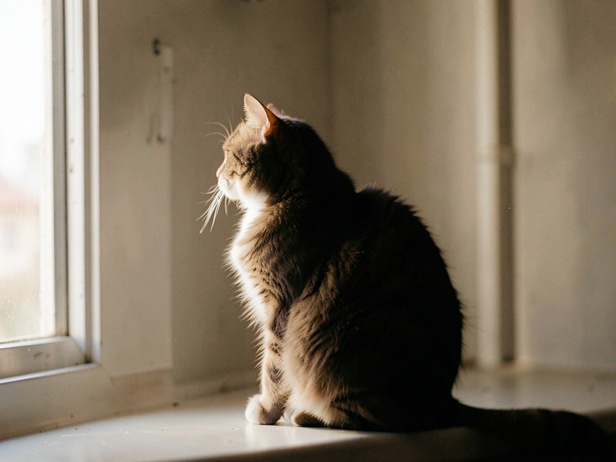
![Cat's Quiet Window Watch]()
Cat's Quiet Window Watch
Image credit : AI
My quiet contemplation from the windowsill. I'm a bit of an overweight indoor cat, enjoying the peaceful view.
Why neutering changes the equation
Most pet cats in Indian homes are neutered, which is the right call for welfare and population reasons. But neutering reduces a cat's resting energy requirement, some estimates put the reduction at around twenty to thirty percent, because the hormones that drive territorial roaming, mating behaviour, and the restlessness that comes with them are no longer present. A neutered cat needs fewer calories to maintain the same body weight, and if the food amount does not change after neutering, the surplus goes to fat. Many owners never adjust the portion size. The cat was eating that amount before, so it continues eating that amount, and the weight climbs slowly enough that no single week looks alarming.
How to actually assess your cat's weight
A number on a scale matters less than what you can feel. Run both hands along your cat's ribcage. You should be able to feel each rib with light pressure, the way you can feel your knuckles through the back of a loosely held fist. If you have to press to find them, the cat is carrying excess fat. Look from above: a healthy cat has a visible waist, a slight tuck behind the ribs. A cat that looks like a cylinder from above, or whose belly swings when it walks, is overweight. If you are unsure, your vet can body-condition score the cat in under a minute and give you a number on a standardised scale.
The moment to stop reading and call a vet is this: if your cat is visibly round, has stopped grooming its lower back and base of tail because it cannot reach, is breathing harder than usual after mild activity, or has not lost weight after four to six weeks of measured feeding and increased play, that is a vet visit, not a home project. Obesity in cats is directly linked to diabetes, hepatic lipidosis, and joint disease, and a vet needs to rule out an underlying thyroid or hormonal condition before any weight-loss plan begins.
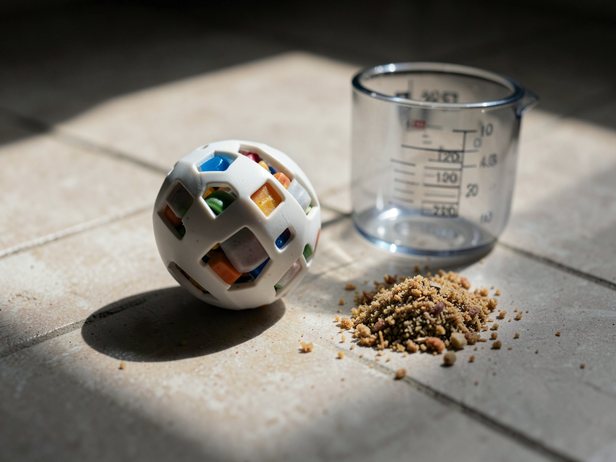
![Cat Food Puzzle Still Life]()
Cat Food Puzzle Still Life
Image credit : AI
This puzzle feeder helps manage my cat's diet and combat potential weight gain.
What an owner can change at home
Portion control is the single most effective lever. Measure food by weight or by the specific amount your vet recommends for your cat's target weight, not its current weight. Free feeding, leaving a full bowl out at all times, is the fastest route to an overweight cat and the hardest habit to break, but it can be broken. Two measured meals a day is a reasonable starting point; your vet will advise on the exact amount.
Puzzle feeders, food-dispensing balls, and hiding small portions around the flat make eating slower and more effortful, which is closer to how a cat is built to eat. They also give a bored cat something to do. A flat with vertical space, shelves, a cat tree, a window perch at height, gives a cat reasons to climb and jump. Two ten-minute play sessions a day with a wand toy or a laser pointer used correctly (always end on a catchable prey so the cat does not feel permanently frustrated) add meaningful movement without requiring a garden.
Treats are not forbidden, but they come out of the day's total calorie count, not on top of it. A piece of plain cooked chicken with no salt, no seasoning, and no onion or garlic is a reasonable occasional treat. Commercial treats should be read for calorie density; many are surprisingly high.
Weight loss in a cat should be slow, rapid weight loss in an obese cat can trigger hepatic lipidosis, a serious and potentially fatal liver condition. Any plan that aims to reduce a cat's weight should be designed and monitored by a vet, not estimated at home.