Most dog owners who are careful about meals are surprisingly relaxed about treats. The biscuit after a walk, the bit of paneer from the dinner plate, the chew given to buy twenty minutes of quiet, none of it feels like feeding. It is all feeding. And in a medium-sized dog eating 400 to 500 kilocalories a day, three or four casual treats can account for a fifth of that total before anyone has noticed.
The ten percent rule and why it exists
Veterinary nutritionists use a simple working guideline: treats should make up no more than ten percent of a dog's daily calorie intake. The number is not arbitrary. Commercial dog food is formulated to deliver a specific balance of protein, fat, vitamins and minerals across a full day's portion. When treats displace a meaningful share of that portion, either because the dog eats less of its meal after snacking, or because the owner quietly reduces the meal to compensate, the balance breaks down. A dog getting fifteen or twenty percent of its calories from plain biscuits or table scraps is getting that share with almost none of the micronutrients the food was designed to supply.
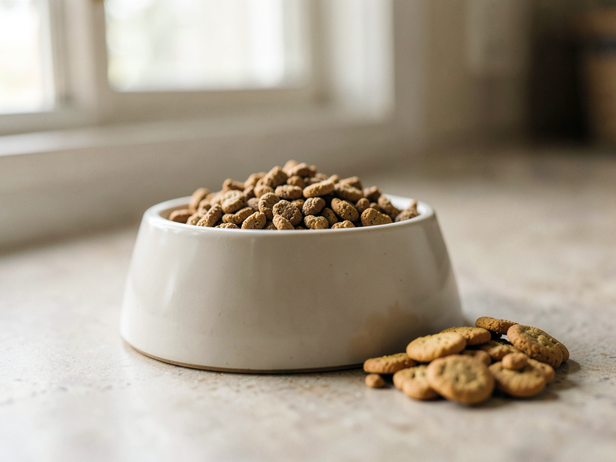
![Dog's Mealtime Essentials]()
Dog's Mealtime Essentials
Image credit : AI
My dog's favorite treats, perfect for rewarding good behavior. Wondering about dog treat calories India?
What a treat actually costs in calories
Treat packaging in India rarely lists kilocalories in a way owners find useful. A single medium-sized commercial dog biscuit typically carries between 30 and 50 kilocalories. A small piece of cooked chicken breast, genuinely one of the lower-calorie options, runs around 25 to 35 kilocalories for a thumbnail-sized piece. A cube of paneer, which many owners reach for because it feels natural and protein-rich, sits closer to 30 to 40 kilocalories depending on fat content. None of these numbers is alarming on its own. The problem is accumulation. Four biscuits across a day, a piece of roti, and a small paneer cube can together approach 200 kilocalories, which, for a Beagle or a Cocker Spaniel, is roughly a third of the day's recommended intake. The dog still eats its bowl. The surplus goes somewhere.
Where the surplus goes
Dogs store excess calories as fat through the same basic mechanism as other mammals: when energy intake exceeds energy expenditure, adipose tissue accumulates. In dogs this tends to show first over the ribs and at the base of the tail, which is why the hands-on rib check, you should feel the ribs easily without pressing hard, but not see them, is a more reliable indicator than looking at the dog from above. Sustained caloric excess also increases the load on joints, which matters more for breeds already predisposed to hip and elbow problems: Labrador Retrievers, German Shepherds, and Golden Retrievers are among the breeds where excess weight measurably worsens the trajectory of joint disease. In smaller dogs, the cardiovascular load of carrying extra body weight relative to frame size is the more pressing concern.
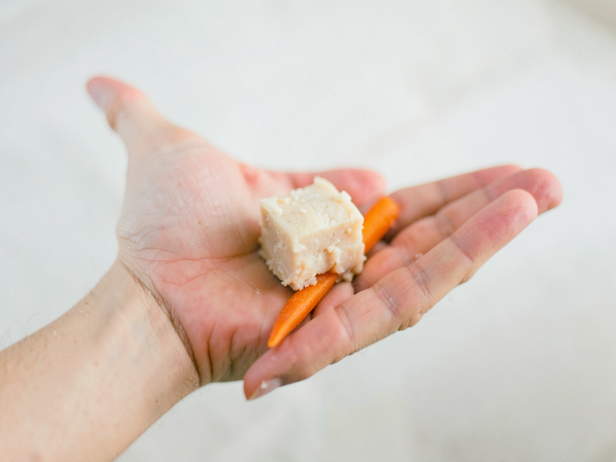
![Hand with Chicken and Carrot]()
Hand with Chicken and Carrot
Image credit : AI
Offering a healthy dog treat, considering dog treat calories India.
Treats that work harder for their calories
Not all treats are equal in what they deliver alongside the calories. Raw carrot sticks, a small piece of plain boiled chicken, or a few blueberries offer something beyond the calorie: fibre, protein, or antioxidants respectively. Commercial treats formulated as dental chews do a specific job, mechanical plaque reduction, that justifies their place in the day if the dog's dental hygiene needs support. What delivers the least for its caloric cost is the table-scrap category: bread, roti, rice, biscuits made for humans. These are calorie-dense, often salted, and carry no benefit a dog-specific food does not already supply. The dog enjoys them because dogs enjoy almost everything offered by hand. The enjoyment is not evidence of nutritional value.
Recalibrating without making treats the enemy
Treats are a legitimate training tool, a bonding moment, and for many owners the most tangible expression of care they have. The goal is not to eliminate them but to account for them. Weigh or measure the day's treat allowance in the morning and draw from that pool rather than reaching into a bag without counting. If training sessions are heavy on treats that day, reduce the meal portion slightly, but only slightly, and only if the treats are nutritionally reasonable rather than empty calories. Read the calorie information on commercial treat packaging; if it is absent, that is worth noting. And if a dog is gaining weight despite what feels like a controlled diet, the treats are the first place to look, because they are the part of the intake that owners most consistently underestimate. A vet can calculate a realistic daily calorie target for your dog's size, age, and activity level, that number makes the ten percent rule concrete rather than abstract.