Your hands are a more honest tool than most owners realise. A weighing scale gives you a number; your hands give you context, whether the fat covering your dog's ribs has thickened since last month, whether the waist is still visible from above, whether the spine now presses up too sharply when you run a palm down the back. Vets use a standardised system called the Body Condition Score, or BCS, to do exactly this during a consultation. The five-point and nine-point versions both exist; most Indian vets use the nine-point scale, where four or five is ideal. You don't need to memorise the scale to use the method at home.
The rib test: where most assessments start
Place both thumbs on your dog's spine and spread your fingers out over the ribcage, pressing gently. You should feel each rib distinctly, the way you feel the knuckles on the back of your own hand. You should not have to press hard to find them, and you should not see them from across the room. If you cannot feel ribs without applying firm pressure, and there is a soft, doughy layer between the skin and the bone, your dog is likely carrying excess weight. If the ribs are immediately visible as ridges under the coat, or if you feel them sharply with almost no pressure at all, the dog is underweight. The rib test is the single most reliable home check because the ribcage is large, consistent in shape, and not distorted by a full stomach the way the belly is.
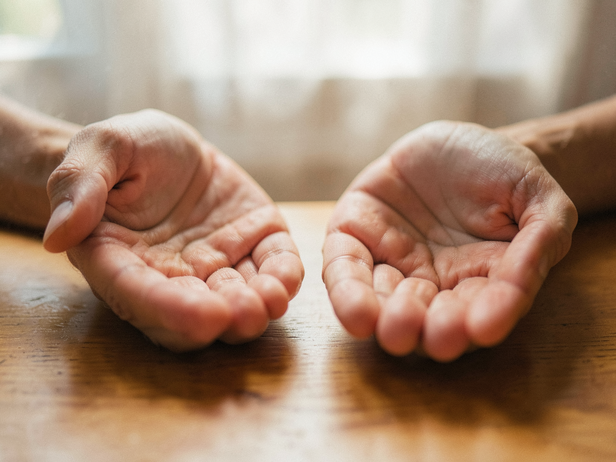
![Open Hands, Morning Light]()
Open Hands, Morning Light
Image credit : AI
My hands rest open, receiving the gentle morning light. A moment of quiet reflection.
The waist and tuck: what you see from two angles
Stand directly above your dog and look down. Behind the ribcage, the body should narrow noticeably before it reaches the hips, this is the waist. In an ideal-weight dog it is clear. In an overweight dog the sides run straight or even bulge outward, giving a sausage shape from above. Now crouch to the side and look at the underline. Behind the last rib, the belly should angle upward toward the hindquarters, this is the abdominal tuck. A dog with no visible tuck, whose belly hangs level or drops below the line of the chest, is almost certainly overweight. These visual checks work on short-coated breeds with little effort. On heavily coated dogs, a Lhasa Apso, a Samoyed, a Tibetan Mastiff, the coat hides everything, and the rib and spine touch tests matter more.
Spine, hips, and the base of the tail
Run a flat palm slowly down the spine from the shoulders to the tail. Each vertebra should be palpable but not prominent, you feel the bumps without seeing them as a ridge. Then place a hand over each hip bone. In a well-conditioned dog the hip bones are easy to find with light pressure but are covered by a thin layer of muscle and fat. If the hips feel like sharp points with no covering, the dog is too lean. If you cannot find them at all without pressing deeply, there is too much fat. Finally, feel around the base of the tail, where fat deposits accumulate early in dogs that are gaining weight. A thickening here, before the rest of the body shows obvious change, is often the first sign that something is shifting.
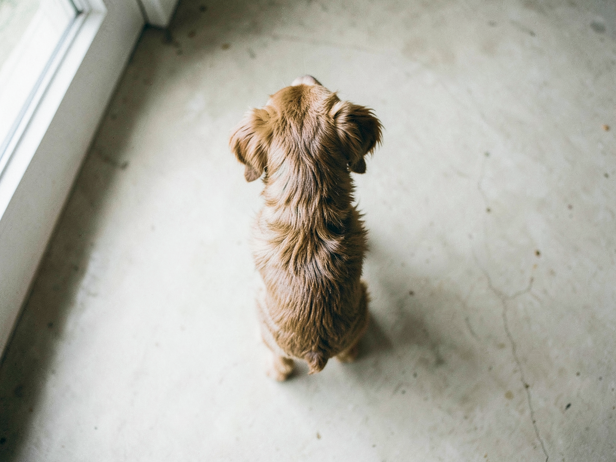
![Dog's healthy body assessment]()
Dog's healthy body assessment
Image credit : AI
Assessing my dog's body condition score at home is easy. I can check my dog's rib test weight without a scale.
What changes over time, and what to do with what you find
A single assessment tells you where your dog is today. Monthly checks, done the same way each time, tell you direction. A dog that was a five on the nine-point scale and now has ribs that are harder to feel and a waist that has softened is moving toward six or seven, worth adjusting food quantity before the gap widens. A dog that was already lean and whose spine is now more prominent needs a vet visit to rule out a reason for the loss before increasing food. Weight loss without a diet change is not a feeding problem. It is a health signal, and it belongs with a vet. The same is true for a dog that gains steadily despite no change in diet, or for any dog whose belly appears distended rather than merely round, a swollen abdomen can indicate fluid, organ enlargement, or bloat, all of which need immediate attention.
The limits of the home check
This method tells you whether your dog's fat coverage is roughly appropriate. It does not tell you muscle mass, hydration status, or organ health. A dog can score a five on the BCS and still be losing muscle, common in older dogs and in some chronic conditions. If your dog looks the right weight but seems weaker, tires faster, or has lost interest in movement, that combination is worth raising with a vet rather than treating as a weight issue. The BCS is a starting point for a conversation, not a substitute for one. If your dog's ribs have become difficult to feel, the waist has disappeared, and the spine and hip checks confirm excess covering, that is a clear enough signal to book a consultation rather than simply cutting food on your own.