A dog that winces getting up from the floor, hesitates at the stairs, or starts lagging on walks is telling you something specific. Most owners reach for a supplement. The problem is usually sitting around the dog's middle.
What excess weight does to a joint
Every kilogram a dog carries above its healthy weight adds roughly two to three kilograms of compressive force across the hip and stifle joints during normal movement. Cartilage has no blood supply of its own. It absorbs nutrients through compression and release as the joint moves, and it tolerates a certain load range. Sustained overloading accelerates cartilage breakdown faster than the tissue can repair itself. Once cartilage thins, bone contacts bone, the joint capsule inflames, and the surrounding muscle tightens to compensate. That tightening changes how the dog moves, which then overloads adjacent joints. A dog that starts with sore hips often develops elbow and wrist problems from the altered gait.
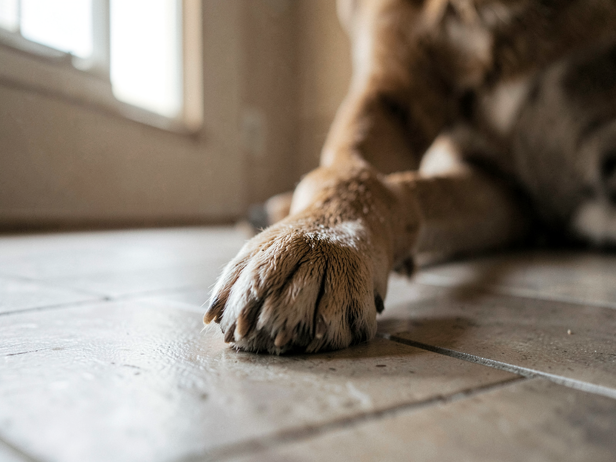
![Dog's Paw on Cool Tile]()
Dog's Paw on Cool Tile
Image credit : AI
My paw finds solace on the cool tiles, a gentle reminder of the need for good joint health in dogs.
Why supplements cannot fix a mechanical problem
Glucosamine and chondroitin are the most commonly given joint supplements in India. Both are precursors to molecules found in cartilage and synovial fluid. The theory is sound: give the body the building blocks and it rebuilds. The evidence is more complicated. Studies in dogs show modest benefit in some animals and none in others, and the benefit is most consistently seen in early-stage disease. A supplement does not reduce the compressive load on the joint. It cannot reverse cartilage that has already worn through. Giving glucosamine to an overweight dog with moderate osteoarthritis while leaving the weight unchanged is like patching a tyre that is still being driven on a nail. The patch may help a little. The nail is still there.
Which breeds carry the highest risk
Large and giant breeds, Labrador Retrievers, Golden Retrievers, German Shepherds, Rottweilers, Great Danes, are predisposed to hip dysplasia and elbow dysplasia because of the way their joints develop during rapid growth. In Indian flats, where exercise is often limited to two short walks a day, these dogs frequently gain weight steadily through middle age without the owner noticing, because the change is gradual. A Labrador that weighed 28 kg at two years and now weighs 36 kg at five has added load equivalent to carrying a second dog on its back with every step. Indie dogs are not exempt. Heavier Indies, particularly those fed table scraps and roti alongside their regular meals, show the same joint degeneration pattern, just without the breed-specific dysplasia predisposition adding to it.
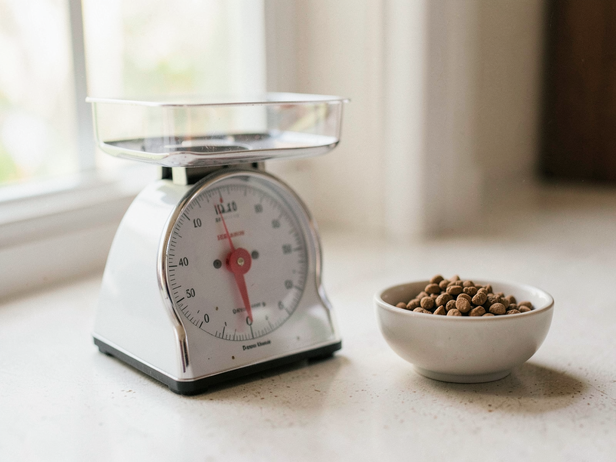
![Precise Dog Food Portion]()
Precise Dog Food Portion
Image credit : AI
Accurate portioning is key for managing your dog's weight and supporting joint health, especially for breeds prone to issues.
How to assess whether your dog is overweight
Scales matter less than body condition. Run both hands along the dog's ribcage from behind the shoulder blades. At a healthy weight, individual ribs are easy to feel with light pressure but not visible. If you have to press firmly to feel them, or cannot feel them at all under a layer of fat, the dog is overweight. Look from above: a healthy dog has a visible waist behind the ribs. Look from the side: the abdomen tucks up slightly behind the chest. A dog whose belly hangs level or drops lower than the chest is carrying excess weight. Your vet can assign a formal body condition score on a nine-point scale, which gives you a number to track at each visit.
What weight loss actually achieves
A landmark study in Labrador Retrievers followed dogs fed to a lean body condition versus dogs allowed to eat freely over their lifetimes. The lean dogs developed osteoarthritis significantly later, needed pain medication later, and lived a median of nearly two years longer. Two years. No supplement has produced a comparable result. In dogs already showing joint pain, a five to ten percent reduction in body weight measurably reduces lameness scores within weeks, because the compressive force on the joint drops with every kilogram lost. The joint does not regenerate, but the inflammation driven by mechanical overload decreases, and pain-signalling quiets. Some dogs that appeared to need long-term anti-inflammatory medication no longer need the same dose after reaching a healthy weight.
Weight is not the only factor in canine joint disease, genetics, early nutrition, and how a dog was exercised as a puppy all contribute. But it is the factor most owners can actually change, and the one with the clearest, most consistent evidence behind it. A supplement added to an overweight dog's bowl is a comfort to the owner. Weight loss is a treatment for the dog.