A fish at the surface, mouth working steadily, is not begging for food. It is trying to breathe.
Dissolved oxygen, the oxygen molecules suspended in water rather than bound into the H₂O molecule itself, is what fish extract through their gills. When that concentration drops below what the fish's metabolism needs, it moves toward the top of the tank, where gas exchange with the air above happens naturally and oxygen levels are marginally higher. The behaviour has a name: surface respiration. It is a distress signal, not a quirk.
How oxygen gets into and out of your tank
Oxygen enters aquarium water at the surface, where water meets air. Agitation, from a filter outlet, an air stone, or a powerhead, breaks the surface and speeds that exchange. Warmer water holds less dissolved oxygen than cooler water: a tank at 30°C carries significantly less oxygen than the same tank at 24°C, which matters in Indian summers when room temperatures climb and tank temperatures follow. Plants add oxygen during the day through photosynthesis, but consume it at night, so a heavily planted tank with no aeration can see oxygen dip sharply after lights-out. Fish, bacteria in the substrate and filter media, and decomposing waste all consume oxygen continuously.
The result is a system where oxygen is always being used and must always be replenished. Anything that slows replenishment or speeds consumption tips the balance.
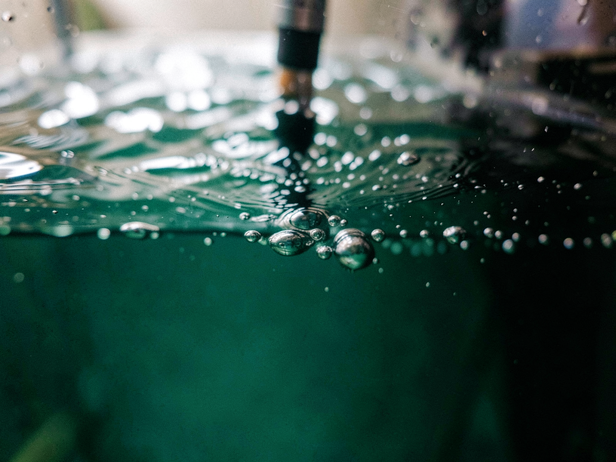
![Aquarium Surface Ripples]()
Aquarium Surface Ripples
Image credit : AI
Observing the subtle agitation and tiny bubbles breaking the surface, a sign of oxygen in the aquarium.
What low oxygen looks like in practice
Surface gasping is the most visible sign, but it is rarely the first. Before a fish reaches the surface, you may notice it becoming sluggish, resting on the bottom or on a leaf, moving less than usual, eating reluctantly or not at all. Gills may move faster than normal, a sign the fish is working harder to extract oxygen from water that has less of it. In a tank with multiple fish, several will show the behaviour at once, which distinguishes a low-oxygen event from a single sick fish.
Other signs that point to oxygen depletion rather than disease: the behaviour is worse in the morning, after a warm night, or after the lights have been off for several hours. It improves quickly when you increase surface agitation, running an air stone, adjusting the filter outlet to break the surface, or doing a partial water change with cooler, well-oxygenated tap water. If the behaviour resolves within twenty to thirty minutes of increased aeration, oxygen was almost certainly the cause.
One thing that looks similar but is not the same: a fish that gasps at the surface and also has clamped fins, visible spots or patches, or a swollen body is showing signs of disease. Gill disease in particular, caused by parasites, bacteria, or ammonia damage, impairs the gill's ability to extract oxygen even when the water is well-oxygenated. A fish with gill disease does not recover when you add an air stone.
The common causes in a home tank
Overstocking is the most frequent culprit. A tank holding more fish than its filtration and surface area can support will chronically run low on oxygen, especially at night. A sudden spike in temperature, a heatwave, a heater malfunction, a tank placed in direct afternoon sun, drops oxygen concentration fast. Overfeeding leads to decomposing food and a bacterial bloom, both of which consume oxygen rapidly. A filter that has stopped running, even for a few hours, removes the main source of surface agitation in most home tanks. New tanks going through the nitrogen cycle carry heavy bacterial loads that compete for oxygen.
A blocked or dirty filter is worth checking first. In many cases, cleaning the filter and adjusting the outlet to break the surface solves the problem within an hour.
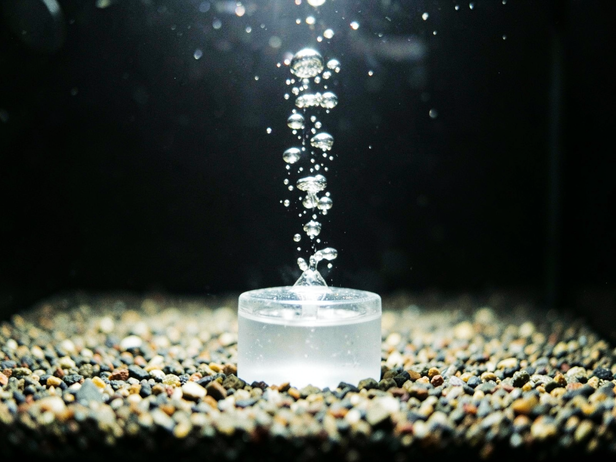
![Bubbles Rise in Aquarium]()
Bubbles Rise in Aquarium
Image credit : AI
Air stone releases bubbles, a sign of oxygenation in the aquarium. Fish tank oxygen problem signs are important to monitor.
What to do immediately
Increase surface agitation right away. Aim a powerhead or filter outlet at the surface, add an air stone if you have one, or lower the water level slightly so the filter outlet creates more turbulence. If the tank is warm, a partial water change, roughly twenty percent, with cooler, dechlorinated water lowers temperature and adds oxygen simultaneously. Remove any uneaten food and check that the filter is running and clean.
Do not add more fish while diagnosing the problem. Do not increase feeding. If you use a heater, check that it has not malfunctioned upward.
A dissolved oxygen test kit, available at most aquarium shops, gives you a number rather than a guess. Most tropical fish do well at dissolved oxygen levels above 6 mg/L. Below 4 mg/L, fish begin to show stress. Below 2 mg/L, mortality becomes likely. The test is inexpensive and removes the guesswork.
When this is a vet problem
Surface gasping that does not improve within thirty minutes of increased aeration, or that is accompanied by visible lesions, colour change, fin damage, or swelling, points to something beyond low oxygen. A fish showing laboured breathing alongside any of those signs needs assessment by an aquatic vet or an experienced aquarium specialist, gill disease, ammonia poisoning, and nitrite toxicity all present similarly and require different responses. Ammonia and nitrite test kits should be part of every home tank kit; if either reads above zero in an established tank, water quality has broken down and a water change is urgent while you seek advice.