A dog that ate an hour ago and now looks uncomfortable is easy to dismiss. Maybe he ate too fast. Maybe he needs a walk. In most dogs, that read is probably right. In a Great Dane, a German Shepherd, a Dobermann, or any deep-chested breed, it is a gamble that can end badly before morning.
Gastric dilatation-volvulus, GDV, or bloat, is one of the few conditions in veterinary medicine where the window between treatable and fatal is measured in hours, not days. Understanding why it happens, what it looks like, and what the owner's job is in those first minutes is the difference between a dog that survives and one that does not.
What actually happens inside the stomach
When gas builds up in a dog's stomach faster than it can be expelled, the stomach distends. In dilatation alone, this is painful and dangerous but survivable with prompt treatment. The catastrophic version is volvulus: the distended stomach rotates on its axis, twisting the oesophageal and pyloric openings shut. Gas is now trapped with no exit. Blood supply to the stomach wall is cut off. The spleen, which sits close to the stomach, often twists with it. Tissue begins to die. Toxins enter the bloodstream. The heart goes into arrhythmia. Shock follows.
This is not a slow process. A dog in full GDV can go from distressed to cardiovascular collapse in two to four hours. The stomach wall can perforate. By the time a dog stops moving, the surgical window may already be closed.
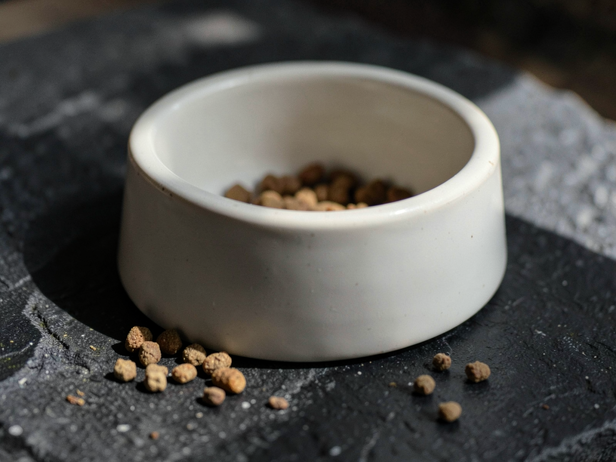
![Dog Bowl and Kibble]()
Dog Bowl and Kibble
Image credit : AI
I see a dog food bowl with kibble, a reminder of potential bloat prevention in large breed dogs.
Which dogs are at highest risk and why
Deep chest anatomy is the primary structural risk factor. A dog whose chest is deep relative to its width, think of the ratio between the ribcage's height and its breadth, has a stomach with more room to swing when gas pushes it. Large and giant breeds carry this shape most often: Great Danes, Standard Poodles, German Shepherds, Dobermann Pinschers, Weimaraners, Irish Setters, Rottweilers, Boxers, and Saint Bernards appear consistently in the clinical literature on GDV. Among Indian households, German Shepherds and Dobermanns are the breeds most commonly kept in this risk group.
Age and sex also factor in. Dogs over seven are at higher risk than younger animals. Males develop GDV more often than females. A dog that has had a first-degree relative with GDV carries a meaningfully elevated risk. Temperament plays a role too: dogs assessed as anxious or fearful by their owners show higher rates in some studies, likely because stress affects gastric motility.
Eating pattern matters. One large meal a day, eating from a raised bowl, eating at speed, and vigorous exercise within an hour of a meal have all been associated with increased risk, though the raised-bowl question has produced conflicting evidence and should not be treated as settled. What is not in dispute: fast eating that introduces large volumes of air into the stomach is a contributing factor, and it is one an owner can address.
What bloat looks like: the signs that cannot wait
The visible signs of GDV are specific enough that an owner who knows them should be able to act before a vet confirms the diagnosis.
The belly distends visibly, particularly behind the ribcage and on the left side. It may feel tight, like a drum, when tapped. The dog retches repeatedly but brings nothing up, this unproductive retching is one of the clearest signs that something is mechanically wrong. He is restless, unable to settle, and looks distressed rather than simply uncomfortable. He may drool heavily, stand with his elbows out and back arched, or repeatedly look at his flank. As the condition progresses, he becomes weak, pale around the gums, and his breathing becomes rapid and shallow.
Any one of these signs in a deep-chested dog after a meal is enough. All of them together is an emergency. Do not wait to see if he improves. Do not offer water. Do not walk him to see if it passes. Get him to a vet immediately, call ahead so the clinic can prepare.
![Veterinary Reception Counter]()
Veterinary Reception Counter
Image credit : AI
A dog lead rests on the counter, a subtle reminder of the care provided. Considering bloat prevention for large breed dogs is crucial.
What treatment involves and why speed determines outcome
A vet will confirm GDV with an X-ray, which shows the characteristic double-bubble gas pattern of a rotated stomach. Stabilisation comes first: intravenous fluids to address shock, oxygen, and cardiac monitoring. Once the dog is stable enough for surgery, the stomach is decompressed and rotated back into position. The surgeon then performs a gastropexy, the stomach wall is sutured to the abdominal wall so it cannot rotate again. Without gastropexy, recurrence rates are high.
Survival depends almost entirely on how quickly surgery happens after the stomach twists. Dogs that reach surgery within a few hours of onset, before significant tissue death has occurred, have good survival rates. Dogs that arrive in shock, with necrotic stomach tissue or cardiac arrhythmia, face a much harder prognosis. The procedure is major abdominal surgery and is not inexpensive; owners of high-risk breeds should know this is a possibility before it becomes an emergency.
Prophylactic gastropexy, the same stomach-tacking procedure performed on a healthy dog before GDV occurs, often at the time of neutering, is an option worth discussing with a vet for any dog in a high-risk breed. It does not prevent dilatation but prevents the volvulus, which is the part that kills.
What owners of at-risk breeds can do day to day
No management strategy eliminates the risk of GDV, but several reduce it. Feeding two or three smaller meals rather than one large meal a day reduces the volume of food and gas the stomach handles at once. Slowing a dog that eats fast, using a slow-feeder bowl, spreading food on a flat surface, or using a food puzzle, reduces the air swallowed during a meal. Keeping the dog calm for at least an hour after eating, avoiding running, jumping, and rough play in that window, is standard advice from veterinary internists.
Knowing your dog's normal is the other half of it. A dog that is usually energetic and becomes quiet and hunched after dinner is showing you something. The owners who catch GDV early are usually the ones who noticed that something was off, not the ones who waited for the dog to collapse.
If a deep-chested dog shows unproductive retching, a visibly distended abdomen, or restlessness that does not settle within minutes of a meal, treat it as an emergency and call your vet now, do not wait for morning.