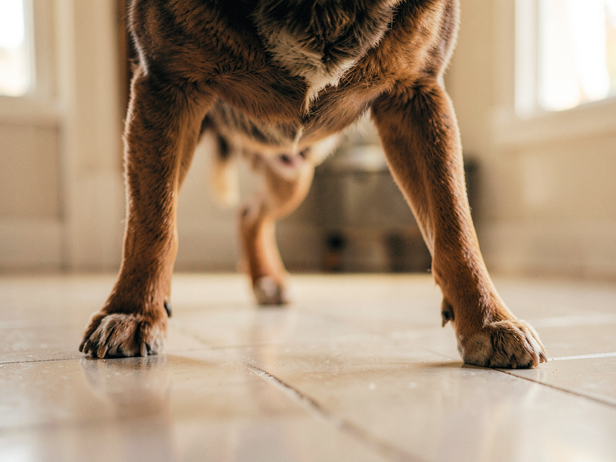
Watch a dog try to stand up on a polished marble floor and you will see the problem in one second. The back legs splay outward, the claws find nothing, and the dog hauls itself up using its spine instead of its hindquarters. It looks minor. Done ten or twenty times a day for years, it is not.
What slipping actually does to a dog's body
When a dog moves on a surface with traction, its muscles fire in a coordinated sequence: the hindquarters push, the core stabilises, the forelimbs land and absorb. On a slick surface, that sequence breaks down. The paws slide before the muscles can respond, so the dog compensates by tensing the neck, bracing the spine, and shifting weight forward onto the front legs. Over time, this compensatory posture overloads the joints that were not designed to carry that load. The muscles around the hips and stifles, the dog's knees, are held in a constant low-grade contraction just to keep the dog upright. Chronic muscle tension of this kind causes fatigue, microtrauma to the tendons, and, in dogs already carrying joint disease, measurable acceleration of cartilage wear. The floor does not cause arthritis on its own. But in a dog with early hip dysplasia or elbow dysplasia, it removes the small mechanical buffer that was still protecting the joint.
![Dog's Hind Legs on Tile]()
Dog's Hind Legs on Tile
Image credit : AI
My paws struggle for grip on this slippery surface. Concerned about dog joint pain in Indian flats.
Which dogs feel it most
Breed and life stage matter here. Large and giant breeds, Labrador Retrievers, German Shepherds, Golden Retrievers, Rottweilers, carry more body mass over fewer square centimetres of paw pad, so the force on each joint during a slip is proportionally higher. Breeds with a low, long body plan, such as Dachshunds and Basset Hounds, are at particular risk because their spines are already under mechanical stress; a slip that torques the lower back can trigger or worsen intervertebral disc problems. Older dogs lose proprioception, the body's sense of where its limbs are in space, as a normal part of ageing, so they are slower to correct a slip and fall harder when they do. Puppies between eight and sixteen weeks, when their joints are forming and their muscle mass is still catching up to their skeletal size, should have almost no access to slick flooring. The repetitive stress during this window can influence how the hip socket develops.
Reading the signs at home
Dogs do not limp dramatically from a slippery floor the way they would from a thorn in the paw. The signs are quieter. A dog that used to bound up to greet you now rises slowly and stands for a moment before moving. A dog that avoided the kitchen tiles and started sleeping only on the rug. Reluctance to go from a lying position to a stand, or a visible wobble in the hindquarters when standing still. Stiffness after rest that eases once the dog has been moving for a few minutes points to joint inflammation, and if the dog is living on hard, slick floors, the floor is a reasonable suspect alongside other causes. None of these observations is a diagnosis. A dog showing persistent stiffness, reluctance to climb stairs, or a change in how it holds one limb needs a vet to assess whether there is underlying joint disease, not just a flooring problem.
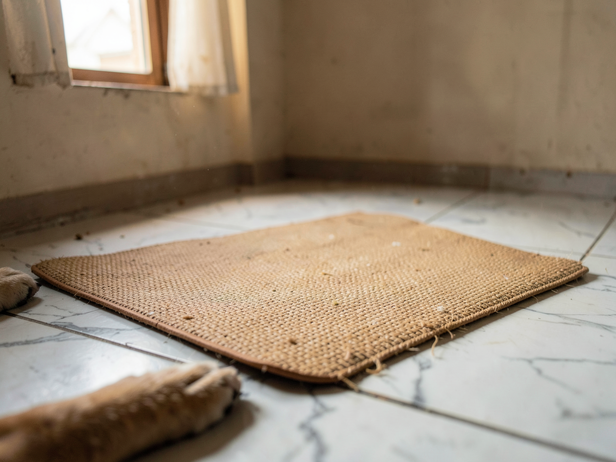
![Dog's Paw on Jute Mat]()
Dog's Paw on Jute Mat
Image credit : AI
Providing better paw grip on slippery marble tiles for my dog's comfort and joint health.
What you can actually do
The fix does not require replacing your floors. Rubber-backed yoga mats or jute runners placed along the routes the dog uses most, from the sleeping spot to the water bowl, from the living room to the door, give the paws something to grip. Anti-slip stick-on paw pads, available from most pet stores, bond to the underside of the paw and last a few days per application; they work well for dogs that resist wearing booties. Keeping the fur between the paw pads trimmed short makes a meaningful difference: the hair that grows between the pads acts like a sock on a tile floor. Long nails compound the problem because they prevent the paw from sitting flat, so the dog is already on an unstable platform before the floor adds its own slipperiness. Nail trimming is not cosmetic in a dog that lives indoors. For dogs already diagnosed with hip dysplasia, arthritis, or a spinal condition, the flooring question is worth raising explicitly with your vet. Physiotherapy for dogs, hydrotherapy and targeted muscle-strengthening exercises, is available in several Indian cities and has good evidence behind it for improving stability and reducing pain in dogs with joint disease. It does not replace veterinary management, but it addresses the muscular compensation patterns that slick floors make worse.