Walk through any busy market in Delhi or Pune and you will still find someone selling a small green parrot in a cage. Most of those birds are Indian ringnecks or Alexandrines, two species that happen to be among the most recognisable parrots in the world and, under Indian law, among the most protected wild animals in the country.
Two birds, one legal reality
The Indian ringneck parakeet (Psittacula krameri manillensis) and the Alexandrine parakeet (Psittacula eupatria) are both listed under Schedule IV of the Wildlife Protection Act, 1972. That listing means it is illegal to trap, sell, buy, keep, or transport either species without a permit issued by the Chief Wildlife Warden of a state. The permit is not a formality, it is rarely granted for private keeping, and the burden of proof that a bird was legally acquired falls on the owner, not the state. A bird bought from a street vendor or a pet shop carries no legal paperwork, because no legal paperwork exists for wild-caught native parrots. Possession alone is an offence.
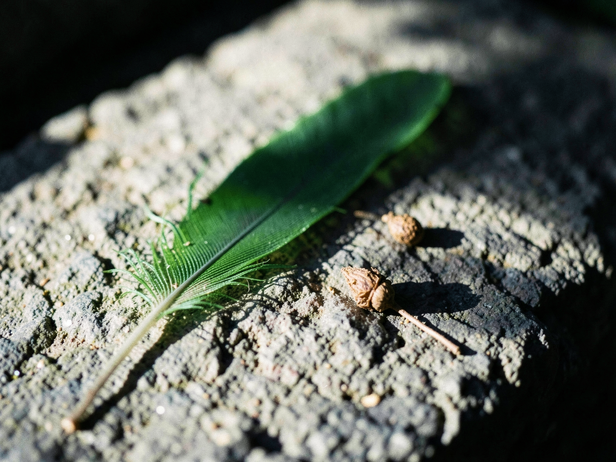
![Parrot Feather and Seed]()
Parrot Feather and Seed
Image credit : AI
I arranged this green parrot feather and seed pod on stone, a study in natural textures. Alexandrine parakeet feathers are beautiful.
Why these two specifically
Both species are native to the Indian subcontinent and have been caught for the cage-bird trade for centuries. The ringneck, smaller and easier to breed in captivity, was historically exported in enormous numbers before the 1991 ban on wild bird exports. The Alexandrine, larger and with a more powerful bite, was prized for its talking ability and its association with Alexander the Great's army, which allegedly brought it west, hence the name. That long history of human interest is precisely the problem. Demand drove trapping, trapping drove population pressure, and both species now face ongoing poaching even though wild populations in India are not currently considered critically endangered. The law exists to prevent the trade from recovering, not to respond to a collapse that has already happened. The Forest Department's position, backed by the Animal Welfare Board of India, is that native wild birds belong in the wild and that captive breeding for private keeping does not offset the harm of continued poaching.
What the birds actually are, biologically
The ringneck is a medium-sized parrot, roughly 40 centimetres from beak to tail tip, with the long tail accounting for nearly half that length. Males develop the characteristic black-and-rose neck ring at around 18 months; females and juveniles lack it entirely, which is why young birds are sometimes sold under the pretence that the buyer cannot tell the species. The Alexandrine is noticeably larger, up to 58 centimetres, with a deeper red shoulder patch and a heavier bill capable of cracking hard seeds and nuts with ease. Both species are highly social in the wild, roosting in large flocks, ranging widely across agricultural land and forest edge, and forming pair bonds that last across breeding seasons. In cognitive terms, both rank among the more capable parrots: they solve simple problems, learn to associate sounds with outcomes quickly, and in captivity develop strong attachments to specific people while becoming genuinely difficult for anyone else to handle.
![Central Indian Dawn Landscape]()
Central Indian Dawn Landscape
Image credit : AI
I observe a flock of small green birds, likely Indian ringneck parakeets, lifting from the canopy at dawn. The landscape is alive with the soft light of a new day.
What this means if you already have one
If a ringneck or Alexandrine is already living in your home, the legal position is uncomfortable but not hopeless. The Wildlife Crime Control Bureau and state forest departments have, in practice, focused enforcement on traders and trappers rather than on individual households with a single bird and no evidence of purchase intent. That said, the bird cannot be sold, given away to another private person, or transported across state lines without a permit. It cannot be bred for sale. If it dies, there is no legal replacement through normal channels. Some owners have approached their state's Chief Wildlife Warden to voluntarily disclose possession and request a record of the bird; the outcome varies by state and officer. The honest answer is that there is no clean path to fully legal status for a bird that entered the home through the trade, and anyone in this position should speak to a lawyer familiar with wildlife law rather than rely on advice from a pet shop.
The birds that can legally be kept
India's pet parrot market did not disappear when native species were protected, it shifted. Budgerigars, cockatiels, lovebirds, and several other parrot species are not native to India and are not listed under the Wildlife Protection Act. Captive-bred populations of these birds are legally available, and keeping them requires no permit. For someone who wants a parrot's intelligence and companionship without the legal exposure, these are the realistic options. A budgerigar is not an Alexandrine, but it is also not a bird that someone caught in a net in a mango grove in Maharashtra last month. The distinction matters.