A Himalayan is not a Persian with a paint job. The colourpoints on its face, ears, paws and tail come from the same gene that gives a Siamese its mask, and that gene arrived through careful, decades-long crossbreeding. The result is a cat with a distinct temperament, a coat that demands serious commitment, and a set of health considerations every prospective owner should understand before bringing one home.
Where the Himalayan came from
Breeders in the United States and the United Kingdom began crossing Persians with Siamese in the 1930s, aiming to fix the Siamese colourpoint pattern onto the Persian's long-coated, heavy-boned frame. The project took roughly two decades of selective breeding before the type stabilised. The Cat Fanciers' Association recognised the Himalayan as a distinct breed in 1957, though some registries still classify it as a colourpoint variety of the Persian. The name references the Himalayan rabbit, which carries the same pointed colouring, not the mountain range.
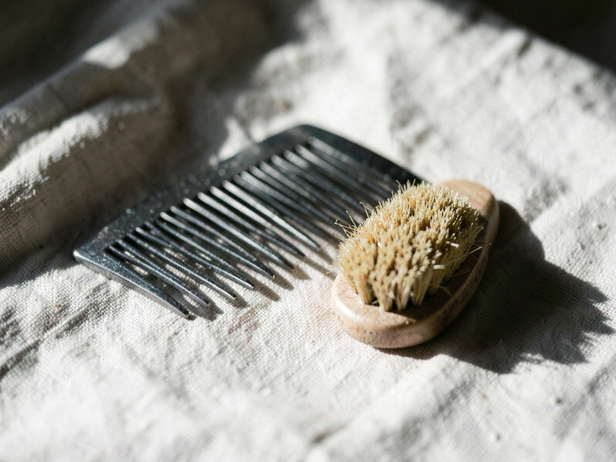
![Grooming Tools on Linen]()
Grooming Tools on Linen
Image credit : AI
I prepare for Himalayan cat grooming, ensuring their coat is pristine. Essential tools for Persian colourpoint cat care.
What the colourpoint gene actually does
The pointing is produced by a temperature-sensitive form of the enzyme that makes melanin. Cooler parts of the body, the extremities, produce pigment; the warmer core stays pale. This is why kittens are born almost entirely white: inside the womb, the temperature is uniform. The points darken over the first year as the cat's body temperature distribution settles. Seal, blue, chocolate, lilac, flame, and tortie are the recognised point colours. The body colour is always a pale cream or off-white that contrasts sharply with the mask. The eyes are always a deep, vivid blue, one of the breed's most striking features and a direct inheritance from the Siamese side.
The coat and what it costs you in time
The Himalayan carries the same coat as a show Persian: long, dense, and with a thick undercoat that mats quickly if it is not combed through daily. In the humidity of most Indian cities, Mumbai, Chennai, Kolkata, that undercoat traps moisture and tangles faster than it would in a dry climate. Daily combing with a wide-toothed metal comb is not optional; it is the price of keeping this cat comfortable. A bath every two to four weeks keeps the coat from becoming oily. Most Himalayans tolerate bathing if they are introduced to it as kittens. If you cannot commit to this, a shorter-coated breed will suit you better, and that is worth saying plainly before purchase.
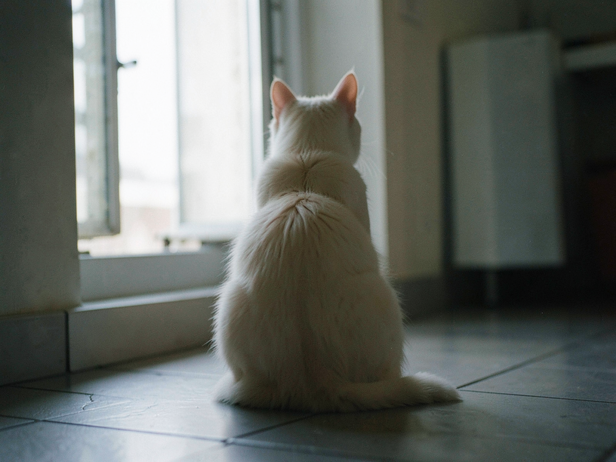
![Cat by the Window]()
Cat by the Window
Image credit : AI
My Himalayan cat enjoys the diffused light by the window. Proper Himalayan cat care is essential for their well-being.
The flat-dweller question
Temperamentally, the Himalayan sits closer to the Persian than the Siamese. It is calm, quiet, and content to spend most of the day in a cool room. It does not demand constant stimulation or high-energy play, which makes it genuinely well-suited to flat life. It bonds closely with its household and is typically gentle with children and other cats. The Siamese inheritance shows up in occasional bursts of vocalisation and a slightly more curious, interactive quality than a pure Persian, but this is a cat that will spend hours in one spot if the spot is comfortable. In India's warmer months, that spot should be air-conditioned. The Himalayan's flat face limits its ability to pant efficiently, and it handles heat poorly.
Health predispositions to know before you commit
The Himalayan inherits the Persian's brachycephalic skull, the flat face that gives it its distinctive look. This compression affects the nasal passages, tear ducts and, in some lines, the soft palate. Breathing noise during rest is common. Watery eyes and facial staining are almost universal; the tear ducts drain poorly because of the skull shape, and the fur below the inner corner of each eye needs daily wiping. Polycystic kidney disease is a serious concern in Persian and Himalayan lines: it is a genetic condition in which cysts form in the kidneys and can lead to kidney failure over years. Responsible breeders screen for the PKD1 gene mutation; ask for documentation before buying. Dental crowding is also common because the shortened jaw leaves less room for teeth. A Himalayan needs annual dental checks and is likely to need professional scaling at some point in its life. If your cat shows laboured breathing, persistent nasal discharge, or stops eating, those are reasons to reach a vet, not reasons to watch and wait.