Watch a gourami long enough and you will notice it: a quick dart to the surface, a tiny gulp, then back down. It looks like nervous habit. It is actually one of the more remarkable adaptations in freshwater fish, and it shapes everything about how gouramis live, what they need, and what a tank must give them.
The labyrinth organ, what it is and how it works
Gouramis belong to the suborder Anabantoidei, a group of fish that evolved a supplementary breathing structure called the labyrinth organ. Tucked just behind the gills, it is a folded chamber of thin, highly vascularised tissue, the folds increase surface area the way the alveoli in a mammal's lungs do. When a gourami rises to the surface and gulps air, oxygen passes across this tissue directly into the bloodstream. The fish does not need this breath to survive every moment, but it cannot go without surface access indefinitely. A sealed tank, or a surface packed so tightly with floating plants that no air gap remains, will suffocate a gourami even in well-oxygenated water.
The organ develops gradually in juveniles. Young gouramis rely more heavily on their gills; adults depend on the labyrinth for a meaningful portion of their oxygen uptake. This is why breeders keep fry tanks in warm rooms: cold air drawn across the labyrinth can damage the developing tissue.
![Bubbles on Calm Water]()
Bubbles on Calm Water
Image credit : AI
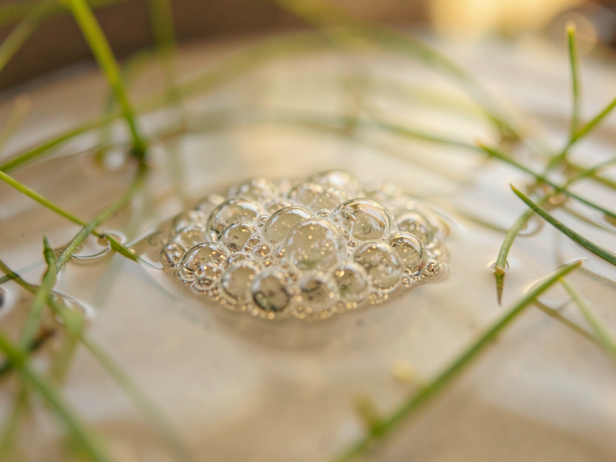
Delicate bubbles rest on calm water, a serene scene. Observing gourami surface gulping behaviour in aquariums can be fascinating.
Where gouramis come from and why the organ made sense
The species most commonly kept as pets, Dwarf Gourami, Pearl Gourami, Three Spot Gourami, Honey Gourami, Moonlight Gourami, are native to South and Southeast Asia: India, Bangladesh, Myanmar, Thailand, the Indonesian archipelago. Their wild habitats are slow-moving rivers, flooded rice paddies, swamps, and seasonal pools. These are warm, often stagnant environments where dissolved oxygen drops low, especially in the dry season when water levels fall and decomposition accelerates. The labyrinth organ is a direct answer to that pressure. A fish that can breathe at the surface survives where a gill-only fish cannot.
The Dwarf Gourami, Trichogaster lalius, is native to the Ganges, Brahmaputra, and Beas river basins, which means it is, in a real sense, a fish of the Indian subcontinent. Wild populations still exist in the slow backwaters of West Bengal and Assam, though habitat loss and the ornamental trade have put pressure on them.
Keeping gouramis in a home tank, what the labyrinth demands
The labyrinth organ sets a few non-negotiable conditions for a tank. First, there must always be an air gap between the water surface and the tank lid, a few centimetres is enough, but it must be there. Second, the air above the surface should be close to the water temperature. In an Indian flat, this is rarely a problem in summer, but in an air-conditioned room where the tank sits near a vent, cold air drafts can irritate the labyrinth and make fish prone to respiratory infections. Third, surface flow should be gentle. Gouramis are not strong swimmers; a powerful filter outlet that churns the surface stresses them and makes the surface gulp harder to execute calmly.
Tank size depends on species. Dwarf Gouramis and Honey Gouramis are comfortable in a 60-litre tank with calm tankmates. Three Spot and Pearl Gouramis grow to 10 to 12 cm and do better in 100 litres or more. All species appreciate dense mid-level planting, they are naturally found among reeds and floating vegetation, and a darker substrate that reduces reflected light stress.
![South Asian River Backwater]()
South Asian River Backwater
Image credit : AI
Observing the still waters, I ponder the fascinating gourami surface gulping behaviour in this tranquil Indian backwater.
Reading a gourami's surface behaviour
A gourami that surfaces every few minutes is behaving normally. One that hangs permanently at the surface, gasping, is not. Persistent surface-hanging in a gourami can mean dissolved oxygen in the water has crashed, check the filter, test the water, look for signs of a bacterial bloom. It can also mean gill damage from ammonia or nitrite spikes, which forces the fish to rely entirely on the labyrinth. A gourami that stops surfacing and sits motionless at the bottom is equally concerning: lethargy combined with loss of normal breathing rhythm is a sign worth acting on quickly.
Dwarf Gouramis in particular are prone to Dwarf Gourami Iridovirus, a viral disease that has spread widely through the ornamental trade and for which there is no treatment. Signs include colour loss, bloating, and progressive lethargy. A fish showing these symptoms alongside abnormal breathing should be isolated and assessed by a vet with aquatic experience.
Bubble nests and the surface as a nursery
Male gouramis build bubble nests, clusters of air bubbles coated in saliva, floating at the surface among plants or in a corner of the tank. This is courtship and parental behaviour: the male constructs the nest, courts the female, and then guards the fertilised eggs within it, catching any that fall and returning them to the bubbles. The labyrinth organ makes this possible. The male gulps air and releases it as a coated bubble; the nest can hold dozens of eggs above the waterline where oxygen is highest and fungal pressure is lower.
A male building a bubble nest is a sign of a healthy, unstressed fish. A male that has stopped building, in a tank where he previously did so regularly, is worth watching. It does not diagnose a problem on its own, but it is one of the clearer behavioural signals that something in the tank has shifted.
The labyrinth organ is not a curiosity or a party trick. It is the reason gouramis exist in the habitats they do, the reason they behave the way they do at the surface, and the reason a tank that ignores it will produce a fish that is technically alive but chronically stressed. Understand the organ and you understand the fish.