The dingo sits in a category that has no clean name. It is not a wolf. It is not a pet dog. It is not a feral dog gone wild over a few generations. It is something older and stranger: a domestic animal that was released into a continent with no other predators to compete with, and then left alone for long enough to become its own thing.
Where the dingo actually came from
The best current evidence, drawn from ancient DNA and archaeological work, places the dingo's arrival in Australia somewhere between 3,500 and 4,000 years ago. The animal that arrived was already domestic, descended from South or Southeast Asian dogs, likely brought by seafarers who had contact with Aboriginal Australians. It was not a wolf that domesticated itself on Australian soil. It arrived tame, or close to tame, and then went feral in a landscape that had no other large land predator.
This matters because it separates the dingo from true wild canids. The dingo's skull, its teeth, its reproductive biology, and its social behaviour all carry the marks of domestication. It breeds once a year, as wolves do, unlike most domestic dogs, which cycle twice, but this is thought to be a reversion rather than a sign it was never domestic. Its brain-to-body ratio sits between a wolf's and a domestic dog's. It is, genetically, a dog that has been living without people for a very long time.
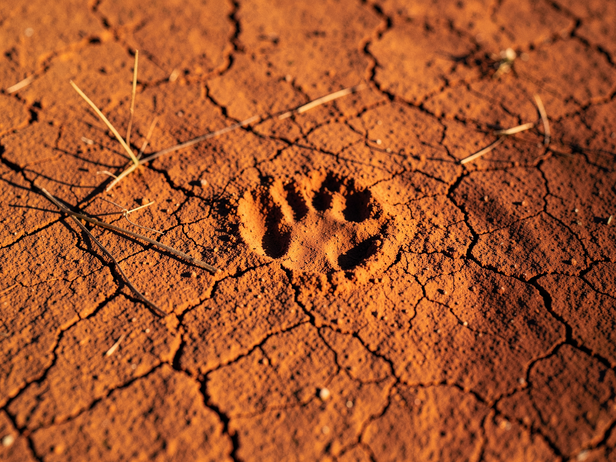
![Cracked Earth, Lone Paw Print]()
Cracked Earth, Lone Paw Print
Image credit : AI
A solitary dingo paw print marks the arid Australian earth, a testament to its wild presence.
What the dingo's body tells you
Dingoes are medium-sized, lean, and built for endurance rather than speed. Most are a sandy yellow-ginger, though some populations carry white or black-and-tan colouring. The coat is short and dense. The ears are erect and mobile. The tail is bushy and carried low.
One feature that surprises people who know domestic dogs: the dingo's wrist joint has an unusually wide range of rotation. It can turn its paws to grip and climb in ways most domestic breeds cannot. It can open latches. It can scale fences that would stop a comparably sized dog. This is not a trick it learned, it is a structural feature, and it is one of the reasons dingoes kept as companions in Australia require very specific containment.
The skull is broader and flatter than most domestic dogs of the same size, and the jaw is proportionally stronger. These are the tools of an animal that takes large prey, kangaroos, wallabies, wombats, as well as small mammals and birds. It is an opportunistic predator, not a specialist.
Behaviour: what separates a dingo from a domestic dog
Dingoes communicate differently from domestic dogs. They howl, and they howl well, long, sustained calls that carry across open country. They rarely bark, and when they do, it is typically a short alarm call rather than the sustained barking that domestic dogs produce. This difference in vocalisation is one of the more reliable ways to distinguish a pure dingo from a dingo-dog hybrid in the field.
Their social structure is flexible. Dingoes can live alone, in pairs, or in small packs depending on prey availability and territory. Pack structure is less rigid than in wolves. Pups are raised cooperatively, but adults do not show the same degree of coordinated pack hunting that wolves do for large prey.
The relationship with humans is genuinely ambiguous. Dingoes raised from puppyhood can form strong bonds with people and behave much like domestic dogs in many respects. But they retain a level of independence and environmental reactivity that most domestic breeds have lost. They do not generalise trust to strangers the way a well-socialised Labrador does. They are not aggressive by default, but they are not reliably deferential either. Experienced keepers describe them as more like a partnership than an ownership.
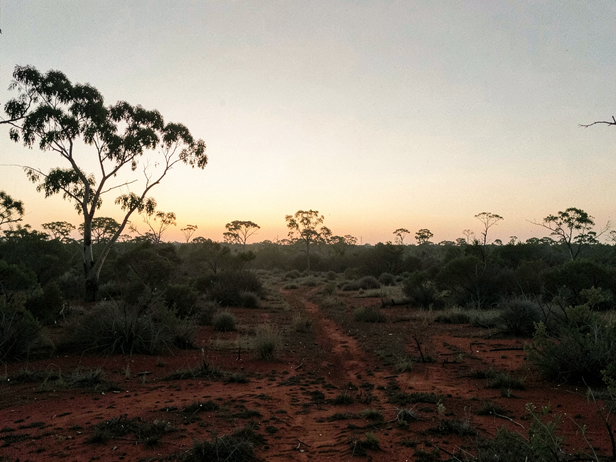
![Australian Bushland Dawn]()
Australian Bushland Dawn
Image credit : AI
I observe the vast Australian bushland at dawn, a serene landscape with eucalyptus silhouettes. The red earth stretches towards the horizon.
The dingo's place in Australia, and the hybrid problem
The dingo arrived in Australia before European settlement and became embedded in the continent's ecology. It is the apex land predator across most of the mainland. Its presence suppresses populations of feral cats and foxes, both of which are catastrophic for native wildlife, through direct competition and predation. Removing dingoes from an area tends to cause an explosion in cat and fox numbers, with cascading damage to small native mammals and ground-nesting birds. This is called a trophic cascade, and it is one reason conservation biologists now argue for dingo protection in many areas rather than culling.
The complication is hybridisation. Since European settlement brought domestic dogs, dingoes have been interbreeding with them across much of the mainland. Pure dingoes are increasingly rare outside the most remote areas and Fraser Island, where the population has been relatively isolated. A hybrid carries dingo ancestry but may not carry dingo behaviour or ecology in the same way. The conservation value of a hybrid population is genuinely contested among researchers.
The dingo's legal status varies by Australian state and territory, protected in some, classified as a pest in others, with livestock protection a central political pressure. It is not a simple story, and anyone writing about it as purely villain or purely misunderstood native animal is leaving most of it out.
What the dingo tells us about domestication itself
The dingo is one of the best natural experiments in what happens when you take a domestic dog and remove human selection pressure for thousands of years. What comes back is not a wolf. The animal that emerges is leaner, more self-sufficient, and more behaviourally flexible than most domestic breeds, but it still carries the genetic and anatomical signature of a dog, not a wild canid that domesticated independently.
This is the finding that makes the dingo genuinely interesting beyond its own story. Domestication does not simply tame an animal. It reshapes its development, its stress responses, its social cognition, and its reproductive biology. Some of those changes reverse under feral conditions. Others, it turns out, do not. The dingo is what persists.
It is also a reminder that the line between wild and domestic is not a wall. It is a position on a continuum, and animals move along it, in both directions, given enough time and the right conditions.