Point at something across the room and your dog will almost certainly look where you are pointing. Do the same with a wolf raised by humans from birth, given every socialisation a captive animal can receive, and it will most likely stare back at your hand. The gap between those two responses is one of the most studied puzzles in animal cognition, and the answer reshapes how we think about what domestication actually did.
It is not about being tame
Hand-raised wolves are not wild. They are comfortable around people, they play, they form attachments. Researchers at the Wolf Science Center in Austria have raised wolves and dogs under identical conditions since puppyhood, giving both species the same human contact, the same training, the same daily life. When both groups were tested on pointing tasks, the dogs followed the gesture reliably. The wolves, despite years of human exposure, mostly did not. Tameness, it turns out, is not the same thing as reading human social cues. A wolf can be tame and still be cognitively tuned to a different channel.
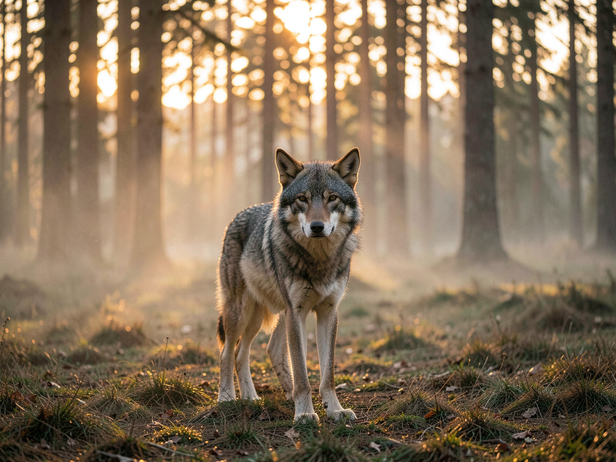
![Wolf in Dawn Forest]()
Wolf in Dawn Forest
Image credit : AI
I observe the forest at dawn, my calm alertness a testament to my wild nature. Understanding wolf and dog difference is key.
What the gesture actually asks of an animal
Following a point requires something specific: the animal has to understand that a human's outstretched arm is not an interesting object in itself but a signal directing attention elsewhere. This is called joint attention, and it is the same cognitive move a human infant makes around nine to twelve months of age. The animal has to look at you, read your intention, shift its gaze to where you are directing it, and act on that information. Dogs do this so automatically that it barely registers as a skill. It is, in fact, a remarkable one. Chimpanzees, our closest relatives, perform poorly on the same task when tested with a human pointer. Dogs, which share far less of our evolutionary history, outperform them consistently.
What domestication selected for
The leading explanation, developed through decades of research including the long-running fox domestication experiments in Russia, is that domestication did not simply make dogs friendlier. It selected for a specific sensitivity to human communicative signals. Dogs that could read where a person was looking, what a person was gesturing toward, and what a person wanted were more likely to survive and reproduce in a human-managed world. Over thousands of generations, that sensitivity became part of the dog's cognitive baseline. Puppies as young as six weeks, with almost no training, follow a human point better than adult wolves with years of human contact. The ability appears to be developmental, wiring itself in early, not learned through repeated exposure the way a trick is learned.
![Stone and Stick Still Life]()
Stone and Stick Still Life
Image credit : AI
Examining the subtle differences between a stone and a stick, much like understanding dog vs wolf behaviour.
What this means for the dog in your flat
When your dog watches your face during a walk, follows your eyes to a rustling bush, or turns toward the kitchen the moment you glance at the treat shelf, it is not being clever in the way a problem-solver is clever. It is doing something more fundamental: it is reading you as a social partner whose signals carry meaning. This is the cognitive infrastructure that makes training possible, that makes a dog responsive to a gesture across a room, and that makes it sensitive to your mood in a way that can feel almost uncanny. The wolf is not less intelligent. It is differently intelligent, tuned to read other wolves rather than people. The dog gave up some of that wolf-to-wolf fluency in exchange for something rarer: a brain shaped, over millennia, to make sense of us.