For most of the twentieth century, the Przewalski's horse carried one of zoology's most satisfying labels: the last wild horse. Every other horse on the planet, the story went, descended from animals humans had tamed. This one had escaped that fate. It roamed the Mongolian steppe on its own terms, stocky and dun-coloured, with a stiff upright mane that no domestic horse shares. The label felt clean. The genetics, when scientists finally read them carefully, did not.
What the genome revealed
A landmark study published in the journal Science in 2018, drawing on ancient DNA from horse remains across Eurasia, found that Przewalski's horses are not a pristine pre-domestic lineage at all. They are the feral descendants of horses domesticated by the Botai people of what is now northern Kazakhstan roughly 5,500 years ago. The Botai were among the earliest known horse-keepers, they milked mares and likely rode, and their horses eventually escaped or were released back into the wild. Over thousands of years, those animals re-wilded so completely that by the time the Russian explorer Nikolai Przewalski described the species to Western science in 1881, there was nothing visible to suggest a domestic past. The genome remembered what the body had forgotten.
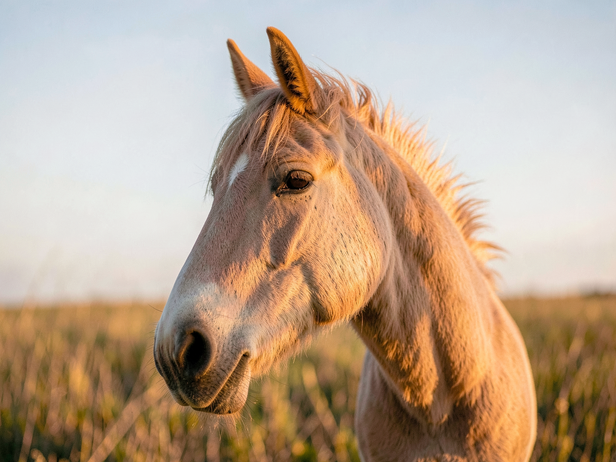
![Golden Hour Przewalski's Horse]()
Golden Hour Przewalski's Horse
Image credit : AI
A Przewalski's horse, a truly wild horse breed, stands against the open sky during golden hour. Its short, bristled mane is clearly visible.
What makes this horse genuinely different
The Botai connection does not make the Przewalski's horse ordinary. It is chromosomally distinct from every domestic horse alive: 66 chromosomes against the domestic horse's 64. The two can interbreed and produce fertile offspring, which is part of why the genetic history is so complicated, but the Przewalski's horse has followed a separate evolutionary path for long enough to accumulate real differences. Its build is heavier through the neck and shoulder, its legs shorter relative to its body, its temperament markedly less tolerant of human handling even after generations in captivity. Zoos that have kept them describe the gap between a Przewalski's horse and a feral domestic horse as immediately obvious to anyone who has worked with both.
Extinction, captivity, and a slow return
The species was declared extinct in the wild in 1969. The last confirmed sighting of a free-living individual in Mongolia was in 1969, and the entire surviving population at that point existed in zoos, descended from roughly 12 to 14 animals captured in the early twentieth century. That genetic bottleneck is severe, the modern population carries the consequences in reduced diversity, but the breeding programme held. Reintroduction efforts began in Mongolia in the 1990s, and populations have since been established in the Khustain Nuruu and Hustai national parks. As of the mid-2020s, several hundred animals live wild again. The IUCN lists the species as Endangered, not Extinct in the Wild, which is a meaningful shift even if it is not a recovery.
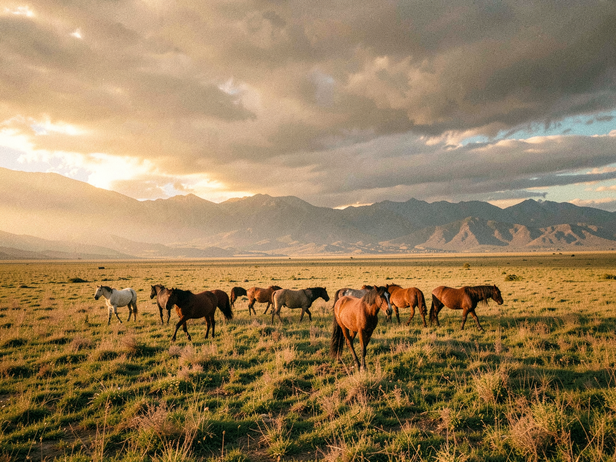
![Golden Hour Horse Herd]()
Golden Hour Horse Herd
Image credit : AI
A small herd of stocky dun horses moves across a vast grassland, evoking the spirit of wild horse breeds.
The Botai horses and what happened to them
One question the 2018 research opened rather than closed: if Przewalski's horses descend from Botai domesticates, where did the ancestors of every modern domestic horse come from? The answer, from subsequent ancient DNA work, is that they did not come from the Botai at all. Modern domestic horses trace their origin to a separate population, likely from the western Eurasian steppe, that expanded rapidly around 4,200 years ago and effectively replaced earlier horse populations across most of their range. The Botai horses, the ones that became Przewalski's horses, were largely displaced from the domestic lineage. They survived by going feral. It is an unusual trajectory: domesticated, released, re-wilded, nearly lost, then partially recovered through the very captive programmes that once held them. The family tree is not a clean branching diagram. It is a loop.