
The Ship Of The Desert Survival In Extreme Hot Climate
Upasna Yadav | Jan 24, 2026, 19:00 IST

Camel - Lifeline of the desert nomads
Camel (genus Camelus), any of three species of large ruminating hoofed mammals of arid Africa and Asia known for their ability to go for long periods without drinking. The Arabian camel, or dromedary , has one back hump, while the domesticated Bactrian camel and the wild Bactrian camel have two. These “ships of the desert” have long been valued as pack or saddle animals, and they are also exploited for milk, meat, wool, and hides.
Highlights
1. The dromedary was domesticated about 3000–2000 BCE in Arabia, the Bactrian camel by 4000 BCE in the steppes of Central Asia. Most of today’s 13 million domesticated dromedaries and roughly 97 domesticated breeds are in India and in the Horn of Africa.
2. A camel’s hump stores up to 80 pounds of fat, which they can live off for weeks or even months. This concentrated fat helps regulate body temperature and provides essential energy and water when food and water are scarce.
3. Camels have long fascinated people around the world, especially in cultures where communities depend on camels for trade, transport and livelihoods. Found mostly in desert regions such as Rajasthan and the Middle East, camels are also known to live in the freezing cold temperatures of Central Asia as well.
2. A camel’s hump stores up to 80 pounds of fat, which they can live off for weeks or even months. This concentrated fat helps regulate body temperature and provides essential energy and water when food and water are scarce.
3. Camels have long fascinated people around the world, especially in cultures where communities depend on camels for trade, transport and livelihoods. Found mostly in desert regions such as Rajasthan and the Middle East, camels are also known to live in the freezing cold temperatures of Central Asia as well.
How do camels survive in deserts?
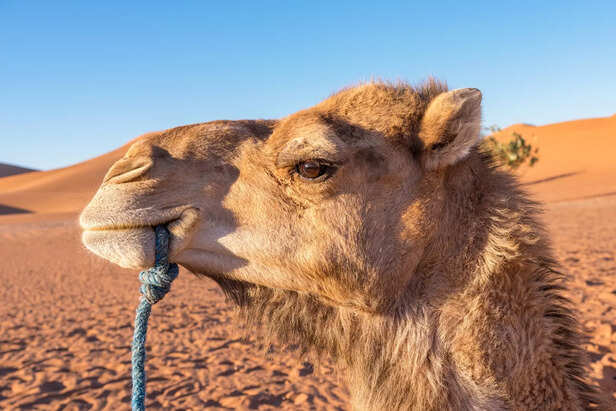
Camel - The ship of the desert
Camels are well suited to their desert habitats, with numerous clever adaptations that help them to tolerate extreme hot and cold environments. Camels are part of a group known as camelids. This makes them close relatives of llamas, alpacas, guanacos and vicuñas, which are all native to South America. There are three species of camels living today and most are domesticated. The one-humped dromedary is found in dry regions in Africa and Asia, including the Sahara Desert and Middle East. The domestic Bactrian camel is found across Central Asia and the wild Bactrian camel is found in remote parts of Mongolia and China and is critically endangered opens in a new window. Domestic and wild Bactrian camels have two humps.
Why do camels have humps?
Camels' humps are often associated with these animals' ability to go for long periods without taking a drink. But they don't store water in them. Instead, their humps are made of fat. Camels are generally found in areas with limited water and vegetation. Their fat store can be converted to energy when they don’t have access to the resources they need to survive. Unlike a lot of other mammals, most of a camel's fat is stored in its humps, which allows for better thermoregulation. It makes it easier for them to release heat from their bodies in hot weather.
How do camels walk on sand without sinking?

Camel walking on golden sand dunes
Sand and other soft surfaces can be tricky to walk on. Sinking into the ground means it takes more effort and energy to take each step. Camels can weigh up to 1,000 kilograms, with males often much larger and heavier than females. Rather than small hooves, camels are equipped with wide snowshoe like feet with two toes. The large size and round shape of their feet help camels to distribute their weight, preventing them from sinking.
Adaptations of camels
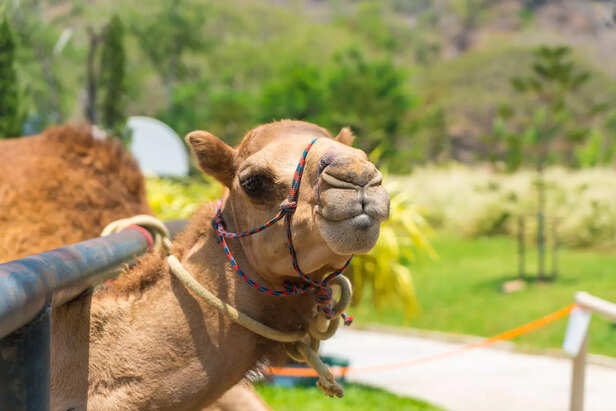
Traditional desert transport: Camel
The camels are the desert animals. These are adapted to survive in harsh hot and dry, water and food deficient environment of the desert. The following are the adaptations found in the camel:
- The camels have large eyelashes which prevents the entry of sand inside the eye.
- A camel can live more than a week without consuming water. They can even survive months without food.
- The camel can store fat in their humps instead of water, which can be metabolized for gaining energy in food scarcity.
- A healthy camel's body temperature fluctuates throughout the day. This helps the camel to conserve water by preventing the sweating as the temperature of the land rises.
- The camel's feet are wide which prevents them from sinking in the sand.
- The camel's have thick lips and large teeth which helps them to cut and eat thorny bushes of deserts scarcity of food.
- The color of the camels helps them to blend with the desert environment and remains undetected from the predators if any.
- The camel's ear consists of hair inside which prevents the entry of the sand inside the ear.
- Camel's have strength and endurance which help them to travel a long distance even in the condition of starvation.
- Camel's body prevents the loss of water through urine and feces.
Frequently asked questions (FAQs)
- What is meant by adaptation of camel ?
Adaptation of camel refers to the special physical and behavioral features that help camels survive in hot, dry desert environments with very little water. - Why is the camel called the ship of the desert ?
The camel is called the ship of the desert because it can travel long distances on sand, carry heavy loads, and survive without water for many days. - How does the camel’s hump help in survival?
The camel’s hump stores fat, not water. This fat provides energy and helps the camel survive when food is scarce in the desert.