A meerkat standing upright on a rock, scanning the horizon, is one of the most recognisable images in wildlife photography. What looks like a single alert animal is actually part of a coordinated system that keeps an entire group alive in one of the harshest environments on earth.
What sentinel duty is
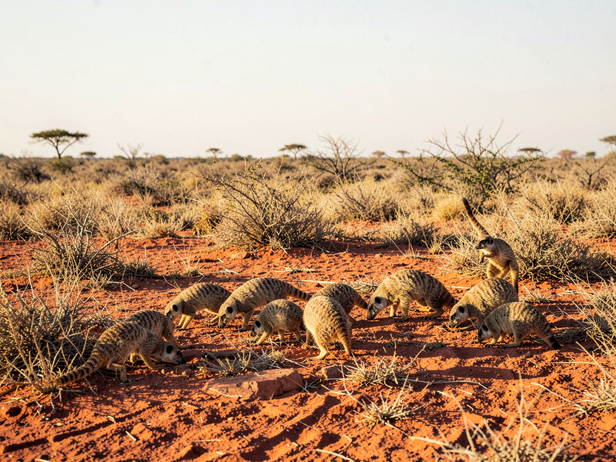
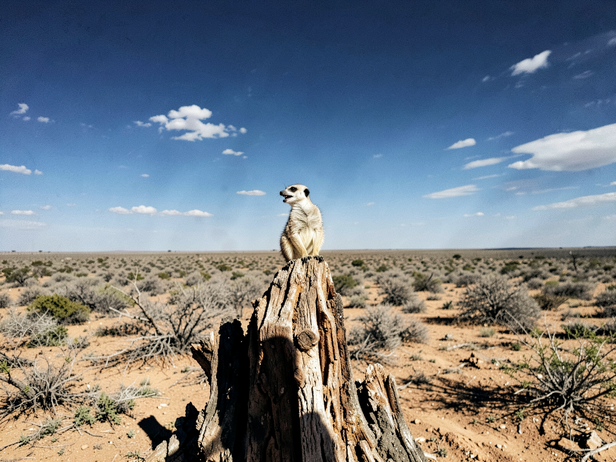
Sentinel duty is the practice of one meerkat, and only one at a time, posting itself at an elevated point while the rest of the group forages, grooms, or tends to pups below. The sentinel's job is to watch for predators: martial eagles and other raptors from above, jackals and cape cobras at ground level. While on watch, the sentinel does not eat. It calls continuously in a soft, low burble that tells the group: all clear. The moment that call stops, every meerkat within earshot freezes or bolts for a burrow.
![Meerkats Forage in Kalahari]()
Meerkats Forage in Kalahari
Image credit : AI
I watch a meerkat sentinel keeping watch over its foraging group in the vast Kalahari scrubland. Their cooperation is vital for survival.
How the rotation works
Sentinels change voluntarily. When one meerkat descends from its post, another typically takes over within a few minutes, often climbing to the same high point. Research on wild meerkats in the Kalahari, where long-term field studies have tracked individually marked animals, shows that most adult group members take sentinel turns across a day, though the frequency varies. Dominant animals do not monopolise the role. Subordinate males and females take watch regularly. What drives the rotation appears to be the individual's own hunger state: a meerkat that has eaten recently is more likely to stand guard than one that is still foraging. The system is self-regulating rather than assigned.
The alarm call system
Meerkat alarm calls carry specific information. Field studies, including work by the Cambridge-based Kalahari Meerkat Project, have documented that meerkats use different calls for aerial versus terrestrial threats, and that call urgency scales with how close and how dangerous the predator is. A distant raptor gets a different call from one diving overhead. The group's response matches: a low-urgency call produces a cautious scan; a high-urgency aerial alarm sends every animal underground in under a second. Pups learn to respond to these calls before they can identify the predators themselves, the call is the instruction.
![Meerkat Sentinel on Duty]()
Meerkat Sentinel on Duty
Image credit : AI
I am a meerkat sentinel, keeping watch over our territory. My alarm calls are crucial for our survival.
Why this counts as cooperative behaviour
Standing sentinel carries a real cost. The sentinel is exposed, cannot eat, and is often the first animal a predator spots. For decades, biologists debated whether the behaviour was genuinely altruistic or whether sentinels were simply positioning themselves to escape fastest. Long-term data from the Kalahari Meerkat Project, which has followed individual meerkats across their lifetimes, supports a more cooperative picture: sentinels do take on real risk, and the group as a whole forages more efficiently and raises more pups successfully when sentinel duty is shared across members. Groups with more participants in the rotation do better than groups where few individuals contribute. The behaviour fits within the framework of kin selection, meerkats live in family groups, so helping relatives survive carries indirect genetic benefit, but reciprocity between less-related group members also plays a role.
What makes meerkats unusual
Many social animals post lookouts. What makes meerkats distinctive is the combination of a graded, information-rich alarm system, voluntary rotation without a dominant animal controlling access to the role, and the degree to which the group's daily routine is structured around the sentinel's calls. Foraging parties move, stop, and change direction in response to sentinel signals. Pup escorts adjust their position. The sentinel is not a passive alarm bell, it is an active coordinator of group movement. This level of functional integration between one individual's behaviour and the rest of the group's activity is what has made meerkats a reference species in the study of animal cooperation. The Kalahari's open terrain, which makes predation pressure constant and visibility high, likely drove the system to the level of sophistication seen today.