The Rajapalayam looks like a dog designed by someone who wanted nothing wasted. Milk-white coat, deep chest, tucked waist, and legs built for covering ground fast, this is a sighthound, and every physical feature follows from that one fact. Bred in the Virudhunagar district of Tamil Nadu to hunt boar and to guard estates, the breed was historically kept by Nayakar royalty and used in the Carnatic Wars. Today it sits on India's list of native breeds worth preserving, and the Army has used it in border patrol. What it has never been is a casual apartment companion.
What the breed was built to do
The Rajapalayam is a coursing dog. It hunts by sight rather than scent, chases at speed, and was bred to work independently rather than wait for a command. That independence is not stubbornness, it is the dog doing exactly what centuries of selection asked of it. In a home, it means the breed thinks for itself, responds to its chosen person with fierce devotion, and views strangers with deep suspicion. One-person loyalty is not a quirk in this breed; it is the design. A Rajapalayam that bonds to you will follow you through the flat. The same dog may never fully accept a visitor it did not meet as a puppy.
What living with one actually looks like
Space matters more than square footage. A Rajapalayam in a Bengaluru flat can manage if it gets two long runs a day, not a walk around the block, but a genuine run in a secured area. Without that outlet, the breed becomes restless and difficult. The lean build means it feels the cold, and a dog sleeping on a cool marble floor in a hill-station winter needs a bed and a blanket, not just a corner. The short white coat sheds moderately and needs almost no grooming beyond a weekly wipe-down, which is one of the breed's genuine practical advantages for a busy owner.
Food intake for a sighthound surprises people. The Rajapalayam carries almost no fat reserves, so its ribs are visible even at a healthy weight. This is normal for the breed. Overfeeding to fill out the silhouette causes joint stress in a dog whose frame was never designed to carry extra weight. A vet familiar with sighthound physiology is worth finding before you bring one home, because standard weight charts built around Labradors and Indies do not apply here.
Socialisation and the single-owner tendency
The window for socialisation in any dog is roughly the first sixteen weeks. In a Rajapalayam, missing that window has lasting consequences. A puppy that meets children, other dogs, motorcycles, autorickshaws, and strangers during those weeks has a chance of growing into a dog that tolerates the world. A puppy that does not will be wary of everything unfamiliar for the rest of its life, and wariness in a large, fast, prey-driven dog is a management problem. This is not a breed for someone who wants to figure it out as they go. The socialisation work has to happen early and deliberately.
The breed's loyalty to one person means it does not transfer well. A Rajapalayam rehomed as an adult often struggles to bond with a new owner in the way it bonded with the first. This is worth understanding before acquisition, not after.
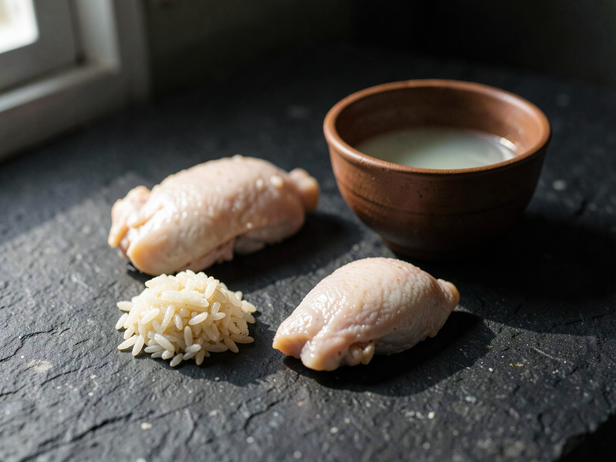
![Lean Dog Meal Prep]()
Lean Dog Meal Prep
Image credit : AI
Crafting a wholesome meal for my Rajapalayam dog, featuring lean chicken and rice. Essential nutrition for my sighthound.
Health predispositions to know
The Rajapalayam carries a known predisposition to deafness, particularly in dogs with the classic milk-white coat and pink-tinted skin. The pigmentation gene associated with the white coat is linked to reduced inner-ear melanocytes in some lines, which affects hearing. Reputable breeders test for this; ask before you buy. A deaf dog is not unmanageable, but it requires different training approaches and a securely fenced environment, because a dog that cannot hear a recall command cannot be trusted off-lead in an open space.
The breed is also prone to skin sensitivity. The pale, lightly pigmented skin burns in direct midday sun, and some dogs develop contact reactions to synthetic surfaces or harsh cleaning products. Hip dysplasia appears in the breed, as it does in most large dogs, and the deep chest creates a predisposition to bloat, gastric dilatation-volvulus, which is a veterinary emergency. Any Rajapalayam that shows a distended abdomen, repeated unproductive retching, or sudden restlessness after eating needs to reach a vet immediately, not the next morning.
Is this breed right for your home
The Rajapalayam suits someone who has kept dogs before, has space for a dog that needs real exercise, and wants a deeply loyal animal that will not perform affection for every person who walks through the door. It does not suit a first-time owner in a small flat with no access to a secure running area, or a household where the dog will be left alone for most of the day. The breed's rarity means finding a responsible breeder takes effort; the Kennel Club of India maintains breed records and is the starting point for tracing legitimate lines.
What the Rajapalayam asks for is not complicated: room to run, a person to attach to, and the socialisation work done early enough to matter. Give it those things, and you have a dog that will guard your home without being asked and stay beside you without needing to be told.