Most first-time fishkeepers lose their earliest fish not to bad luck but to a mismatch between what the fish needs and what the tank provides. Mollies and platies survive that learning curve better than almost any other aquarium fish, which is why they appear in community tanks from Mumbai to Chennai and in every beginner guide written in the last fifty years. They share a family and a feeding style, but they are not the same fish, and knowing the difference will save you from the one mistake that trips up most new owners.
What makes a livebearer different from other aquarium fish
Mollies and platies belong to the family Poeciliidae. Instead of laying eggs that hatch outside the body, the female carries fertilised eggs internally and gives birth to free-swimming fry. A single mating can produce multiple batches of young over several months because the female stores sperm. This means a tank with one female and no male can still produce fry if she was with a male before you bought her. It also means a mixed group will breed without any effort on your part, which is either a delight or a problem depending on how much tank space you have. The fry are large enough at birth to eat crushed flake food and to hide in plants, so some survive even without a separate breeding tank.
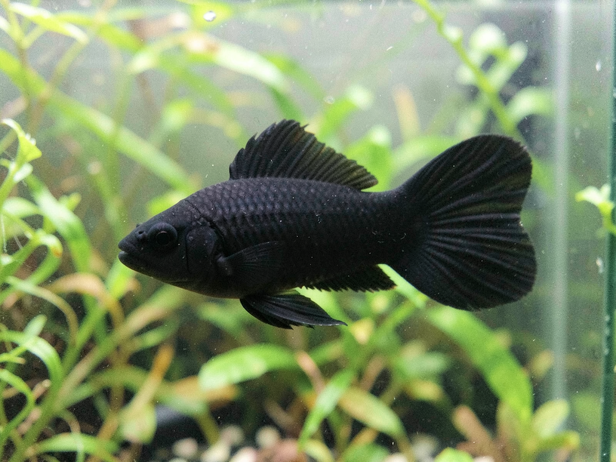
![Sailfin Molly Portrait]()
Sailfin Molly Portrait
Image credit : AI
This sailfin molly, a popular livebearer aquarium fish, displays its magnificent fin. Perfect for beginner tanks.
Mollies: what they need and what they will not forgive
The common molly sold in Indian fish shops is usually a selectively bred form of Poecilia sphenops or the sailfin Poecilia latipinna. Wild mollies live in brackish coastal waters in Central America, and that ancestry matters. They do best in water with a pH between 7.5 and 8.5 and tolerate a small amount of aquarium salt, roughly half a teaspoon per ten litres, though a freshwater setup without salt is fine if the pH stays on the alkaline side. Soft, acidic water is where mollies struggle and where new owners most often lose them. Temperature between 24 and 28 degrees Celsius suits them well. They are active swimmers and need horizontal space more than depth, so a tank of at least 60 litres works for a small group. Mollies are omnivores that graze on algae throughout the day. A diet of quality flake food supplemented with blanched spinach or spirulina wafers keeps them healthy and reduces the algae problem in the tank at the same time. Males are smaller and have a modified anal fin called a gonopodium; females are rounder and noticeably larger. Keep two females for every male to prevent a single female from being harassed constantly.
Platies: the more forgiving of the two
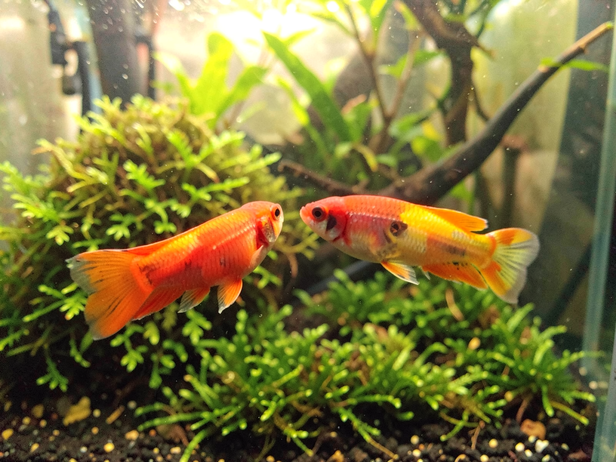
Platies, Xiphophorus maculatus and the related X. variatus, come from slow-moving freshwater streams in Mexico and Central America. They tolerate a broader pH range than mollies, roughly 7.0 to 8.0, and are more comfortable in the moderately soft to moderately hard water that comes out of taps in most Indian cities without adjustment. Temperature between 22 and 28 degrees Celsius suits them, and the lower end of that range means they handle the cooler months in cities like Pune or Delhi without a heater set to maximum. A group of six platies is comfortable in a 40-litre tank, making them one of the few fish that work in the smaller aquariums common in Indian flats. They eat the same varied diet as mollies and will accept flake, frozen bloodworm, and vegetable matter without complaint. The same two-females-to-one-male ratio applies. Platies come in more colour forms than almost any other aquarium fish, and Indian fish shops typically carry sunset, red wag, blue mirror, and marigold varieties, often without labelling them by variety name.
![Vibrant Platy Fish Swim]()
Vibrant Platy Fish Swim
Image credit : AI
These livebearer aquarium fish, platies, add vibrant color to any planted tank. Perfect for beginners!
Keeping them together and choosing tank mates
Mollies and platies coexist peacefully and can share a tank without any compatibility problem. Both species are active in the middle and upper water column, so pairing them with a bottom-dweller like a corydoras catfish gives the tank visual depth and puts the lower level to use. Avoid fin-nipping species such as tiger barbs, which will target the flowing fins of male mollies in particular. Guppies work well with both, though adding guppies to a tank that already has mollies and platies means managing three livebearer populations at once. Tetras, danios, and rasboras are reliable community choices that do not compete with livebearers for space or resources. One practical note for Indian flat-dwellers: both species handle the temperature fluctuations that come with an inconsistent power supply better than more delicate fish, but a reliable heater and a thermometer are still worth the investment. If a molly or platy sits at the surface gasping, hangs near the heater, or loses colour and stops eating for more than a day, those are signs to check water parameters with a test kit and, if the readings are within normal range, to consult an aquarium specialist or a vet with fish experience rather than guessing at a treatment.
Controlling the population
Both species breed readily, and a tank that starts with six fish can hold thirty within a few months if fry are not managed. Dense planting with java moss or hornwort gives fry hiding places and raises survival rates, which is helpful if you want to grow them out but counterproductive if you are already at capacity. Separating pregnant females into a breeding box before they give birth and then removing the fry to a grow-out container is the most reliable method. Feeding fry to larger fish in a separate tank is a common and practical solution that experienced fishkeepers use without difficulty. The alternative is to keep a single-sex group, though this removes one of the most interesting behaviours these fish display. Mollies and platies reward patience. A well-maintained tank with a balanced group, stable water, and a varied diet will show natural behaviour, genuine colour, and, in the case of sailfin mollies, the full dorsal display that makes the fish worth keeping in the first place.