
Meet the Indian Grey Hornbill, India’s Quiet Forest Guardian
Upasna Yadav | Jan 11, 2026, 14:14 IST

The Majestic Grey Hornbill
The Indian grey hornbill has grey feathers, a black-and-yellow bill, red iris, and beautiful eyelashes. Males have a larger casque than females. Measuring around 55-70 cm, the Indian grey hornbill is one of nine species of hornbills found in India. t has an ashy, silvery-grey body, with long tail feathers that end in a band of white. This hornbill has a curved ivory-colored beak that is long, blackish at the base, and has a sharp, narrow protruding casque. Male and female birds look very similar, though the female is slightly smaller and has a less prominent casque.
Highlights
1. If you see an Indian grey hornbill, notice their beautiful eyelashes. I especially love to watch it in flight when it beats its wings for a short while and then glides, and almost dives into a fruit-laden fig tree.
2. The Indian gray hornbill is a common hornbill found on the Indian subcontinent. It is mostly arboreal and is commonly sighted in pairs.
3. If a hornbill is seen flying over or visiting their residences, it said that good luck fortune will bestow the community.
2. The Indian gray hornbill is a common hornbill found on the Indian subcontinent. It is mostly arboreal and is commonly sighted in pairs.
3. If a hornbill is seen flying over or visiting their residences, it said that good luck fortune will bestow the community.
Why the Indian Grey Hornbill Matters ?
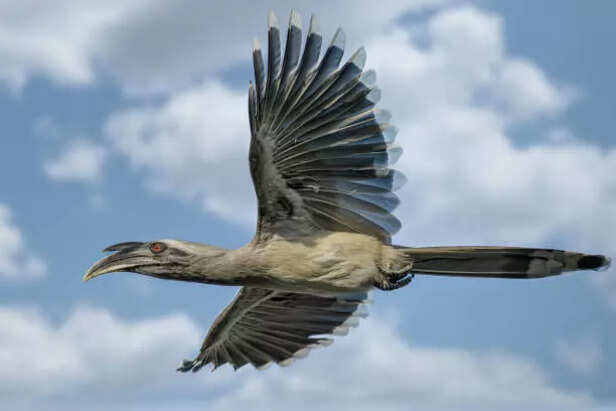
Grey hornbill in flight
When people think of hornbills, they usually imagine the striking great hornbill with its bright yellow casque. However, the Indian grey hornbill is just as impressive, even if it’s often ignored. Unlike its more colorful relatives, the grey hornbill dons a simple look with ash-grey feathers and a noticeable yet understated casque. It is also one of the most adaptable hornbills that can be found in forests, agricultural fields, and scrublands, and even in urban locales throughout India. Did you know that the Indian grey hornbill is also the state bird of Chandigarh? It is a wonderful way to honor the bird that sustains the health of green landscapes, weaving its significance into the country’s natural heritage.
About the Nesting of hornbill
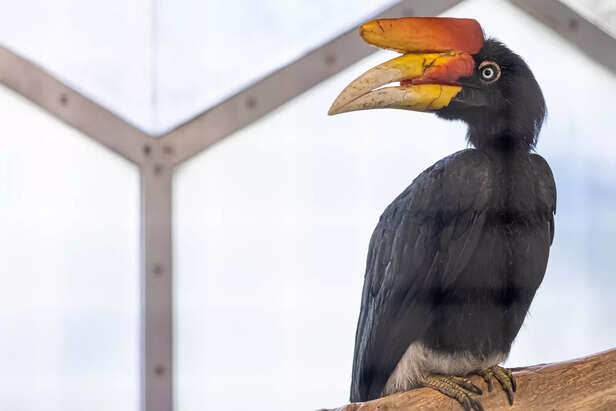
Unique nesting habits
The nesting season of the Indian grey hornbill is between February and June. During this time, the male feeds the female, who seals herself in the hollow of a tree. Small cavities on trees serve as a nest for a pair of breeding Indian grey hornbills. Hornbills rely on existing holes in trees because they cannot build their own nests or dig up cavities. They seem to be quite adaptable when choosing a nest cavity. Their nests can be seen on a range of trees which have cavities, from tall thin coconut trees to large raintrees or mango trees. I was surprised to also see them regularly using artificial nest boxes fixed up on trees. Recently, there have been increasing instances of hornbills using holes in buildings for nesting. I think it is a signal for humans in cities to protect trees in their concrete jungles.
The Grey hornbill diet
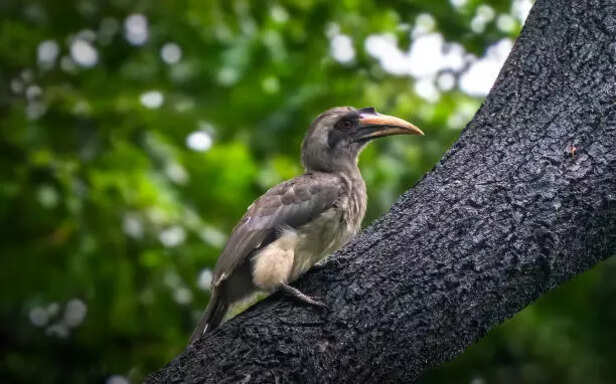
The grey hornbill and its diet
Indian grey hornbills feast on ripe fleshy figs and juicy berries. They are fruit-lovers but also feed on a variety of animals — from insects, to reptiles and rodents. The huge old fig trees along the roadsides in some cities are a favorite stopover for them in the fruiting season. They also feed on jamun and neem fruits, and berries of the false Ashoka trees which are common trees along fences in urban gardens. It amuses me when I see them feeding on the papaya fruit near my house. They are active hunters too, going after lizards, frogs and mice, and also preying on young chicks from other birds’ nests. Indian grey hornbills are mostly seen in pairs, but also seen in small flocks when there is a fruit party on a banyan tree.
Some interesting facts about hornbill
Dustbathing removes the excess oil from the hornbill’s feathers, keeping them in top condition. It also helps get rid of parasites. These birds are nature’s green engineers in the true sense. They play an important role in dispersing seeds of various trees across large spaces. As urbanization increases, frugivores and dispersers such as Indian grey hornbills are of utmost importance in ensuring the natural cycle of trees in urban spaces. Though widely distributed in India, the Indian grey hornbill faces many threats. The foremost threat is the loss of trees for nesting and foraging. The species is adapting to eating exotic fruits and has even succumbed to human-assisted food such as chapati and savory fried snacks but that is no excuse to degrade their natural habitat any further.
Their continued presence indicates the quality or health of our surrounding environment and we should protect them for our own betterment. In fact, we have an opportunity to make our urban spaces friendly for such species by planting their food plants in our surroundings.
Celebrate the bond with your pets, explore Health & Nutrition, discover Breeds, master Training Tips, Behavior Decoder, and set out on exciting Travel Tails with Times Pets!
Frequently asked questions (FAQs)
- Are grey hornbill endangered ?
The Grey Hornbill is not currently listed as endangered. However, they are facing threats from habitat loss and deforestation, which can impact their populations. - Where do Grey hornbills live ?
Grey Hornbills are native to the Indian subcontinent. They are commonly found in India, Nepal, Bangladesh, and Sri Lanka, inhabiting a variety of forest types. - What is the scientific name of the Indian grey hornbill?
The scientific name of the Indian grey hornbill is Ocyceros birostris. - Why this bird us important?
Grey Hornbills help in seed dispersal, which supports forest growth and maintains ecological balance