
Indian Roller: The Colorful Bird of India Folklore
Upasna Yadav | Feb 18, 2026, 09:30 IST

Bird With Brilliant Blue Wings
The Indian roller occurs widely from West Asia to the Indian subcontinent. Often found perched on roadside trees and wires, it is common in open grassland and scrub forest habitats, and has adapted well to human-modified landscapes. It mainly feeds on insects, especially beetles. The species is best known for the aerobatic displays of males during the breeding season. The roller is the state bird of three Indian states. It is listed as a species of least concern on the IUCN.
Highlights
1. The Indian roller is a bird of open grasslands and scrub forests, resident all over India, and doesn’t mind staying in human-modified habitats: gardens, orchards, and fields.
2. Indian rollers have even been spotted diving for fish something that could cause a good deal of confusion for a newbie birder whose first reaction, not unexpectedly, would be to think it’s a kingfisher! And indeed, the roller does dive rather like the kingfisher, even if it doesn’t fly like one.
3. The Indian Roller bird, also known as the Blue Jay or Neelkanth, is believed to be associated with Lord Shiva, and it is often depicted perched on Lord Shiva's shoulder. Its distinctive blue color is arguably considered symbolic of divinity and power.
2. Indian rollers have even been spotted diving for fish something that could cause a good deal of confusion for a newbie birder whose first reaction, not unexpectedly, would be to think it’s a kingfisher! And indeed, the roller does dive rather like the kingfisher, even if it doesn’t fly like one.
3. The Indian Roller bird, also known as the Blue Jay or Neelkanth, is believed to be associated with Lord Shiva, and it is often depicted perched on Lord Shiva's shoulder. Its distinctive blue color is arguably considered symbolic of divinity and power.
Differences from other species
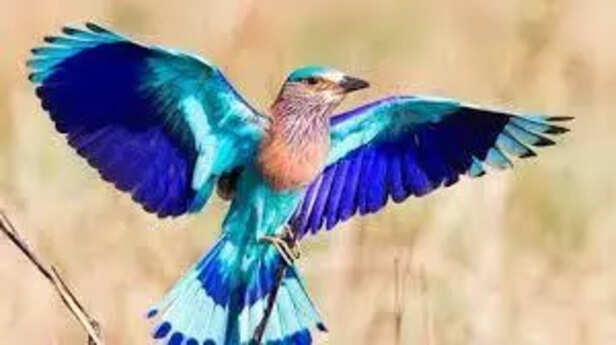
Indian Roller Perched in Natural Habitat
At a distance the species can be mistaken for the European roller, which is a migrant through parts of the Indian roller's range. The European roller has a longer neck and tail in flight, as well as black primaries and an all-blue head. The Indochinese roller is darker, larger and has a purplish brown and streaked face and breast, and blue-green forehead. The underwing coverts are a deeper shade of blue. Its call is higher-pitched and has a more nasal sound. But the face and throat of Indian roller are pinkish, the head and back are brown, with blue on the rump and contrasting light and dark blue on the wings and tail. The bright blue markings on the wing are prominent in flight. Two subspecies are recognized.
Cultural and socio-religious significance
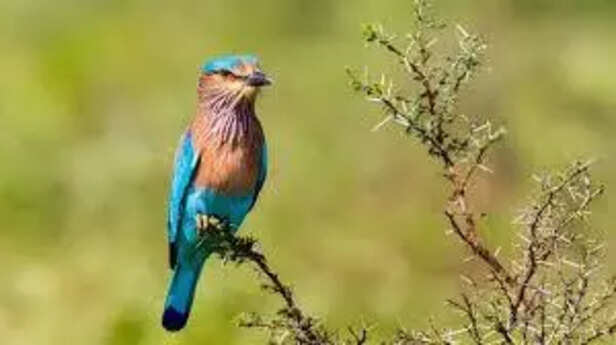
Indian Roller Bird in Mythology and Culture
Across India the bird features strongly in folklore and religion. It is called Neelkanth (blue-throated) and associated with deities such as Shiva and Vishnu; spotting the bird during auspicious days like Dussehra is widely considered a good omen. In several regions traditional beliefs attribute benefits to the bird or its feathers examples include using feathers in rituals or folk remedies. The species is also a state bird in some states (e.g., Telangana/Odisha/Karnataka), which highlights its cultural prominence.
Harmful religious/festival practices and their impacts
Several culturally rooted practices around festivals and superstitions are actively harming individual birds and, cumulatively, local populations. During Dussehra and related observances, people sometimes attempt to catch Indian rollers because seeing one is considered very lucky. Reports document birds being captured, having wings glued or bound, or feet tied, often causing injury, inability to forage or fly, and death. These captures are sometimes public and repeated each year Use of feathers or body parts in folk remedies such as adding feather fragments to cattle fodder due to beliefs about increasing milk have historically encouraged handling or killing of birds for body parts.
Legal status and conservation context
The Indian roller is currently listed as Least Concern on the IUCN Red List, and its overall range remains large; Bird Life notes populations are stable or even expanding in some altered landscapes. However, the species is protected by Indian law (it is listed under schedules of the Wildlife (Protection) Act), meaning capture and trade are illegal without permission. Local, repeated illegal capture and killing during festivals therefore represent both a conservation threat and a legal violation.
Plumage
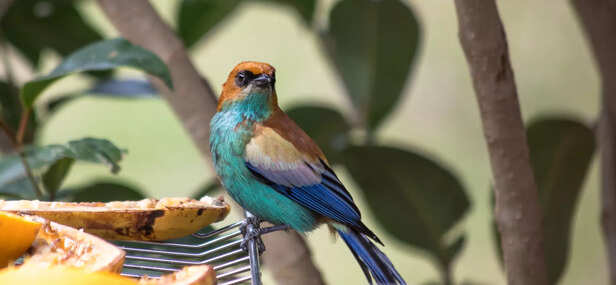
Indian Roller in Mid-Flight Showing Blue Plumage
The plumage on the forehead, chin and lore are pinkish buff, the ear coverts are darker red-brown with pale cream or pinkish streaks, while the throat is a dull wine-red with narrow cream streaks. The crown and nape are a darker dull turquoise. The back and rump are a bright turquoise, and the belly is pale blue. The tail coverts are dark purple-blue with turquoise tips. The middle two tail feathers are greyish blue-olive with black shafts, while the surrounding tail feathers are an intense purple-blue with a broad pale blue band and greenish tinge towards the tips. The flight feathers on the wings have the same purple-blue color of those on the tail, with a similar pale blue band across the most distal five or six primaries.
Behavior and ecology
The Indian roller is generally not very gregarious and is usually found alone or in pairs. It is often territorial, though migrants may forage in flocks with no aggression. They patrol their territory by flying at treetop height or three-stories high and when an intruder is spotted, they drive it away by a fast rolling flight. Its migration patterns are not well understood; in Oman they are present year-round but appear to be more common in winter than summer.
Celebrate the bond with your pets, explore Health & Nutrition, discover Breeds, master Training Tips, Behavior Decoder, and set out on exciting Travel Tails with Times Pets!
Frequently asked questions (FAQs)
- Why is the Indian Roller called Neelkanth?
The Indian Roller is called Neelkanth because of its striking blue feathers, especially visible during flight. In Indian folklore, the name symbolizes purity, divinity, and a connection to Lord Krishna. - What is the cultural significance of the Indian Roller in India?
The Indian Roller holds an important place in Indian folklore and mythology. It is considered a symbol of good luck, prosperity, and protection, and is traditionally sighted during festivals like Dussehra. - Why is the Indian Roller the state bird of Karnataka?
The Indian Roller was chosen as Karnataka’s state bird because of its distinctive colors, cultural value, and widespread presence in the region.