
Gouldian Finch: A Most Attractive and Colorful Bird You won't Believe Exist
Upasna Yadav | Mar 24, 2026, 13:04 IST

Vibrant Rainbow Colors of the Gouldian Finch
For such a small bird, the Gouldian finch inspires a huge number of questions. This passerine, native to northern Australia, averages just six inches long, but can count itself among the most colorful birds around, with its brilliant and distinctive blocked pattern: green wings, bright purple chest, yellow belly, and turquoise headband. But perhaps the most interesting, and definitely the most telling, characteristic of this species is its head color.
Highlights
1. In wild populations, there are three possible head color variations, or “morphs”—black, yellow, and red—and how these birds have these unique features.
2. A brilliantly colorful, unmistakable bird with vivid green back, yellow belly, purple chest, blue nape, black throat, and very pale bill; face may be red, yellow or black. Juvenile dull olive above, pale below, with paler bill than most other small finch-like birds. Feeds on the ground; when disturbed, flushes into trees, showing a flash of bright green backs.
3. A lot of genetic coordination and several different cellular processes go into the Gouldian finch's extravagant coloration. To start, their six colors come from a number of different sources.
2. A brilliantly colorful, unmistakable bird with vivid green back, yellow belly, purple chest, blue nape, black throat, and very pale bill; face may be red, yellow or black. Juvenile dull olive above, pale below, with paler bill than most other small finch-like birds. Feeds on the ground; when disturbed, flushes into trees, showing a flash of bright green backs.
3. A lot of genetic coordination and several different cellular processes go into the Gouldian finch's extravagant coloration. To start, their six colors come from a number of different sources.
How rare a Gouldian Finch ?
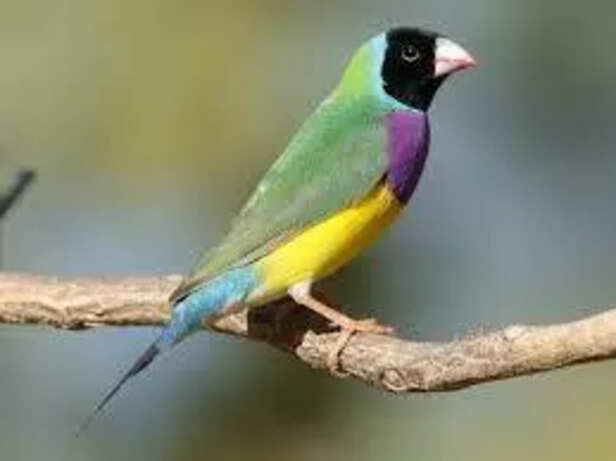
Gouldian Finch Sitting Gracefully on a Branch
Gouldian Finches are Australia's most spectacularly colored grass finches, and are perhaps the most spectacularly colored of all Australian birds. They are small birds, with a bright green back, yellow belly and a purple breast. The facial color is usually black, and is found in about 75% of the birds. Red-faced forms make up about 25% of the population, and rare, yellow-faced birds occur from time to time. The yellow color results from a lack of red pigment in the red-faced birds. The males are brighter in plumage than the females. Young Gouldian Finches are dull ashy grey on the head and hind neck, becoming olive on the back and tail. The underparts are brown white, paler on chin, and have a faint yellow tinge on the belly. The upper bill is blackish and the lower bill is pinkish white. The end of the beak is tipped with red and there are pale nodules on the gape.
Where do Gouldian Finches live?
Close-Up of a Gouldian Finch’s Bright Plumage
Habitat
As with most other grass finch species, the Gouldian Finch is seldom found far from water, and needs to drink several times during the day. Throughout its range the species inhabits the edges of mangroves and thickets, and savannas dotted with trees.
Distribution
The Gouldian Finch is patchily distributed in tropical northern sub-coastal areas from Derby, Western Australia, to the Gulf of Carpentaria and thinly to central Cape York Peninsula, but is locally common in the north and north-western parts of its range.
Seasonality
Outside the breeding season the Gouldian Finch is partly migratory. Birds move in quite large flocks to more coastal areas and return back inland to breed when the rainy season arrives.
Feeding and diet
For most of the year Gouldian Finches feed mostly on ripe or half-ripe grass seeds. During the breeding season, however, the diet consists almost entirely of insects. Insects are rich in protein and help satisfy the demanding appetite of the young birds. Birds feed in small to large groups, and food may be taken on the ground or in flight.
Color Sources
A lot of genetic coordination and several different cellular processes go into the Gouldian finch’s extravagant coloration. To start, their six colors come from a number of different sources. For example, finches acquire their red and yellow colors from their diet, which consists of grass seeds, particularly sorghum. These foods contain red-hued carotenoid pigments that are absorbed by the bird’s fatty tissues and expressed in its feathers. The blues we see are structural colors, which are expressed when light is reflected through nanostructures within the feather. Greens and purples are a combination of blue structural colors and carotenoid pigments. Finally, black is the result of melanin pigment, produced by the skin cells as the feathers grow. Whether or not melanin is produced is determined by a recessive sex-linked gene. When present, melanin completely masks the carotenoid pigments.
Celebrate the bond with your pets, explore Health & Nutrition, discover Breeds, master Training Tips, Behavior Decoder, and set out on exciting Travel Tails with Times Pets!
Frequently asked questions (FAQs)
- What is the ideal cage setup for a Gouldian Finch?
A spacious cage with good ventilation, natural perches, and enough room for flying is ideal. Adding plants and safe toys helps mimic their natural habitat. - Are Gouldian Finches noisy birds?
No, they are relatively quiet birds. Their soft chirping is pleasant and not disturbing, making them suitable for indoor living. - How can you tell male and female Gouldian Finches apart?
Male Gouldian Finches usually have brighter and more vibrant colors, while females have slightly duller shades. Males are also more active in displaying behavior.