A black cat that spends its days stretched across a sunny windowsill can develop a coat that looks more chocolate or rust than jet black, usually along the spine and flanks where the light hits hardest. The change is gradual enough that many owners assume the cat was always a dark brown, until a photograph from a few months ago proves otherwise.
The pigment behind the colour
Black fur gets its colour from eumelanin, a form of melanin produced by cells called melanocytes in the hair follicle. Eumelanin comes in two structural forms: a dense, tightly packed version that reads as true black, and a less dense version that reads as brown or dark grey. In a genetically black cat, the dense form dominates, but it is chemically vulnerable in a way that lighter pigments are not.
![Fur Texture Study]()
Fur Texture Study
Image credit : AI
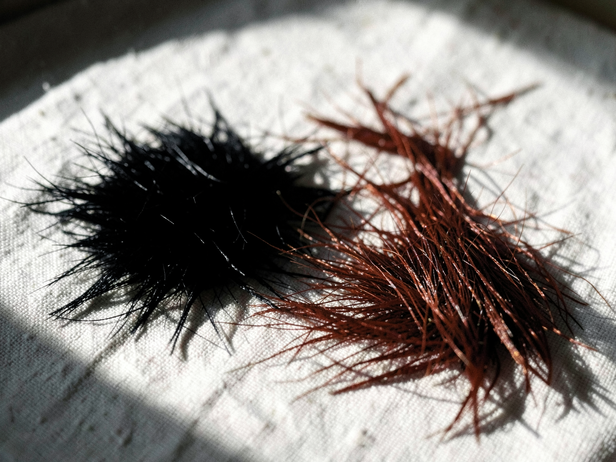
Examining the subtle shift in black cat fur turning rusty under light. Eumelanin plays a role.
What sunlight actually does to the hair shaft
Ultraviolet light breaks the chemical bonds that hold eumelanin molecules together. This process is called photooxidation, and it is the same mechanism that bleaches dark human hair in summer. In a cat's coat, repeated UV exposure degrades the eumelanin in the outer portion of each hair shaft, shifting its absorption of light toward the red and brown end of the spectrum. The result is the rusty or reddish-brown tinge owners notice, sometimes called rusting. The hair itself is not damaged in any structural sense, it is simply carrying less functional pigment than it did before the sun got to it.
Tyrosine and diet: a second factor
Rusting can also appear in cats that have limited access to sunlight, and here the cause is different. Eumelanin synthesis depends on the amino acid tyrosine. When a cat's diet is low in tyrosine, or low in phenylalanine, the precursor the body converts into tyrosine, the melanocytes produce less pigment per hair shaft, and the coat drifts toward brown. This is why some black cats on nutritionally incomplete diets show rusting even if they never sit near a window. A commercially complete cat food formulated for the species should supply adequate tyrosine; homemade or restricted diets are the more common culprit when diet is the driver.
![Kibble and Herbs Still Life]()
Kibble and Herbs Still Life
Image credit : AI
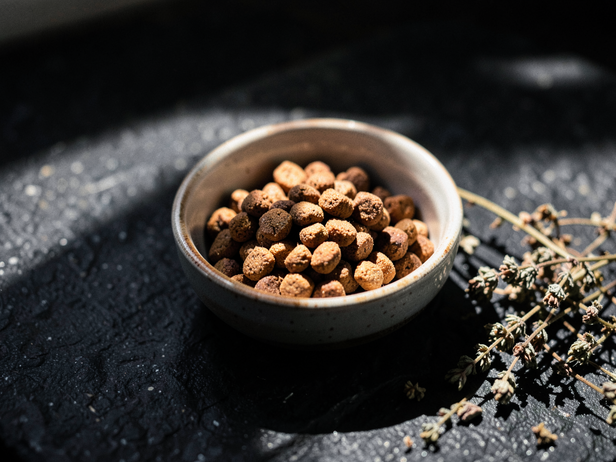
Examining the subtle grain and natural color of kibble, a hint of dried herbs beside it.
The tabby pattern underneath
Many black cats carry a tabby gene that is suppressed by a separate gene called the agouti inhibitor. Rusting from any cause can make the underlying tabby striping faintly visible, particularly in raking light. This is sometimes called ghost striping, and it is not a sign of mixed parentage or a coat disorder, it is the tabby pattern that was always there, briefly legible because the black pigment no longer fully masks it.
When rusting is worth a vet check
Sun-related rusting is cosmetic and reverses on its own as the coat grows out, usually within one or two shedding cycles once UV exposure is reduced. Diet-related rusting resolves when the nutritional gap is corrected. Rusting that appears suddenly in a cat with no change in sun exposure or diet, or that comes with dull, brittle fur, weight loss, or changes in drinking and urination, is worth raising with a vet. Liver and kidney conditions can affect coat pigmentation and condition, and those warrant a proper look rather than a wait-and-see approach. A coat that is changing in texture as well as colour tells a different story than one that is simply a little sun-kissed.