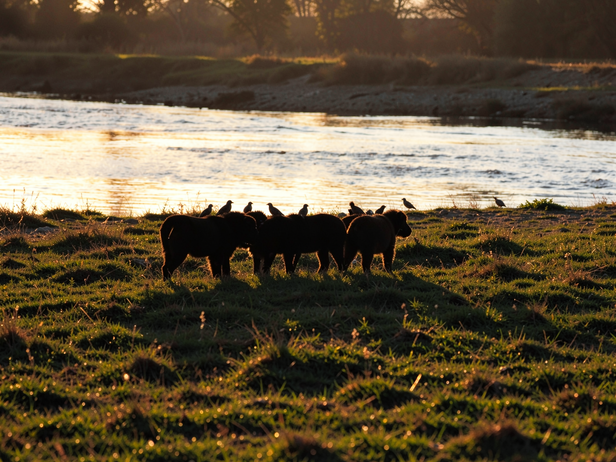
A caiman rests its jaw on a capybara's back. A dozen birds queue along its spine. A monkey grooms its fur. The capybara does not move. This is not a trained animal or a lucky photograph, it is a pattern documented consistently across the wetlands and grasslands of South America, and it has a real explanation.
The world's largest rodent, by some distance
The capybara (Hydrochoerus hydrochaeris) is the largest living rodent on Earth, weighing between 35 and 65 kilograms at maturity, with some individuals recorded heavier. It is native to South America, ranging from Venezuela and Colombia south through Brazil, Peru, and Argentina, always close to water. Despite the size, it is unmistakably a rodent: continuously growing incisors, a barrel-shaped body, and a digestive system built around fermenting tough grasses. Its closest relatives are guinea pigs and rock cavies, which gives some sense of how far the rodent body plan can scale when the ecological conditions allow it.
![Wetland Dawn Awakening]()
Wetland Dawn Awakening
Image credit : AI
I witness a capybara, the world's largest rodent, at the water's edge as dawn breaks over the wetland.
Why so many other animals tolerate them, and use them
The capybara's reputation as a universal companion has two separate explanations that are often collapsed into one. The first is what the capybara offers other species. Its large, warm body is a reliable perching and grooming platform for birds, particularly yellow-headed caracaras and cowbirds, which pick ticks and insects from its skin. This is a straightforward mutualism: the birds get a meal, the capybara gets parasite removal. The capybara's calm response to this is not unusual, most large mammals tolerate oxpeckers and similar birds for the same reason.
The second explanation is more interesting. Capybaras appear to have a genuinely low threat-response threshold around species that are not actively hunting them. Caimans, South American crocodilians, share waterholes with capybara herds, and while caimans do occasionally take young or isolated capybaras, adult capybaras in a group do not flee at caiman proximity the way a prey animal might be expected to. Researchers studying capybara behaviour note that the animals calibrate their alarm responses carefully. They do not treat every predator-adjacent species as an immediate threat. This is not naivety. It is a form of risk assessment: the energy cost of constant flight is high, and a large herd of adults is genuinely difficult for a caiman to target successfully.
The social structure that makes it work
Capybaras are intensely social animals. They live in groups of ten to thirty individuals, sometimes larger in the dry season when waterholes concentrate both animals and the predators that follow them. The group structure has a clear hierarchy, but it is not aggressive in the way primate or canid hierarchies can be. Dominant males maintain position through scent-marking and posturing rather than sustained fighting. The result is a herd that is cohesive, relatively calm, and collectively alert.
This collective calm is part of what makes the interspecies photographs so consistent. A lone capybara is a nervous animal. A capybara in a group of twenty, near water, in a familiar environment, is operating at a much lower baseline stress level. The birds, the turtles sunning on their backs, the monkeys, these are all happening in conditions where the capybara's threat assessment has already concluded that nothing urgent is happening. The animals are not being friendly. They are being relaxed.
![Golden Hour Riverbank Gathering]()
Golden Hour Riverbank Gathering
Image credit : AI
A serene scene of capybara interspecies friendliness at golden hour, with birds finding rest.
What the research actually says about animal sociality
The capybara has become a symbol on the internet for interspecies harmony, which has led to some overclaiming. Capybaras do not seek out other species for companionship. They do not have an unusual neurological capacity for empathy or bonding across species lines. What they have is a combination of large body size, herd living, semi-aquatic habitat, and a calibrated alarm system that produces, as a side effect, a high tolerance for the presence of other animals in shared spaces.
Studies on capybara stress behaviour, measured through cortisol levels and flight-initiation distance, confirm that they are not uniquely fearless. Isolated capybaras show significant stress responses. Capybaras in unfamiliar environments are skittish. The apparent serenity is a product of context, not temperament. That distinction matters because it tells us something accurate about how social animals manage risk: the group does the threat-monitoring, which frees each individual to be calmer than it could ever be alone.
Capybaras in captivity and as pets
Capybaras are kept in zoos worldwide and are legal to own as pets in some jurisdictions, though regulations vary significantly by country and state. In India, they are not a native species and are subject to import and wildlife regulations; ownership is not straightforward and prospective owners would need to confirm current legal status with the relevant authorities before pursuing it. In zoo settings, capybaras are often housed with other species precisely because their low reactivity makes mixed enclosures manageable. They have been successfully kept alongside tapirs, deer, and various bird species.
What captivity reveals is that the social need is not optional. Capybaras kept alone show chronic stress. They require the presence of at least one other capybara to function well. The interspecies tolerance that makes them internet-famous is a bonus feature of a social system built primarily for their own kind.
The capybara's apparent friendliness is real in the sense that it produces real outcomes, mutualistic relationships, shared spaces, photographs that seem too good to be staged. But the mechanism is evolutionary pragmatism rather than warmth. A large, herd-living herbivore near water, in a stable group, has done the math on every nearby animal and decided that most of them are not worth the energy of a response. That calculation, repeated across millions of years of selection pressure, produced an animal that the internet reads as the world's most agreeable creature. The biology is less poetic and considerably more interesting.