Most people who keep budgies or cockatiels think of them as small, manageable birds that need a cage, some seed, and company. That is not wrong, but it is incomplete. Both species spent millions of years becoming something specific before they ever saw the inside of a flat, and that history is still running inside every bird sitting on a perch in Bengaluru or Mumbai.
Where they come from and what they were built for
The budgerigar, Melopsittacus undulatus, is native to the interior of Australia, the dry scrublands, grasslands, and semi-arid plains that stretch across most of the continent. The cockatiel, Nymphicus hollandicus, shares much of the same range, with a preference for open woodland near water. Neither bird evolved in a lush, food-rich environment. They evolved in a place where rain is unpredictable, food appears in bursts, and survival depends on moving fast and moving together.
Wild budgies are nomadic. They do not hold territories the way many birds do. Instead, they track rainfall across the continent, sometimes covering hundreds of kilometres in a matter of weeks to reach areas where grass has seeded after rain. Flocks can number in the tens of thousands, occasionally more, moving as a single coordinated mass that shifts direction in an instant. Cockatiels are similarly nomadic, though they tend to travel in smaller groups and are more closely tied to watercourses. Both species are built for endurance flight, not perching and waiting.
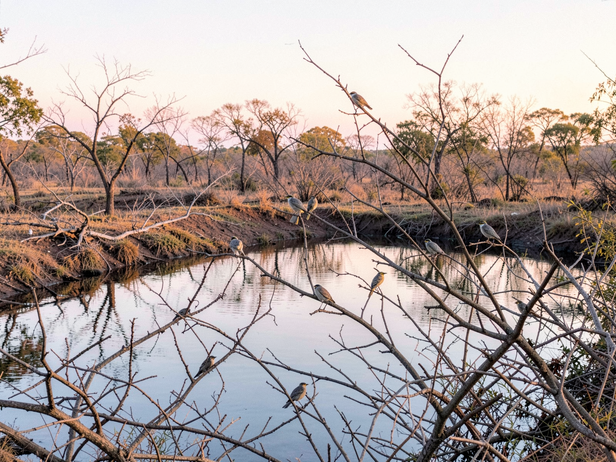
![Outback Dawn Waterhole Serenity]()
Outback Dawn Waterhole Serenity
Image credit : AI
I witness budgerigar social needs met in this serene outback waterhole at dawn, a moment of natural beauty.
How they eat, drink, and survive the heat
In the wild, budgies feed almost entirely on grass seeds, taken from the ground or directly from seed heads. They are highly efficient at processing dry seed and can go without water for longer than most birds of comparable size, though they drink daily when water is available. Cockatiels eat a broader range of foods, grass seeds, grain, berries, and some insects, and are rarely found far from a water source. Both species are crepuscular feeders in the hottest months, active in the early morning and late afternoon and resting in shade during the midday heat.
The Australian interior regularly reaches temperatures above 40°C. Neither bird has the option of retreating to a cool burrow or a dense forest canopy. They manage heat through behaviour, seeking shade, fluffing feathers slightly to trap cooler air near the skin, and reducing activity. This is worth knowing for anyone keeping these birds in an Indian summer, where temperatures in many cities match or exceed the Australian outback. A cage in direct afternoon sun, even through glass, can be genuinely dangerous for both species.
Social structure and what it means for a caged bird
A wild budgie is never alone. The flock is the survival unit. Predator detection, finding food, navigating to water, all of these depend on many eyes and many wings. A lone budgie in the wild is a budgie in serious trouble. The same drive is present in a pet bird. A budgie kept singly and without sufficient interaction will show it: repetitive movements, feather-related problems, persistent loud calling. These are not personality quirks. They are the behaviours of an animal whose social wiring has nowhere to go.
Cockatiels are somewhat more flexible, they form strong pair bonds and are content with a single companion, but they are not solitary animals either. The cockatiel's characteristic contact call, the rising whistle that carries a long distance, is a flock-cohesion sound. In a home, it is directed at the nearest available flock member, which is usually the person in the room. A cockatiel that calls constantly when left alone is doing exactly what its biology asks of it.
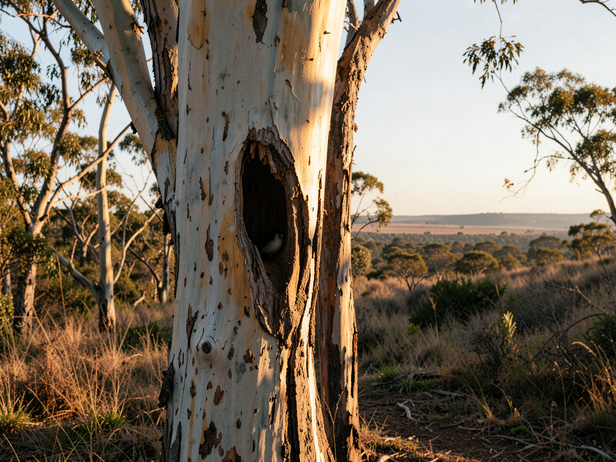
![Eucalyptus Hollow, Golden Hour]()
Eucalyptus Hollow, Golden Hour
Image credit : AI
A lone bird finds shelter in a eucalyptus hollow, a common sight in Australian parrots' natural habitat.
Breeding, nesting, and what triggers it
Wild budgies do not breed on a fixed seasonal calendar the way many birds do. They breed opportunistically, triggered by rainfall and the resulting food abundance. This means a wild budgie's reproductive system is designed to respond to environmental cues, day length, humidity, food availability, the presence of other breeding pairs, rather than a fixed time of year. In captivity, with consistent food, warmth, and artificial light, these cues can be permanently present, which is one reason why pet budgies can breed year-round in a way that wild birds do not and that is not always healthy for the female.
Cockatiels nest in tree hollows, usually in dead eucalyptus near water. Both parents incubate the eggs and feed the chicks. The pair bond is strong enough that a cockatiel that loses a partner will often show a period of reduced activity and appetite before bonding with a new companion. Whether this is grief in the way a human experiences it is a question the research does not yet answer cleanly. What is clear is that the behaviour is real, consistent, and worth taking seriously.
What wild origins mean for a pet bird in an Indian home
The budgerigar and cockatiel are among the most widely kept pet birds in the world, partly because they adapt to captivity more readily than many parrot species. But adapt is not the same as thrive without thought. A bird from a nomadic, high-movement, socially dense environment has needs that a small cage and a mirror do not meet.
The practical implications are straightforward. Both species need space to fly, not just to perch. They need social contact, either from a companion bird or from regular, genuine interaction with the people in the home. They need a diet that goes beyond dry seed alone: fresh vegetables, leafy greens, and occasional fruit give them the nutritional variety their wild diet provides. And they need an owner who reads stillness, fluffing, and changes in call pattern as information, because these birds communicate clearly once you know what you are looking at. The outback shaped them into animals that are alert, social, and always moving. The best a home environment can do is give that somewhere to go.