The Rampur Greyhound does not announce itself. It stands quietly at the edge of the room, watching, and then moves across the floor in a way that makes you understand, immediately, that this animal was built for something other than apartment life.
Bred in the court of the Nawab of Rampur in what is now Uttar Pradesh, probably from Afghan Hound and native Indian sighthound stock crossed with English Greyhound, this breed was the hunting companion of Mughal-era nobility. Its job was to course deer, wild boar, and jackals across open ground, not to retrieve, not to herd, not to guard, but to run down prey at speed and hold it. That original purpose shapes everything about the dog you are considering bringing home today.
What the breed was built to do
The Rampur Greyhound is a sighthound, which means it hunts by sight rather than scent. Sighthounds are wired to spot movement at distance and respond to it with explosive acceleration before the thinking brain has a chance to intervene. This is not a training failure. It is the breed's core function, refined over centuries. A Rampur Greyhound can reach speeds close to 65 kilometres per hour in a short burst, making it one of the fastest dog breeds in India.
The body is built for exactly this: a deep chest for lung capacity, a tucked abdomen, long legs with a flexible spine that acts as a spring, and very little body fat. That last detail matters practically. Low body fat means this dog is sensitive to cold, cannot tolerate anaesthesia the same way a heavier breed does, and bruises and cuts more visibly than a dog with a denser coat and more subcutaneous fat.
The breed's working history also explains its temperament. A dog bred to course independently, making split-second decisions in open terrain without waiting for a handler's instruction, is not going to be the eager-to-please, eye-contact-seeking companion that a Labrador is. Rampurs are loyal to their people but reserved with strangers, sometimes aloof, and capable of long stretches of apparent indifference followed by short bursts of intense play. They are not cold. They are selective.
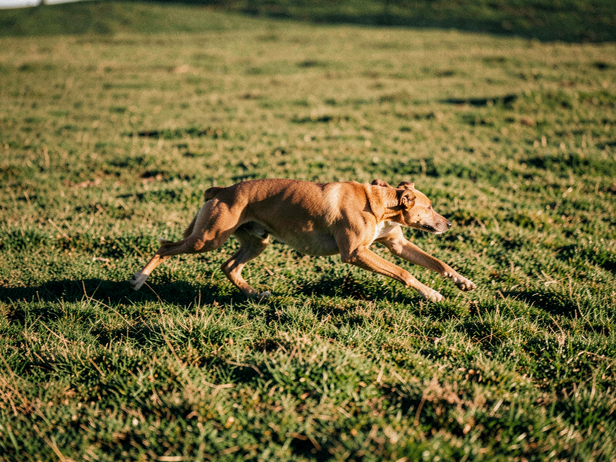
![Sighthound in Full Flight]()
Sighthound in Full Flight
Image credit : AI
Witnessing the raw power of a sighthound in full sprint. This breed demands ample exercise.
What this means in a flat in India today
The honest answer is that a Rampur Greyhound in a flat is workable, but only under specific conditions. The breed is calm indoors, genuinely calm, not merely tolerant, and does not bark excessively or chew furniture out of boredom the way a working breed like a Border Collie might. In that sense, it is easier to live with than its size suggests.
The non-negotiable is off-leash running. This dog needs a securely fenced area where it can sprint at full speed, not once a week but several times a week. A long walk on a leash does not substitute for a run. The muscles and the cardiovascular system of a sighthound are built for short, explosive effort, not sustained steady-state exercise. A Rampur that only ever walks becomes physically restless in ways that eventually show up as anxiety or destructive behaviour.
The recall problem is real and worth stating plainly. A Rampur Greyhound that spots a cat, a squirrel, or a moving vehicle across an open road will go after it. The prey drive is instinct, not disobedience, and it overrides recall training in the moment of chase. This is not a breed to walk off-leash in an unfenced area. Ever. Many experienced sighthound owners describe this as the single most important thing a new owner fails to take seriously until something goes wrong.
If you live in a metro flat with access to a large, properly fenced ground, a society compound with no gaps in the boundary wall, a farmhouse on weekends, the breed can genuinely thrive. If the only outdoor space is a pavement walk and a small park, it cannot.
Coat, grooming and the Indian climate
The Rampur Greyhound carries a short, dense, smooth coat that requires almost no grooming effort. A weekly wipe-down and a check of the ears and nails covers most of it. The coat does not trap dust or develop the matting problems that longer-coated breeds face in Indian humidity.
The climate consideration runs the other way. This breed has almost no insulating fat and a thin coat, which means it feels cold acutely. In north Indian winters, Delhi, Chandigarh, Lucknow, a Rampur will need a dog coat or blanket at night if it sleeps anywhere other than a heated room. In the south and in coastal cities, the heat is a more relevant concern: like all dogs, the Rampur can overheat, and its low body fat does not protect it from heat the way it might seem to. Exercise should happen in the early morning or after sunset during summer months.
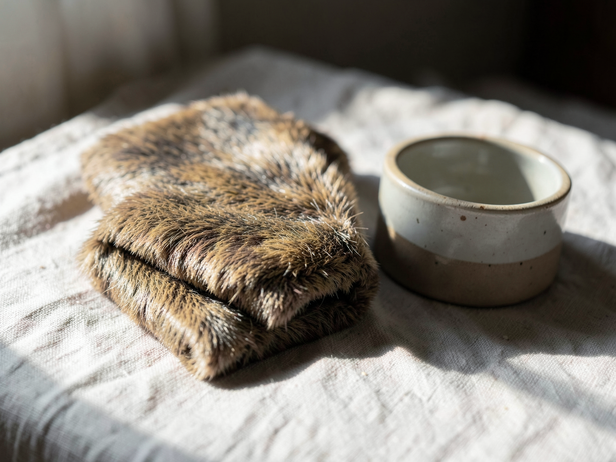
![Dog Coat and Bowl]()
Dog Coat and Bowl
Image credit : AI
My Rampur Greyhound's coat rests beside its water bowl, a quiet morning scene.
Health predispositions
As a breed with low body fat, the Rampur Greyhound has known sensitivities that any owner and any vet working with the dog should understand before a procedure is planned.
Sighthound breeds metabolise certain anaesthetic agents differently from other dogs. Barbiturate-based anaesthetics in particular are processed more slowly in dogs with very low body fat, which can extend recovery time significantly. This is not a reason to avoid surgery when surgery is needed, but it is a reason to ensure your vet is aware the dog is a sighthound before any procedure is scheduled. A vet experienced with sighthounds will adjust the protocol accordingly.
The breed is also predisposed to bloat, gastric dilatation-volvulus, a condition where the stomach fills with gas and can twist on itself. It is more common in large, deep-chested breeds. The signs include a visibly distended abdomen, unproductive retching, restlessness and distress. This is a veterinary emergency. If you see these signs, reach a vet immediately; there is no home management for bloat.
Skin and paw injuries are more common in this breed than in heavier-coated dogs because the skin is thin and exposed. Check paws after runs on rough ground. Cuts that look minor can go deeper than they appear.
There is no registry-level data on the full range of heritable conditions in the Rampur Greyhound the way there is for internationally registered breeds, partly because the breed has not been subject to the same systematic health surveys. Treat any health claim about the breed as a predisposition, a higher likelihood, not a certainty, and build a relationship with a vet who is willing to learn the breed's specific physiology alongside you.
Finding a Rampur Greyhound and what to ask
The Rampur Greyhound is not a breed you will find at a pet shop, and that is not a loss. Breeders who work with Indian native breeds are fewer than those working with imported ones, but they exist, particularly in Uttar Pradesh and Rajasthan where the breed has historical roots. The Kennel Club of India recognises the breed. Contact them for a list of registered breeders rather than sourcing through an unverified online listing.
Ask a breeder about the working history of their lines, what the parent dogs are like in temperament, and whether they have placed dogs in flat environments before. A breeder who has never placed a dog in a city home is not necessarily a bad breeder, but it means you will be navigating the flat-adaptation yourself without their experience to draw on.
Rescue is also a real option. Sighthounds sometimes end up in shelters when owners underestimate the exercise requirement, and a rescue organisation familiar with the breed can match temperament to household more precisely than a general shelter intake.
The Rampur Greyhound is not a difficult dog. It is a specific one. The owners who do well with this breed are the ones who went in knowing what the breed is, a coursing hound built for speed and independence, and arranged their life around that, rather than hoping the dog would arrange itself around them.