Most people who see a Pandikona for the first time mistake it for an underfed street dog. That is a reasonable error. The breed carries almost no fat, its ribs are visible under a short coat, and its face has the long, narrow skull of a dog built to spot movement at distance rather than charm a visitor at the door. The resemblance to a stray is superficial. The Pandikona is a purpose-built hunting dog with a specific origin, a specific working style, and a temperament that does not bend easily to the expectations of flat life.
Where the Pandikona comes from
The breed takes its name from Pandikona village in Kurnool district, Andhra Pradesh, and is associated historically with the Chenchu and Yerukala tribal communities of the Nallamala forest region. These communities used the dog to hunt small game, hare, monitor lizard, small deer, across open scrubland and rocky terrain. The Pandikona worked by sight and speed rather than nose, which places it in the sighthound family alongside the Mudhol Hound, the Chippiparai, and the Rampur Greyhound.
No organised breeding programme has shaped it. The dogs that survived were the ones fast enough and tough enough to be useful. That selective pressure over generations produced an animal that is lean almost to the point of appearing unwell, heat-tolerant, and capable of sustained speed in conditions that would exhaust a heavier dog. The breed has no recognition from the Kennel Club of India or the FCI, and population numbers are not reliably documented. Most dogs that fit the type are found in and around Kurnool, Nandyal, and the surrounding districts.
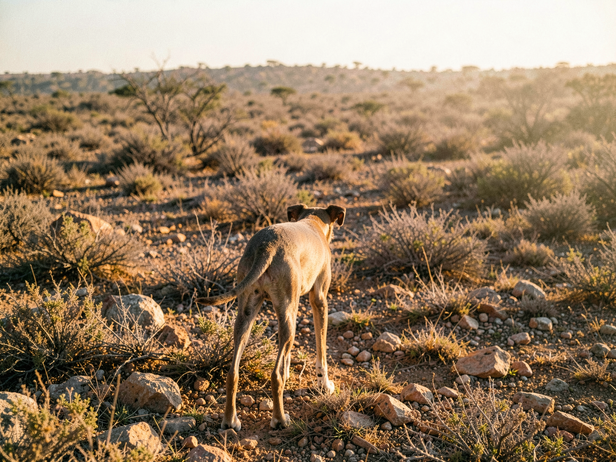
![Lone dog on scrubland]()
Lone dog on scrubland
Image credit : AI
I survey the vast, dry scrubland, a solitary Pandikona dog breed against the warm, hazy light.
What the Pandikona looks like and how it moves
A typical Pandikona stands between 22 and 26 inches at the shoulder and weighs somewhere between 18 and 28 kilograms, though working dogs on the leaner end of that range are common. The build is the defining feature: a deep chest that narrows sharply at the abdomen, a tucked-up belly, long legs, and a tail that curves upward in a sickle shape. The head is long and narrow, the ears are folded and carried back when the dog is relaxed, and the eyes are light-coloured in many individuals, amber or pale hazel, which gives the face an alert, almost wary expression.
The coat is short, dense, and single-layered, which makes the breed well-suited to hot weather and easy to maintain. Colour varies: fawn, brindle, black, and black-and-tan are all seen. The gait at a trot is effortless and ground-covering. At full speed, the Pandikona uses a double-suspension gallop, both sets of legs leave the ground twice per stride, which is the same mechanism that makes greyhounds fast. A fit Pandikona can cover open ground quickly enough that recall in an unfenced space is not a reliable option.
Temperament in a home setting
The Pandikona is not an unfriendly dog, but it is not a dog that warms to strangers quickly. With its own family, it is typically calm, loyal, and low on the kind of attention-seeking behaviour common in breeds developed for close human companionship. It bonds to a small group of people and is often reserved or cautious with anyone outside that group. This is not aggression, it is the default wariness of a dog that was never bred to solicit affection from people it does not know.
The prey drive is high and consistent. A Pandikona that sees a cat, a squirrel, a small dog, or a bird move quickly across its field of vision will give chase. This is not a training failure; it is the breed's central purpose. Managing it in a city or a flat requires either very reliable recall built over months of consistent work, or the acceptance that off-leash time happens only in securely fenced spaces. The breed is not well-suited to households with cats or small animals unless raised with them from a young age, and even then the instinct does not disappear.
Exercise needs are high. A Pandikona that does not get sufficient daily movement, at minimum an hour of real running, not a slow walk around the block, will become restless and difficult to settle indoors. In a flat with no access to open ground, meeting that need is a genuine logistical challenge that prospective owners should think through honestly before acquiring the dog.
![Earthy Still Life]()
Earthy Still Life
Image credit : AI
A simple ceramic bowl on rough stone, reminiscent of the arid landscapes where the Pandikona dog thrives.
Health and what to watch for
Because no studbook exists and breeding has been unmanaged, there is no reliable breed health survey for the Pandikona. What can be said is that sighthound physiology carries a few consistent considerations regardless of breed. Sighthounds have lower body fat than most dogs, which affects how they metabolise certain anaesthetic agents, a vet unfamiliar with the type should be told this before any procedure requiring general anaesthesia. The lean frame also means they feel the cold more than a heavier-coated dog and should not be left outside in low temperatures without shelter.
The deep chest and narrow abdomen that make the Pandikona fast also make it, like other deep-chested breeds, potentially susceptible to gastric dilatation, a condition where the stomach fills with gas and can twist, which is a veterinary emergency. Feeding one large meal a day and exercising immediately before or after eating are the two practices most associated with increased risk; splitting meals and allowing a rest period around feeding time is the standard precaution. Any Pandikona that appears bloated, is retching without producing anything, or is restless and unable to settle after eating needs a vet immediately.
Beyond these sighthound-specific considerations, the breed appears to be hardy. This is not a claim about individual dogs, any dog can develop health problems, but a reflection of the fact that generations of natural selection in a demanding environment tend to produce animals without the accumulated structural problems that come from closed studbooks and repeated use of popular sires.
Living with a Pandikona in India today
The Pandikona is not a dog for a first-time owner, not because it is dangerous but because its needs are specific and its temperament does not forgive neglect of those needs. It does best with someone who has kept dogs before, understands sighthound behaviour, has access to open running space, and is not looking for a dog that will perform reliably in a crowded social environment.
For the right owner, patient, physically active, unbothered by a dog that is affectionate on its own terms rather than on demand, the Pandikona is a genuinely rewarding animal. It is also one of the few remaining native Indian breeds that has not been diluted by crossbreeding or reshaped by show-ring standards. Keeping it is, in a practical sense, a form of conservation. The dogs exist in small numbers, in a limited geography, with no organised effort to document or protect the population. That will not change without the attention of people who actually want to live with one.