Most people who keep birds in Indian flats default to budgerigars or cockatiels. Java sparrows and finches rarely come up in that conversation, which is a gap worth closing. Both are small, quiet, and genuinely suited to apartment life, not because they are passive, but because their needs fit neatly inside a small home without demanding constant human attention.
What Java sparrows are and where they come from
Java sparrows (Lonchura oryzivora, also known as Java finches or rice birds) are native to Java and Bali in Indonesia, where they historically fed on cultivated rice and became a significant crop bird. They were kept as cage birds across Asia for centuries before reaching Europe and the rest of the world. Adults are compact, around 15 to 17 centimetres, with a grey body, bold black head, white cheek patches, and a thick pink-red bill that is their most recognisable feature. They are social birds that live in flocks in the wild, and that instinct does not disappear in captivity. A single Java sparrow kept alone is an unhappy bird. They should be kept in pairs at minimum.
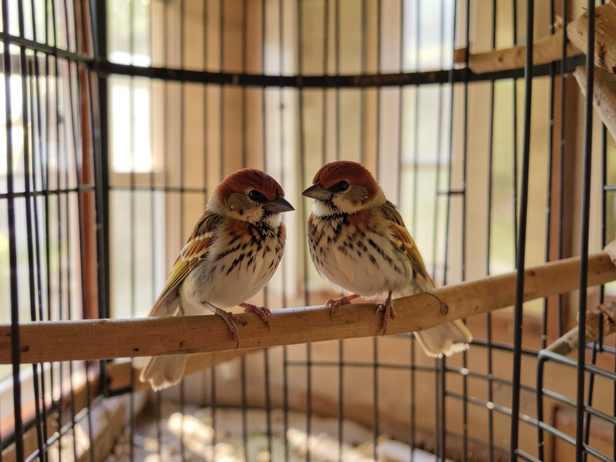
![Striped Finches on Dowel]()
Striped Finches on Dowel
Image credit : AI
These finches are perfect small pet birds for quiet homes, offering charming companionship.
What finches are and which varieties suit a home
Finch is a broad term covering dozens of species, but the ones most commonly kept as pets in India fall into a handful of groups: zebra finches (Taeniopygia guttata), society finches (Lonchura domestica, also called Bengalese finches), and occasionally strawberry finches (Amandava amandava, the red avadavat, which is native to the Indian subcontinent). Zebra finches are the most widely available and the easiest to keep. The male's orange cheek patches and striped chest make sexing straightforward, and they breed readily in captivity. Society finches are slightly calmer and are often used as foster parents for other finch species because of their reliable brooding behaviour. All finches are flock birds. Like Java sparrows, they do poorly alone and should be kept in pairs or small groups.
What a quiet home actually means for these birds
Java sparrows and finches are not silent. The male Java sparrow produces a soft, rhythmic song, pleasant rather than piercing, audible in a quiet room but not through a closed door. Zebra finches call frequently in short, reedy beeps. Society finches are the quietest of the common varieties. None of these birds screams the way a parrot can. The noise ceiling is low enough that neighbours in an adjacent flat are unlikely to notice. What they do produce is constant low-level activity: movement between perches, soft contact calls between paired birds, and the rustling of a bird that is never quite still. That activity is part of what makes them interesting to watch. A flat that is genuinely very quiet, someone who works from home and needs silence, should factor in that finches and Java sparrows are always audible to the person in the room with them.
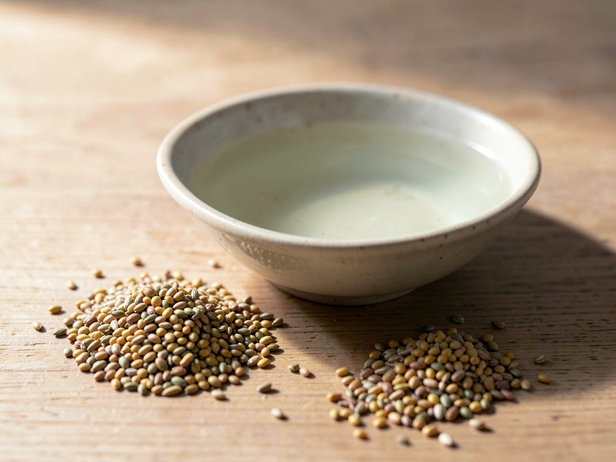
![Morning Seed Offering]()
Morning Seed Offering
Image credit : AI
I offer a simple meal of millet and canary seed, perfect for finches for apartment living.
Housing, feeding, and realistic care
These birds need a cage that is wide rather than tall, because they fly horizontally. A cage that is at least 60 centimetres wide for a pair gives them room to move. Perches of varying thickness help maintain foot health. The diet for Java sparrows and most finches is seed-based, a good quality mixed seed with millet, canary seed, and some grass seeds, supplemented with fresh greens such as spinach or coriander, occasional egg food for protein, and cuttlebone for calcium. Grit is debated among keepers; fine insoluble grit in small amounts is generally considered safe, but the question is worth raising with an avian vet. Fresh water daily is non-negotiable. These birds bathe enthusiastically and should have a shallow dish available several times a week. They are not birds that bond closely with humans in the way a hand-raised parrot might. They can become comfortable with a calm owner's presence, and some individuals will take food from a hand, but they do not seek handling and should not be forced into it. Their interest is in each other. The owner's role is to provide a stable environment and watch.
Health considerations and when to see an avian vet
Java sparrows and finches are generally hardy if their environment is stable, but they hide illness well, a bird that looks unwell is often already significantly sick. Weight loss is one of the earliest signs and is difficult to detect by eye on a small bird; a bird that sits fluffed on the bottom of the cage, is less active than usual, or has a change in droppings needs to be seen by an avian vet promptly. Air sac mites are a known problem in finches, particularly in birds sourced from crowded conditions, and cause laboured breathing. Scaly face mite and overgrown beaks are also seen. Java sparrows are noted to be prone to obesity in captivity if given too much millet or oily seed without enough space to fly; a wide cage and a varied diet reduce that risk. Finding an avian vet before you need one is worth doing at the start, not during a health crisis. General small-animal vets are not always trained in bird medicine, and an avian specialist or a vet with documented bird experience is the right first contact.