The Russian Blue does not warm up quickly, and it is not trying to. This is a breed built on caution, not fear, not damage, but a genuine preference for the familiar over the unknown. In an Indian flat where guests arrive often and the doorbell rings without warning, that trait shows up fast and can confuse owners who expected an affectionate cat from day one.
Where the reserve comes from
The Russian Blue was developed in northern Russia, likely around the port city of Arkhangelsk, before reaching Britain in the late nineteenth century. Working cats in cold climates that survived on their own wits tend to be selective about trust, and selective is exactly what this breed is. It was not bred to perform for strangers or to solicit attention from anyone who walks in. Its loyalty is earned slowly and then held steadily. That is not a flaw in the breed's temperament, it is the temperament.
The behaviour has a physical component too. Russian Blues are sensitive to noise, unpredictable movement, and unfamiliar smells. A flat with rotating visitors, loud television, or a chaotic daily schedule will push this cat toward the quietest corner it can find. The same cat in a calm, predictable home will be visible, vocal, and present in a way that surprises people who only ever saw it hiding under a bed.
![Russian Blue on Ledge]()
Russian Blue on Ledge
Image credit : AI
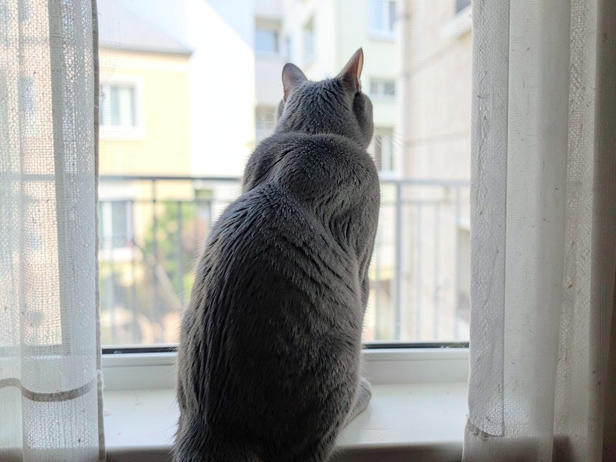
My Russian Blue cat, a picture of calm, watches the world from its perch. Its shy, loyal nature shines through.
What loyalty actually looks like in this breed
Russian Blues do not follow their person from room to room the way a Ragdoll or a Burmese might. Their attachment shows differently: they choose to be in the same room, they track your movements with their eyes, they show up when you are unwell or upset, and they have a particular talent for sitting beside you without demanding anything. Owners often describe this as the cat simply knowing. It is more likely that the breed is highly attuned to routine and reads small changes in behaviour accurately.
They are vocal but not loud. A Russian Blue will make its preferences known, for food, for play, for the door to be opened, in a quiet, persistent way rather than the full-throated announcement of a Siamese. In a flat setting, this is a practical advantage. They tend to bond most closely with one or two people in the household and treat others warmly but with slightly more distance. Children who are calm and gentle are usually accepted; a toddler who chases will send this cat straight to its safe spot.
Living with a Russian Blue in an Indian flat
The breed's exercise needs are moderate. It plays with real focus and then rests, which suits a flat well. It is not a cat that needs a garden or long roaming time, but it does need daily interactive play, a wand toy, a puzzle feeder, something that engages its attention rather than just its body. Boredom in this breed shows up as over-grooming or withdrawal rather than the destructive behaviour you might see in a more extroverted cat.
The coat is the Russian Blue's most distinctive feature: a dense double layer that stands slightly away from the body and carries a silver-tipped sheen. It sheds less than most double-coated breeds and requires only one or two brushing sessions a week. For owners in Indian cities managing heat and air-conditioning cycles, the coat holds up reasonably well, though the breed is more comfortable in cooler, stable temperatures than in the heat of a north Indian summer without climate control.
![Morning Pet Essentials Still Life]()
Morning Pet Essentials Still Life
Image credit : AI
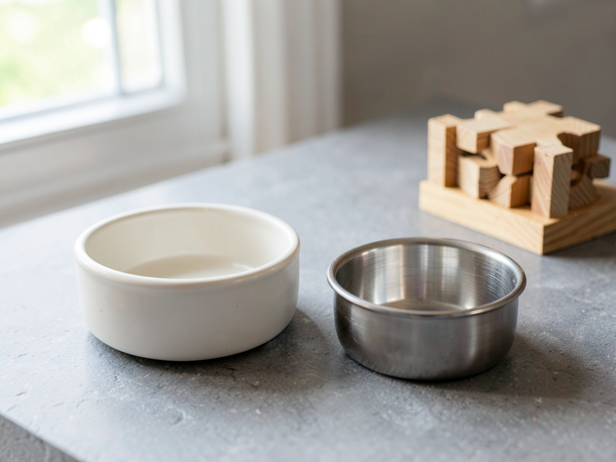
My Russian Blue cat's feeding station awaits, a quiet morning scene.
Health predispositions to know
The Russian Blue is generally a long-lived breed, with many cats reaching fifteen years or more. It has no single dramatic hereditary condition the way some pedigree cats do, but there are tendencies worth knowing. This breed has a strong appetite and a tendency to overeat if food is left out freely; obesity is the most common health problem seen in kept Russian Blues, and it leads downstream to joint issues and urinary problems. Structured meal times rather than free feeding make a real difference.
Some lines show a predisposition toward bladder sensitivity, including feline idiopathic cystitis, which is linked to stress. Given how stress-reactive this breed is, any change in the household, a new person, a move, a schedule shift, can trigger a flare. Knowing this in advance means watching for straining in the litter box or changes in urination after a stressful event, and getting to a vet promptly rather than waiting it out. A blocked male cat is a medical emergency; if your male Russian Blue is visiting the litter box repeatedly and producing little or nothing, that is a vet visit now, not tomorrow.
Bringing a Russian Blue home in India
Russian Blues are not widely bred in India, and sourcing one responsibly takes effort. The Kennel Club of India registers cat breeds, and a registered breeder who health-tests breeding pairs is a meaningful baseline. Importing from abroad is possible but involves quarantine regulations, airline carrier rules, and documentation that change often, confirm every requirement directly with the relevant authority and airline before making any commitment.
The first weeks at home set the pattern for years. Give the cat a single room to start, with its litter box, food, water, and a hiding spot it chose rather than one you assigned. Let it come out on its terms. Visitors during the settling period slow the process considerably; the fewer new people in those first weeks, the faster the cat builds its baseline sense of safety. Once it has claimed the flat as its own, the Russian Blue that hid from everyone on arrival becomes the cat that greets you at the door every evening, quietly, reliably, on its own terms.