Most people have seen the small, grey-brown squirrels that dart across park walls and balcony railings across Indian cities. The Indian giant squirrel, Ratufa indica, is their distant cousin, and the comparison ends at the name. This is an animal that can measure nearly a metre from nose to tail-tip, weighs up to two kilograms, and moves through the forest canopy in leaps that can cover six metres in a single bound.
A squirrel built for the high canopy
![Tropical Forest Morning Light]()
Tropical Forest Morning Light
Image credit : AI
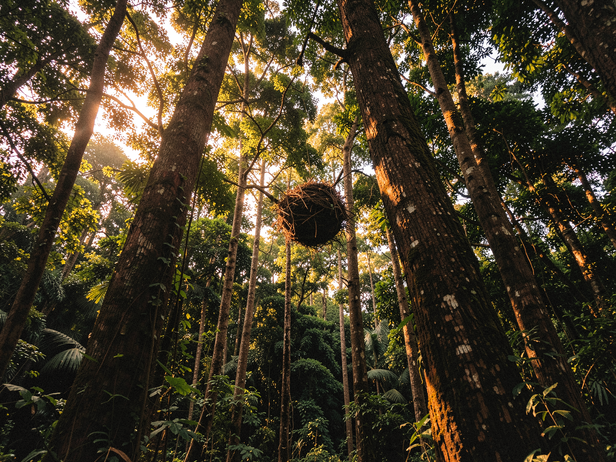
Morning light filters through a dense Indian tropical forest, highlighting a large nest. Home to the Indian giant squirrel.
Ratufa indica spends almost its entire life in the upper layers of dense forest, rarely descending to the ground. Its hind legs are powerful and its claws are adapted for gripping bark on large-diameter trees. The tail, often longer than the body itself, acts as a counterbalance during leaps and as a rudder mid-air. When threatened, it does not flee downward. It flattens against a branch and freezes, relying on its position and the broken light of the canopy to disappear.
It is a solitary animal outside the breeding season. Each individual maintains a large home range and builds multiple large, spherical nests called dreys from twigs and leaves, using different ones on different days. This is not random, rotating nests reduces the chance that a predator learns a fixed location.
The colours that stop people mid-trail
The Indian giant squirrel is one of the most visually striking mammals in India. Its coat combines deep maroon, cream, and sometimes orange or buff across the back, head, and underside in patterns that vary noticeably between the four recognised subspecies. The Malabar giant squirrel, found in the Western Ghats, tends toward the richest colour contrasts. The variation across subspecies reflects adaptation to different forest types and light conditions, the broken, dappled light of a dense canopy turns what looks vivid in a photograph into effective camouflage in the tree tops.
Researchers have noted that the squirrel's fur reflects ultraviolet light in ways that may be visible to other squirrels but not to the large raptors that prey on them. This is an area of ongoing study, not settled science, but it adds another layer to an animal that rewards close attention.
Where it lives and how it is doing
![Tropical Bounty on Bark]()
Tropical Bounty on Bark
Image credit : AI
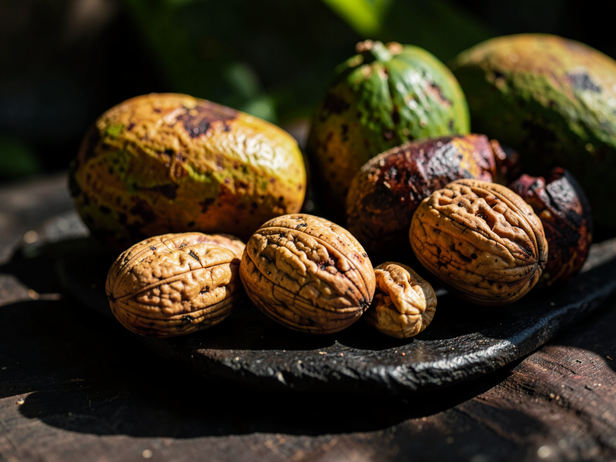
A rich arrangement of tropical fruits and nuts, reminiscent of the bounty found in the Western Ghats, presented with deep shadows and soft light.
The Indian giant squirrel is found across the forests of peninsular India, the Western Ghats, the Eastern Ghats, parts of central India, and pockets of forest in Maharashtra, Odisha, and Tamil Nadu. It is the state animal of Maharashtra. It depends on large, contiguous tracts of tall forest with mature trees. Fragmented forest, where patches are separated by roads, farms, or settlements, makes the long leaps between canopy trees impossible and isolates populations from one another.
The IUCN currently lists Ratufa indica as Least Concern, but that status reflects the species as a whole. Individual subspecies face greater pressure, and the quality of remaining habitat is declining faster than the headline number suggests. Protected areas such as Nagarhole, Bhadra, and Anamalai Tiger Reserve hold healthy populations. Outside protected land, sightings have become less reliable over the past two decades in areas where forest cover has thinned.
What it eats and why that matters to the forest
The Indian giant squirrel is primarily a frugivore, it eats fruit, nuts, seeds, flowers, and bark, with occasional insects. Its size means it can handle large, hard-shelled fruits that smaller squirrels cannot open. It caches some seeds, and like many seed-caching animals, it does not always return for them. Seeds left in the ground germinate. In a tall forest ecosystem, the giant squirrel functions as a disperser for tree species that depend on animals to move their seeds away from the parent tree. Remove the disperser, and the forest's ability to regenerate those species is reduced, not immediately, and not in a way that shows up in any single season, but over decades.
The Indian giant squirrel is not a pet, cannot be kept legally under the Wildlife Protection Act, 1972, and does not belong in any captive setting. Its value is entirely in the canopy, doing what it has done for millennia. The best way to see one is in a forest with good canopy cover, early in the morning, looking up.