The Chartreux arrives in a room without announcing itself. It watches from a doorway, decides you are worth approaching, and then stays close without demanding anything. That restraint is not shyness, it is the breed's defining character, and it has been remarked upon for centuries.
The monastery legend and what history actually supports
The most repeated story about the Chartreux places its origins with the Carthusian monks of the Grande Chartreuse monastery in the French Alps, who supposedly bred the cats to keep their libraries free of mice and their corridors free of noise. The monks, who observed long periods of silence, are said to have selected for quiet, calm cats over generations.
What history actually supports is more modest. The name Chartreux appears in French natural history writing from the eighteenth century, and the naturalist Buffon used it to describe a distinct blue-grey cat type in France. Whether the monks bred them deliberately or simply kept them is not established. The association with the Grande Chartreuse is plausible, the monastery existed, the monks did keep animals, but no written record from the monastery confirms a breeding programme. The legend is old enough to be taken seriously as cultural history, and honest enough to be told as a legend rather than a fact.
What is not disputed: the Chartreux is a natural breed, meaning it developed without planned human crosses, and it was nearly lost after the Second World War. French breeders rebuilt the population carefully, and the breed was recognised by the Fédération Internationale Féline. It remains rare outside France and a handful of specialist breeders in Europe and North America.
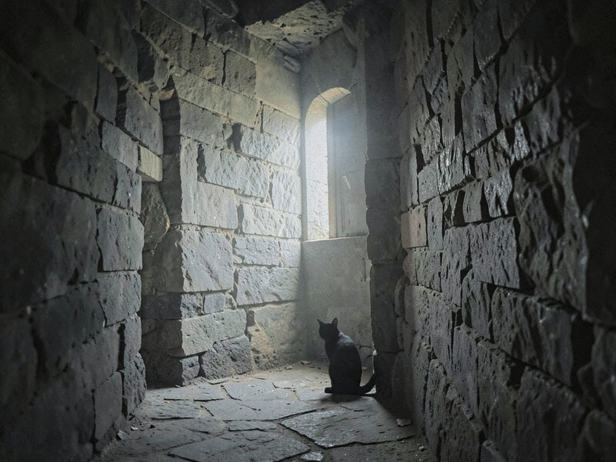
![Monastery Cat's Quiet Vigil]()
Monastery Cat's Quiet Vigil
Image credit : AI
A blue-grey cat, reminiscent of the Chartreux breed, finds peace in the ancient monastery's quiet halls.
What the breed looks like and why the coat is unusual
The Chartreux has one colour and one colour only: blue, which in cat terminology means a range of grey from ash to slate. The coat is dense and slightly woolly in texture, with a water-resistant quality that comes from a double layer, a shorter, thick undercoat beneath a longer topcoat. Running a hand through it feels different from a typical shorthaired cat's coat; it has resistance and body.
The eyes are copper to gold, and the contrast against the grey coat is one of the breed's most striking features. The face is broad and rounded, with full cheeks and a slightly tapered muzzle that gives the cat what breeders and owners describe as a smile, a fixed upward curve at the corners of the mouth that has nothing to do with mood. The body is substantial and muscular, described in breed standards as primitive, meaning built for function rather than refinement. Males are noticeably larger than females and take longer to reach full size, sometimes up to four or five years.
The Chartreux does not look like a cat assembled for a show ring. It looks like a working animal that has been kept well for a very long time.
Temperament: what quiet actually means in practice
The Chartreux is consistently described as one of the quietest cat breeds, and this is accurate in a specific sense. It vocalises rarely and softly. It does not demand food with noise, does not yowl at closed doors, and does not fill a flat with sound. Owners who have lived with more vocal breeds, Siamese, Bengal, Burmese, often find the silence startling at first.
Quiet does not mean withdrawn. The Chartreux is attentive and follows its person through a home without being underfoot. It tends to bond closely with one or two people and is more reserved with strangers, not aggressive, but watchful. It plays with focus, brief, purposeful sessions, and then settles. It tolerates being alone better than many breeds, which makes it a reasonable fit for owners who work outside the home, provided it has enough environmental enrichment to occupy itself.
It is not a lap cat in the persistent, demanding sense. It will sit beside you more often than on you, and it will choose when that happens. Owners who want a cat that initiates contact on its own schedule tend to find this satisfying. Owners who want a cat that actively seeks handling may find the Chartreux a little distant.
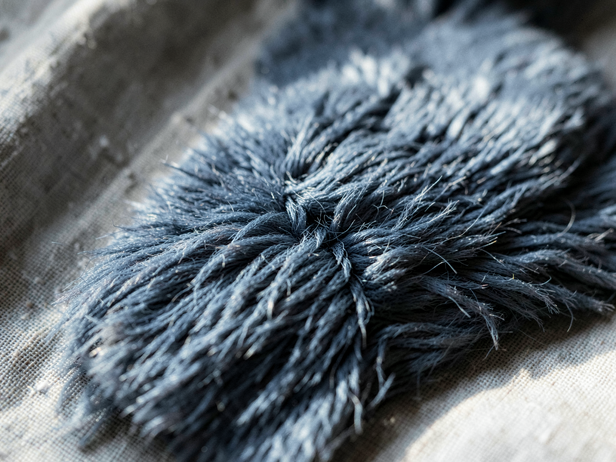
![Blue-Grey Fur Texture]()
Blue-Grey Fur Texture
Image credit : AI
I explore the deep, cool tones of blue-grey cat fur, a study in texture and light. Chartreux cat breed.
Health predispositions and what an owner should know
The Chartreux is generally a healthy breed with a longer natural history than many purpose-bred cats, and it does not carry the structural problems that come with extreme conformation, no flat face, no folded ears, no shortened limbs. That said, the breed has a known predisposition to a condition called patellar luxation, where the kneecap slips out of its normal position. In mild cases it causes an occasional skip in the gait; in more severe cases it causes pain and requires veterinary attention. Any Chartreux that starts favouring a leg or moving differently should be seen by a vet rather than watched and waited on.
The dense double coat sheds, particularly during seasonal changes, and requires regular brushing to prevent matting and reduce the amount of hair the cat ingests during self-grooming. Hairballs are a practical concern with this coat type. Routine dental care matters, as it does for all cats, dental disease is the most common health problem in domestic cats across breeds, and it progresses silently until it causes pain.
A Chartreux that stops eating, loses weight gradually, or becomes less active than usual warrants a vet visit. These are not breed-specific signs; they are the signs that something is wrong in a cat that will not tell you so with noise.
Owning a Chartreux in India: what is realistic
The Chartreux is rare in India. Locating a responsible breeder requires significant research, and most people who want one will need to look outside the country, which involves import paperwork, quarantine considerations, and costs that go well beyond the cat's price. Anyone who finds a local seller offering Chartreux kittens at unusually low prices should ask to see pedigree documentation and registration with a recognised body such as the FCI or TICA before proceeding.
The breed's temperament suits flat living reasonably well. It does not need outdoor space the way a high-energy breed does, and its quiet nature is compatible with neighbours and shared walls. The coat, however, is built for a temperate climate. In Indian summers, particularly in cities without reliable air conditioning, a cat with a dense double coat will be uncomfortable. This is not a disqualifying factor, but it is a real one, a climate-controlled home matters more for this breed than for a short-coated cat.
The Chartreux is not a cat for someone who wants visible, demonstrative affection on demand. It is a cat for someone who finds meaning in a quieter kind of presence, the cat asleep on the far end of the sofa, the cat that appears when you are unwell, the cat that has decided, without theatre, that you are its person.