The Nilgiri marten is one of the least-seen carnivores in India, not because it is nocturnal or deeply secretive, but because the forest it lives in has shrunk to fragments, and most people simply never go where it goes. A member of the mustelid family that includes otters, badgers and weasels, it is the only marten species found in southern India, and its entire known range sits within the Western Ghats, mostly above 1,000 metres.
What the Nilgiri marten actually is
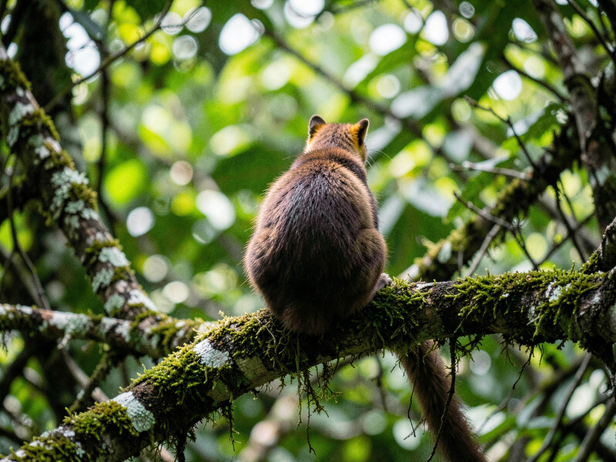
The Nilgiri marten, Martes gwatkinsii, is a medium-sized carnivore, roughly 55 to 65 centimetres in body length with a long, bushy tail adding another 40 to 45 centimetres. Adults weigh somewhere between one and two kilograms. The coat is a deep chocolate-brown to chestnut across the back, with a distinctive bright yellow to orange throat patch that makes identification possible at a distance if you are lucky enough to spot one. The head is broad, the ears rounded, and the eyes carry the alert, forward-facing gaze of an animal that hunts by sight as much as smell. It is diurnal, active during the day, which in theory makes it more observable than many forest mammals, but the dense shola forest and high-elevation grassland mosaic it prefers keeps it out of view for most visitors.
![Marten's Glimpse in Shola]()
Marten's Glimpse in Shola
Image credit : AI
A rare Nilgiri marten, seen from behind, perches on a mossy branch in the dense shola forest, its throat patch catching the morning light.
What it was built to do
The marten's body is a climbing machine. Long, semi-retractable claws, flexible ankles that can rotate to grip bark on the way down as well as up, and a low centre of gravity let it move through the canopy at a pace that surprises anyone who sees it. It hunts small mammals, birds, lizards, insects and fruit, taking whatever the forest offers at a given elevation and season. This dietary flexibility is typical of mustelids, and it is part of what makes the Nilgiri marten a functional predator across a range of forest types, from dense evergreen shola patches to the transition zones where grassland meets tree line. It does not cache food the way some mustelids do, and it is largely solitary outside the breeding season.
Where it lives and why that matters
The Western Ghats stretch roughly 1,600 kilometres down the western edge of peninsular India, from Gujarat through Maharashtra, Goa, Karnataka, Kerala and into Tamil Nadu. The Nilgiri marten is concentrated in the southern and central sections of this range, the Nilgiris, Anamalai Hills, Palani Hills, and the forests of Wayanad and Kodagu. It is classified as Vulnerable on the IUCN Red List, and the population trend is considered decreasing. The pressures are familiar: habitat loss from tea, coffee and eucalyptus plantations pushing into shola forest, road fragmentation cutting movement corridors, and the general reduction in undisturbed high-elevation forest that the species needs. Because it is a predator that requires a functioning prey base and enough contiguous forest to maintain a territory, it is sensitive to disturbance in ways that more generalist species are not.
![Shola Forest Meets Grassland]()
Shola Forest Meets Grassland
Image credit : AI
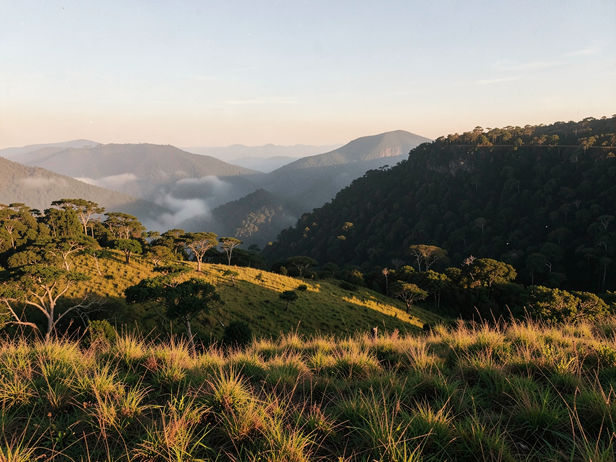
I witness the ethereal beauty of the Western Ghats, where shola forests meet grasslands under golden hour light. A glimpse of rare carnivores of India.
How rarely it is studied
The Nilgiri marten sits in an uncomfortable gap in the scientific literature. It is not unknown, naturalists have documented it since the nineteenth century, but rigorous population estimates, detailed home range data and breeding biology are still sparse compared to better-studied carnivores like leopards or dholes. Camera trap surveys in protected areas such as the Anamalai Tiger Reserve and Mukurthi National Park have recorded it, and these records are among the most reliable evidence for where it persists. What is not well understood is how viable the fragmented subpopulations are, how much forest each individual needs, and whether the corridors between protected areas are functional for this species or effectively broken. That uncertainty is itself a conservation concern: it is difficult to protect an animal whose requirements are not precisely mapped.
What distinguishes it from other Indian mustelids
India has several mustelid species, the smooth-coated otter, the Eurasian otter, the honey badger, the yellow-throated marten in the Himalayas and northeast, and several weasel species. The Nilgiri marten is the only marten in peninsular India, and the yellow throat patch separates it visually from every other carnivore in its range. The yellow-throated marten of the Himalayas and northeast, Martes flavigula, is a close relative and shares the throat-patch characteristic, but the two species do not overlap geographically. For anyone walking the shola-grassland edges of the Nilgiris or the Anamalais, a chestnut animal with a bright yellow throat moving fast through the mid-canopy is nothing else. The challenge is that most people never see it at all, and a brief glimpse is easily dismissed as a large squirrel or a mongoose. The marten's fluid, bounding gait and the way it uses branches rather than ground cover are the clearest distinguishing features in the field.