
Desert Tortoise Diet and Nutritional Need in Arid Environment
Upasna Yadav | Mar 17, 2026, 10:00 IST

Desert Tortoise Showing Its Hard Protective Shell
With their long-life span, arid tortoises can make quiet, friendly companions. Although they live on land, pet tortoises enjoy soaking in their water dish to help prevent dehydration, clean themselves and defecate. These small tortoises enjoy roaming about their habitat and burrowing into their substrate. As these tortoises frequently carry salmonella bacteria and are easily injured if dropped, they are not ideal pets for very young children. Children handling tortoises should always be supervised, as these animals get stressed when handled too often or aggressively restrained.
Highlights
1. The Arctic and Antarctic are referred to as polar deserts. 20% of the total deserts have sand on their surfaces. Cold deserts have a very low temperature in comparison to hot deserts and are covered with snow or ice.
2. ortoises have many adaptations that help them survive, such as scutes, protective scales on tortoise shells that protect them from injury. They dig burrows, tunnels or holes in the ground, so they can hide from predators and hibernate for the summer.
3. During prolonged droughts, they retreat to burrows and reduce their metabolism and loss of water while consuming little food. Adult desert tortoises lose water at such a slow rate that they can survive for more than a year without access to water
2. ortoises have many adaptations that help them survive, such as scutes, protective scales on tortoise shells that protect them from injury. They dig burrows, tunnels or holes in the ground, so they can hide from predators and hibernate for the summer.
3. During prolonged droughts, they retreat to burrows and reduce their metabolism and loss of water while consuming little food. Adult desert tortoises lose water at such a slow rate that they can survive for more than a year without access to water
Arid Tortoise Species Overview
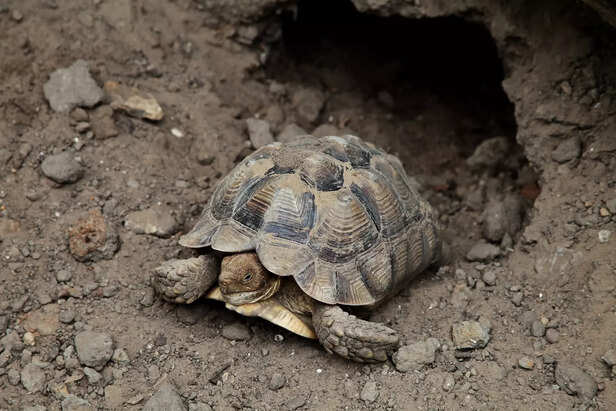
Desert Tortoise Resting in a Dry Desert Landscape
Arid tortoises are friendly, active reptiles that are native to dry climates. This care sheet outlines basic care needs for a variety of arid tortoise species, including:
- Greek tortoises
- Russian tortoises
Arid Tortoise Supply Checklist
- Appropriately sized habitat
- Timothy hay
- Substrate
- Food & water dish
- Hideaway place
- Plants
- Heat light & fixture
- UVB lighting and fixture
- Multivitamin supplement
Arid Tortoise Habitat
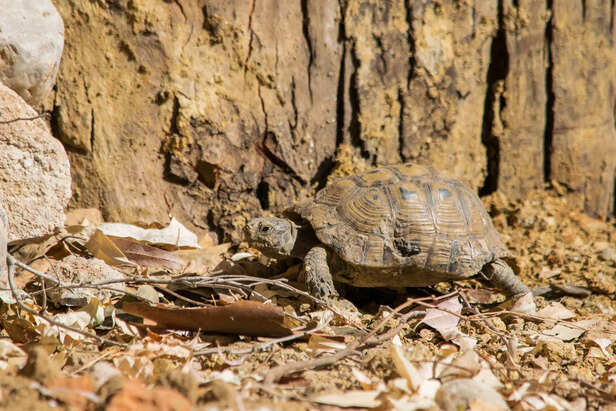
Desert Tortoise Walking Across a Rocky Desert Habitat
Arid tortoises can be kept indoors in a large, well-ventilated glass, wood, or plastic habitat. Ideally, indoor enclosures should be at least 36” L x 18” W x 16” H for a single tortoise. The habitat should be secured with a screened lid to prevent escaping. Always provide the largest habitat possible. As tortoises grow, the size of the habitats should increase, accordingly. Glass enclosures can trap air and increase the habitat’s humidity levels outside the ideal range, putting the tortoise at greater risk of developing respiratory tract infections. If using a glass tank or aquarium as an indoor habitat, pet parents must ensure the enclosure is well-ventilated and measure its humidity level each day using a humidity gauge.
Temperature
Typical arid tortoise appearance & behavior
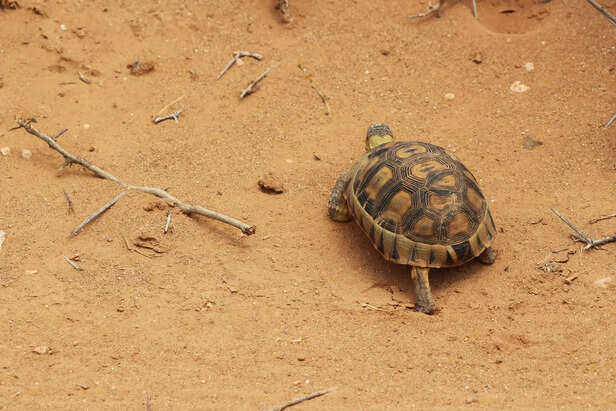
Desert Tortoise Unique Appearance and Physical Features
- Active, friendly and outgoing
- Are small tortoises with big personalities
- Will likely become tame with gentle handling and time; move slowly around tortoises to avoid startling them
- Adept at digging to escape; hide in objects and burrow into substrate
- Can be housed outside in warm, dry climates as long as precautions are taken to prevent escape
- Male tortoises have a curved plastron (bottom shell) and a longer tail than females. Their vent is located toward the end of their tail, while the female’s vent is closer to their shell.
- Female tortoises are larger than male
Frequently asked questions (FAQs)
- What type of environment do desert tortoises live in?
Desert tortoises live in hot and dry desert regions with very little rainfall. They prefer sandy or rocky areas where they can dig burrows to escape extreme heat and cold. - How do desert tortoises survive in arid environments?
Desert tortoises survive by conserving water, storing moisture in their bodies, and spending much of their time in underground burrows that protect them from harsh desert temperatures. - What do desert tortoises need to survive in the desert?
Desert tortoises need access to desert plants for food, safe burrowing areas, occasional rainfall for water, and a stable desert habitat to survive successfully.