Few dogs are as instinctively suited to life indoors as the Cavalier King Charles Spaniel. Bred for centuries as a lap dog for English royalty, it has none of the working dog's restlessness and all of a companion animal's attentiveness. In an Indian flat, where space is limited and the owner is often the centre of the dog's world, that temperament fits well. The breed also carries a cardiac predisposition serious enough that any honest account of it must put the heart condition alongside the gentle eyes and silky ears, not after them.
What the breed was built to do
Cavaliers descend from the toy spaniels that appear in European court portraits from the sixteenth and seventeenth centuries, small, soft-faced dogs bred entirely for human company. Unlike working spaniels bred to flush or retrieve game, the Cavalier's job was to sit with a person, travel with them, and keep them warm. That history explains almost everything about the dog's behaviour today: it is not a breed that tolerates long hours alone, it does not have a strong independent streak, and it actively seeks physical contact. A Cavalier left alone in a flat for eight hours a day will struggle in ways a more self-sufficient breed might not.
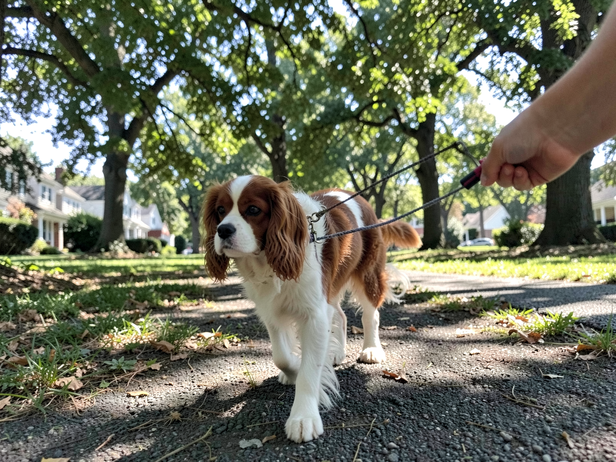
![Cavalier's Morning Stroll]()
Cavalier's Morning Stroll
Image credit : AI
Enjoying a peaceful morning walk with my Cavalier King Charles Spaniel, the dappled light creating a serene atmosphere.
Temperament and what it means in a flat
The Cavalier is consistently gentle, rarely aggressive, and unusually tolerant of children and other animals. Its energy level sits in the moderate range, it enjoys a walk and will happily play, but it does not demand the sustained exercise of a retriever or a terrier. Two moderate walks a day, twenty to thirty minutes each, generally meets its physical needs. Mental stimulation matters more than raw distance; a Cavalier that spends time with its owner, even just in the same room, is a settled dog. The breed adapts well to apartment life provided it is not left in isolation for long stretches. Separation anxiety is a genuine risk with this breed, not a minor quirk.
Coat, grooming, and the Indian climate
The Cavalier has a silky, medium-length coat that feathers at the ears, chest, legs, and tail. It is not a heavy shedder by large-breed standards, but it does shed, and the feathering tangles if not brushed two or three times a week. In the humidity of coastal Indian cities, the ear feathering can trap moisture and become a site for skin fold irritation and ear infections. The ears hang low and close to the head, limiting airflow. Regular ear checks, looking for redness, odour, or the dog shaking its head, are part of routine care for this breed, not an occasional concern. In a warm climate, the Cavalier manages reasonably well; it is not a double-coated Arctic breed, and it does not have the flat face that makes brachycephalic dogs struggle with heat. Even so, exercise should be scheduled for cooler parts of the day during summer.
![Veterinary Tools on Cotton]()
Veterinary Tools on Cotton
Image credit : AI
My stethoscope rests beside my notebook, ready to help a Cavalier King Charles Spaniel with heart disease.
Mitral valve disease: the cardiac condition the breed is known for
Mitral valve disease, sometimes called MVD, is a degenerative condition affecting the heart's mitral valve, the valve between the left atrium and left ventricle. As the valve deteriorates, it no longer closes cleanly, and blood leaks backward with each heartbeat. Over time, the heart compensates by enlarging, and eventually the compensation fails. The Cavalier King Charles Spaniel is the breed most affected by this condition. The predisposition is genetic and well-documented: a significant proportion of Cavaliers develop a detectable heart murmur by middle age, and the proportion increases sharply in older dogs. This is not a rare complication in an unlucky individual, it is a breed-wide predisposition that responsible breeders screen for and that every Cavalier owner needs to understand from the start. A veterinary cardiologist can detect a murmur through auscultation before the dog shows any outward sign of illness. The current screening protocol recommended by Cavalier breed health organisations involves annual cardiac examinations, starting before breeding age. An owner buying a Cavalier puppy should ask whether both parents have been cardiac-cleared by a veterinary cardiologist at the appropriate age, not just given a general health check. Early-stage MVD often requires no treatment, but the dog needs monitoring. When the disease progresses to a point where the heart is enlarging or the dog begins showing signs, exercise intolerance, a persistent cough, laboured breathing, or fainting, that is a conversation for a veterinary cardiologist, not a home management problem. If your Cavalier develops a cough that does not resolve within a few days, or tires quickly on walks it previously handled easily, see a vet promptly rather than waiting to see whether it passes.
Other health considerations
Beyond the heart, the Cavalier has a few other predispositions worth knowing. Syringomyelia, a neurological condition in which fluid-filled cavities form in the spinal cord, is linked to the breed's skull shape and can cause pain, sensitivity around the head and neck, and a characteristic scratching motion, often scratching at the shoulder or ear without making contact. A Cavalier that scratches persistently at one spot or vocalises when touched around the neck warrants a neurological assessment. Hip dysplasia and eye conditions, including cataracts and retinal problems, also appear in the breed at higher rates than in mixed-breed dogs. None of these are certainties for any individual Cavalier, but they are reasons to choose a breeder who screens breeding stock and to maintain regular veterinary check-ups rather than visiting only when something is visibly wrong.
The Cavalier is a genuinely rewarding dog for the right owner, someone who is home often, wants a dog that is actively interested in them, and is prepared to take cardiac health seriously from the day the dog arrives. The temperament is not exaggerated in breed descriptions; these dogs are as gentle and people-focused as their reputation suggests. The heart condition is not exaggerated either. Knowing both, and planning for both, is what responsible Cavalier ownership looks like.