The Akita arrives in your life like a decision that cannot be undone. Large, silent, and watchful, it does not perform affection for guests or warm up to strangers on a walk. What it offers instead is a loyalty so total that owners who have lived with one rarely want any other breed. That quality, which sounds like a selling point, is also the reason this dog is not for everyone.
Where the Akita comes from and what it was built to do
The Akita originated in the Akita prefecture of northern Japan, where it was bred to hunt large game, bear, wild boar, and deer, in mountainous, snow-covered terrain. That history shaped everything about the dog: its heavy double coat, its powerful build, its independence, and its habit of working without instruction from a handler. Hunting dogs that track and corner large prey cannot wait for commands. They make decisions. The Akita still does.
There are two distinct types. The Japanese Akita, also called the Akita Inu, tends toward a leaner frame and a narrower range of accepted colours. The American Akita, developed after World War II from dogs brought back by US servicemen, is heavier and comes in a wider colour range including pinto. Both share the same temperament fundamentals. The dog most associated with the breed in public memory is Hachiko, the Akita who waited at Shibuya station in Tokyo every day for nearly ten years after his owner's death, a story that is well-documented and publicly recorded, and that tells you something real about how this breed attaches.
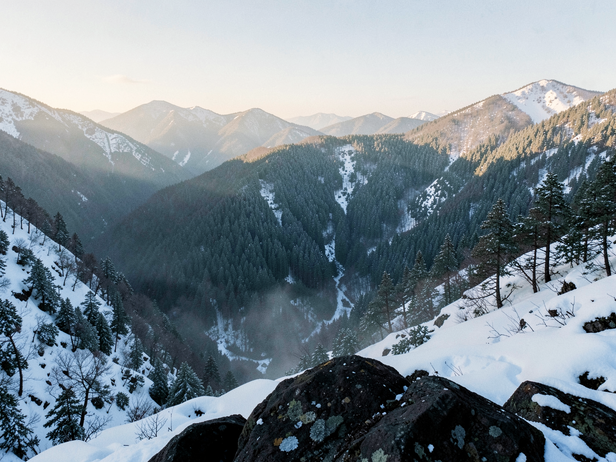
![Japanese Mountain Dawn Landscape]()
Japanese Mountain Dawn Landscape
Image credit : AI
I capture the serene beauty of a Japanese mountain dawn, a vast landscape with mist and pine forests. An Akita dog would thrive here.
What the Akita is actually like to live with
With its own family, the Akita is devoted, calm, and often gentle with children it has been raised alongside. It tends to be quiet, it does not bark without reason, which is one of its more underrated qualities in a flat or a residential building. It is also clean to a degree unusual in dogs, often grooming itself in a manner that owners describe as cat-like.
Outside the family circle, the picture changes. The Akita is reserved with strangers and can be actively aggressive toward dogs it does not know, particularly dogs of the same sex. This is not a training failure, it is a breed tendency with a long history behind it. An Akita that has been well-socialised from puppyhood will be manageable; one that has not been socialised is a serious liability in a public space. The prey drive is also high, which means smaller animals in the home, cats, rabbits, smaller dogs, carry real risk unless the Akita has grown up with them from a young age, and even then, caution is warranted.
The breed is also known for what experienced owners call stubbornness, but is more accurately described as independence. The Akita will obey a handler it respects. It will not perform for someone it has decided is not worth listening to. Establishing that relationship requires consistency, calm authority, and genuine experience with large, dominant-tendency breeds. Harsh or punishment-based handling backfires badly with this dog, it tends to harden rather than submit, and a hardened Akita is a dangerous one. Reward-based methods work, but they require patience and a handler who reads the dog accurately.
Size, coat and what Indian conditions mean for this breed
Male Akitas typically stand between 66 and 71 centimetres at the shoulder and weigh between 32 and 59 kilograms. Females are smaller but still substantial. This is not a dog that fits comfortably into a small flat, and its exercise needs, daily walks of reasonable length plus mental engagement, are non-negotiable. An under-exercised Akita in a confined space becomes destructive and difficult.
The double coat is dense, straight, and designed for cold. It sheds heavily twice a year during seasonal coat blows, and moderately the rest of the time. In India's climate, particularly in cities like Mumbai, Chennai, or Bengaluru, heat is a genuine welfare concern. The breed does better in cooler climates, hill stations, or cities with milder summers, and requires access to air-conditioning during hot months. This is not a dog that can be kept outdoors in Indian heat. Owners in warmer cities take on a real responsibility when they choose this breed, and should speak honestly with a vet about what that commitment looks like across the dog's lifetime.
Coat maintenance requires regular brushing, with more intensive grooming during the two annual shedding periods. The Akita is not a low-maintenance dog in this regard, though it is cleaner in its habits than many breeds of comparable size.
![Dog Fur and Water Bowl]()
Dog Fur and Water Bowl
Image credit : AI
A macro still life of shed Akita dog breed India fur beside a water bowl, bathed in soft morning light.
Health predispositions worth knowing before you commit
The Akita carries several known health predispositions. Hip dysplasia is among the most significant, as it is with many large breeds, this is a structural tendency, not a certainty, and responsible breeding reduces but does not eliminate the risk. Progressive retinal atrophy, which affects vision, appears in the breed. Hypothyroidism, an underactive thyroid, is also seen with some frequency and can affect coat condition, weight, and energy levels. Sebaceous adenitis, a skin condition that damages the glands responsible for coat health, is another breed-associated condition worth discussing with a vet before and during ownership.
The Akita also carries a known sensitivity to certain drugs, including some anaesthetics and sedatives. This is not universal, but it is established enough that any vet treating an Akita should be informed of the breed before any procedure. Make sure your vet is aware of this from the first visit.
Lifespan is typically ten to thirteen years. That is a long commitment for a large, demanding dog, and prospective owners should think carefully about what their household will look like across that span, in terms of space, time, and the physical capacity to manage a dog of this size if its behaviour becomes difficult.
Who this dog actually suits
The Akita is not a first dog. It is not a dog for a household that wants something sociable and easy to take to a park. It is not a dog that will tolerate being left alone for long stretches, or one that will forgive an inconsistent owner.
What it suits is an experienced owner who has handled large, independent-minded breeds before, who has the time and space to socialise the dog thoroughly from puppyhood, who can commit to reward-based training with patience and consistency, and who understands that the dog's loyalty is not unconditional in the way a Labrador's might feel, it is earned, maintained, and specific. In that household, the Akita is a remarkable animal. The bond it forms is not casual. It is, for owners who have experienced it, the whole point.