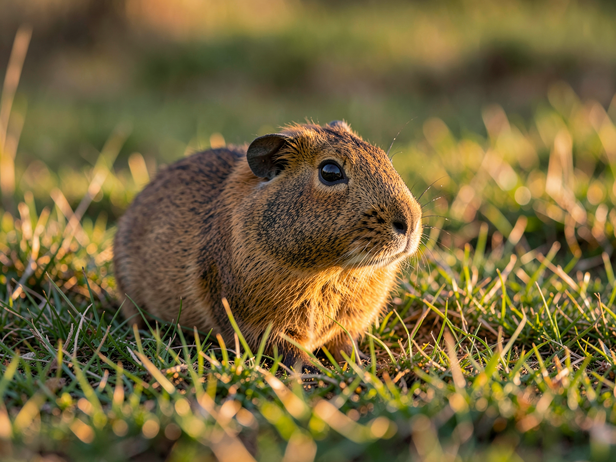
A guinea pig mid-munch suddenly goes completely still, body locked, eyes wide, not even chewing. If you have seen it, you probably wondered whether something was wrong. Nothing was wrong. What you saw was a prey animal doing exactly what evolution built it to do.
The freeze is a survival reflex, not a fear of you
![Guinea Pig's Golden Stillness]()
Guinea Pig's Golden Stillness
Image credit : AI
A guinea pig's prey animal response: frozen stillness in golden light. Observing its surroundings with wide eyes.
Guinea pigs are prey animals. In the wild, Cavia porcellus lived on open grasslands in South America, where predators, hawks, foxes, snakes, could come from any direction. The animal that moved got spotted. The animal that froze, blended into the grass, and waited for the threat to pass survived long enough to breed.
That reflex is still running in your pet, even though the biggest threat in your flat is a ceiling fan switching on. The brain's amygdala registers a sudden sound, movement, or shadow and fires a threat response before the conscious brain has processed anything. Muscles lock, breathing slows, and the animal holds absolutely still. The whole sequence takes milliseconds.
What is actually happening in the body during a freeze
The freeze response sits alongside fight and flight in the autonomic nervous system's threat toolkit. When the amygdala signals danger, the hypothalamus triggers a surge of adrenaline. Heart rate spikes, but movement stops. The logic is counterintuitive: stay still so the predator's motion-detection system, which is tuned to movement, misses you entirely.
In guinea pigs this response is particularly sharp because their visual field covers nearly 340 degrees. They detect movement at the edge of their vision constantly. A hand coming in from above, which mimics a bird of prey diving, is one of the most reliable triggers. So is a sudden loud noise, a fast shadow crossing the cage, or an unfamiliar smell arriving without warning.
The freeze typically lasts between one and thirty seconds. When the animal decides the threat has passed, it either resumes what it was doing or bolts to cover. Both are normal.
The difference between a normal freeze and a stress response worth noticing
![Still Life: Rodent Habitat]()
Still Life: Rodent Habitat
Image credit : AI
A quiet moment in a guinea pig's world. Understanding their prey animal response is key to their well-being.
A single freeze followed by a quick return to eating, vocalising, or moving around is unremarkable. What changes the picture is pattern and duration.
A guinea pig that freezes repeatedly throughout the day, stays frozen for more than a minute at a time, or combines freezing with other signs, hiding constantly, refusing food, grinding teeth, a hunched posture, or laboured breathing, is telling you something different. Chronic stress in guinea pigs suppresses the immune system and can contribute to digestive problems. Prolonged freezing with no obvious trigger can also indicate pain, which activates the same threat-response circuitry. A guinea pig in pain may freeze not because it heard something but because movement hurts.
If the freezing is frequent, lasts a long time, or comes with any of those other signs, a vet visit is the right next step rather than waiting to see if it settles.
How to reduce unnecessary startling in a home environment
You cannot and should not try to eliminate the freeze reflex, it is not a behaviour problem. What you can do is reduce the number of times your guinea pig's threat system fires unnecessarily.
Approach the cage from the side, not from above. Announce yourself with your voice before your hand appears, guinea pigs have excellent hearing and learn to associate a familiar voice with safety. Place the enclosure away from speakers, washing machines, and the direct path of foot traffic. Avoid sudden loud noises near the cage: a dropped pan in the kitchen, a door slamming, a television turned up sharply.
When you handle a guinea pig that has just frozen, wait. Let it unfreeze on its own terms. Picking it up mid-freeze adds a second threat on top of the first and can escalate the stress response significantly.
What the freeze tells you about how guinea pigs experience their environment
Guinea pigs are not anxious animals by nature. In a stable environment with familiar sounds, consistent handling, and a companion, they are social animals and do poorly alone, they spend most of their time active, vocalising, and exploring. The freeze is not evidence of a traumatised pet; it is evidence of a functioning nervous system doing its job.
The animal that never freezes is not calmer. It is either very well habituated to its environment or it has learned that freezing does not help, which happens in animals under chronic, inescapable stress, and is a worse sign than the freeze itself.
Understanding the reflex changes how you read your guinea pig. That sudden stillness is not confusion or illness. It is a very old animal saying: I heard something. I am waiting to find out what it is.