Every dog owner has seen it. The dog walks to its bed, sniffs it, scratches at the surface with both front paws, turns a half-circle, scratches again, and only then lies down. It can take ten seconds or two full minutes. To the person watching, it looks like the dog is solving a problem that does not exist.
An instinct carried forward from the wild
Wild canids, wolves, jackals, African wild dogs, sleep on whatever the ground offers: grass, leaf litter, soil. Before lying down, they paw and circle to flatten the surface, clear out insects or debris, and press the vegetation into a rough nest shape. The motion also activates scent glands in the paws, leaving a mild chemical mark that says this patch is taken. Domesticated dogs still carry this wiring. The bed in a Bengaluru flat is not a grass patch, but the brain that controls the behaviour does not know that. It runs the sequence anyway because the sequence was never selected against, it costs the dog almost nothing and harms nothing, so it persisted across thousands of years of domestication.
![Dog Blanket Mound]()
Dog Blanket Mound
Image credit : AI
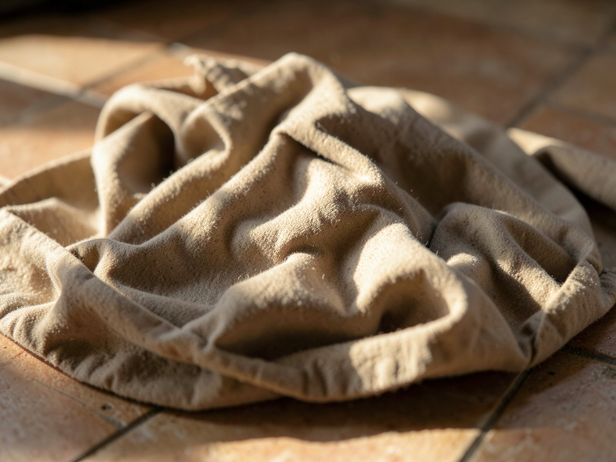
My dog's nesting behaviour creates this cozy, rumpled blanket mound. The morning light highlights the fabric's texture.
Temperature and comfort have a role too
Scratching and circling are not purely about territory. In cooler weather, the motion brings warmer air up from beneath a surface, and the circular path helps a dog find the orientation that puts its back to a draft. In warmer conditions, a dog may scratch to expose a cooler layer underneath a blanket or to push the bedding aside entirely. This is why the same dog may pile its blanket into a mound in a cold room and shove it to the edge in a hot one. The behaviour is adaptive even now, even in a climate-controlled flat, because the dog is working from sensation rather than knowing the thermostat setting.
What the variations tell you
Most scratching is brief, rhythmic, and ends the moment the dog settles. A few variations are worth noticing. A dog that scratches obsessively, several minutes, visibly unable to stop, repeated across the night, may be anxious rather than nesting. Anxiety-driven repetitive behaviour tends to look frantic, lacks the settling endpoint of normal nesting, and often appears alongside other signs: pacing, whining, reluctance to eat. A dog that scratches hard at a specific corner of the bed and keeps returning to it may be responding to a smell the owner cannot detect. And a dog that has recently started scratching much more than before, especially if it is also restless at night or seems stiff when it finally lies down, may be uncomfortable, pain from joints or muscles can make a dog fidget longer before finding a position that works. That last combination, new or worsening restlessness plus visible stiffness, is worth raising with a vet rather than watching.
![Dog rests on blanket]()
Dog rests on blanket
Image credit : AI
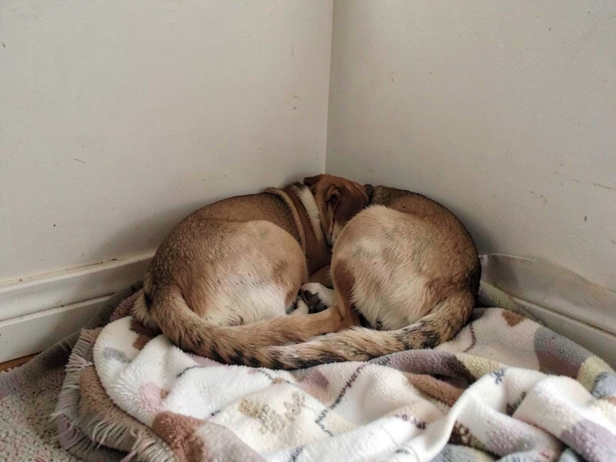
My dog exhibits nesting behaviour, finding comfort on his blanket. He's so peaceful when he settles down.
When to leave it alone and when not to
For the vast majority of dogs, bed-scratching is normal, harmless, and requires nothing from the owner except a blanket that can take the wear. Trying to stop it with a firm no teaches the dog to suppress the behaviour in front of you; it does not remove the drive. A dog that scratches its bed is not misbehaving. It is doing something its nervous system has been running for a very long time. The practical response is to give it a surface worth scratching: a blanket or mat it can bunch and rearrange, rather than a rigid bed that offers no give. Dogs with high-nesting behaviour often settle faster when they have something to actually move around.