One moment your cat is stretched across the sofa. The doorbell rings, unfamiliar voices fill the hallway, and she is simply gone. No drama, no warning, just an empty cushion and a faint warmth where she was sitting. Most owners read this as shyness. The real picture is more layered than that.
Cats map their world by smell, sound and routine
A cat's sense of safety is built on a mental map of her territory: which smells belong here, which sounds are background noise, which movements are predictable. Guests disrupt all three at once. New shoes carry unfamiliar scent. Voices land at volumes and pitches she has not catalogued. Furniture gets shifted, bags get dropped, children run. From her perspective, the flat has briefly become a different place, and she has not agreed to that.
This is not anxiety in the clinical sense for most cats, it is a sensory recalibration. She is not frightened of your guests specifically. She is waiting for the environment to stabilise before she re-enters it. The under-bed retreat, the top of the wardrobe, the bathroom behind the washing machine, these are positions she has already assessed as safe. She is not hiding from something so much as returning to a known baseline.
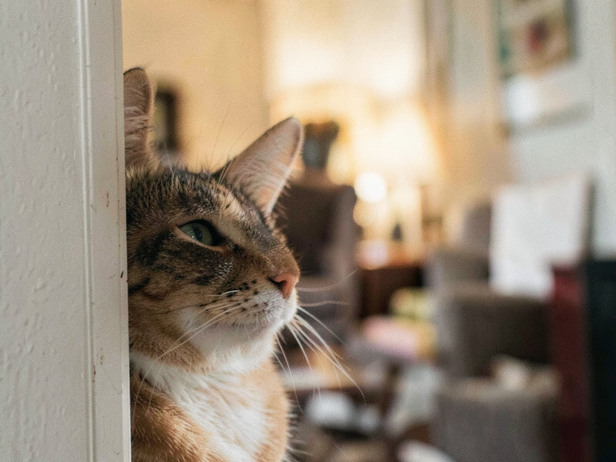
![Alert Cat at Doorway]()
Alert Cat at Doorway
Image credit : AI
I'm watching from the doorway, a bit wary of the new people. This is why cats hide when visitors come.
Socialisation in kittenhood shapes how she responds now
A cat exposed to varied people, sounds and handling between roughly two and seven weeks of age develops a wider tolerance for novelty. One who spent that window in a quiet corner of a shelter, or in a home with a single owner and no visitors, did not get that input. Her nervous system learned a narrower definition of normal, and strangers fall outside it.
This is not a character flaw. It is a developmental window that closed before you met her. The implication is that a cat who hides from guests is not broken and does not need fixing, she needs the pressure taken off. Forcing interaction, carrying her to meet guests, or blocking her exit routes makes the association between strangers and discomfort stronger, not weaker.
Some cats hide for reasons that deserve a second look
There is a difference between a cat who retreats when the flat fills with people and a cat who has started hiding more than usual, including when the flat is quiet. Pain, hyperthyroidism, cognitive decline in older cats, and urinary discomfort can all produce withdrawal that looks like social avoidance. If the hiding is new, has intensified, or is accompanied by changes in eating, litter box use, grooming or vocalisation, those are signs worth raising with a vet rather than attributing to personality.
A cat who used to greet guests and now disappears every time is telling you something has changed. The question is whether what changed is the guest list or something inside her.
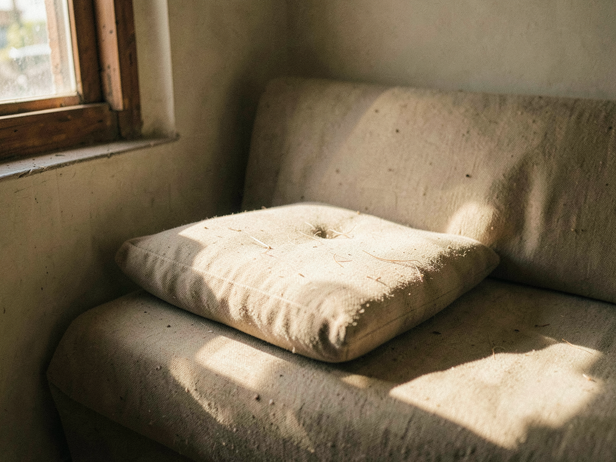
![Sunlit Sofa Cushion Impression]()
Sunlit Sofa Cushion Impression
Image credit : AI
The cushion holds a faint impression, a silent testament to a cat hiding from guests.
What actually helps, and what makes it worse
The most effective thing you can do is give her a room she can own during visits: door closed, familiar bedding, water, a litter tray, and no well-meaning guests opening the door to say hello. This is not exile. It is giving her the option to opt out completely, which reduces stress more reliably than any amount of coaxing.
If you want to build her tolerance over time, the method is slow and guest-led, not owner-led. Ask visitors to ignore her entirely. No eye contact, no reaching, no calling her name. Let her approach on her own terms. When she does, the visitor can toss a small treat in her direction without looking at her. Over many repetitions across many visits, some cats extend their comfort zone. Others do not, and that is a legitimate outcome too.
Punishment, shooing her away from a hiding spot, confining her to a social space against her will, achieves nothing except teaching her that guests predict unpleasant things. The hiding gets worse, not better.
A cat who disappears when the doorbell rings is doing exactly what her instincts were built to do. The gap between her world and yours is not a problem to solve so much as a difference to accommodate, and for most cats, a quiet room and a patient household is all the help they need.