Watch two cats use a litter box and you might wonder if they belong to the same species. One scratches for thirty seconds, does its business, then covers with the focused efficiency of a cat who has thought about nothing else. The other steps in, does what it came to do, and exits, leaving a small excavation site behind. Neither cat is broken. Both are following instincts that predate domestication by a very long margin.
What covering is actually for
Cats that bury their waste are not being tidy for your benefit. In the wild, subordinate cats cover their scent to avoid advertising their presence to dominant animals or predators. Covering is a survival behaviour rooted in vulnerability. A cat that buries is, in some sense, signalling that it feels it has something to hide from.
The opposite is also true. Dominant cats in multi-cat territories often leave waste uncovered, or even in conspicuous places, as a deliberate scent marker. This is called middening, and it is a communication act, not a failure of manners. Your indoor cat may have no rival cats in the flat, but the instinct to broadcast or conceal can still run strong depending on its personality and how secure it feels in its environment.
![Clean Litter Box Morning Light]()
Clean Litter Box Morning Light
Image credit : AI
Observing the clean litter box, I notice the pale grey clumping litter and a small metal scoop. This setup aims to address cat litter kicking behavior.
The box itself is often the real answer
Before reading your cat's psychology, check the box. Cats that kick litter excessively are frequently responding to something physical: a box that is too small for them to turn around and position properly, litter that is too shallow to dig into and cover with, or a litter type that does not clump or compress in a satisfying way. A cat that cannot complete the covering motion the way its instinct expects will often scratch at the walls and rim instead, which is what sends litter flying.
Litter depth matters more than most owners realise. Three to four centimetres is the minimum; many cats prefer closer to five. A box that is consistently overfull of waste can also suppress covering behaviour, the cat assesses the surface, finds it already compromised, and leaves without engaging. Scooping twice a day removes this variable entirely.
The size of the box is the other common culprit. Commercial litter boxes are frequently too small for an adult cat to move through a full covering sequence. A flat with a standard small tray and a large cat will almost always produce litter on the floor. A storage container with high sides and a cut-out entry point, bought from any hardware store, gives the cat room to work and contains the scatter.
When litter kicking is about the other cat
In a multi-cat home, watch which cat is doing the kicking and when. A cat that has recently had its position in the household challenged, by a new cat, a new person, or a change in routine, may stop covering as a way of asserting itself. Conversely, a cat that was previously a confident non-coverer may begin burying after a social disruption, suddenly feeling less secure. These shifts in litter behaviour are often the first sign that the social dynamics in the home have changed, and they usually resolve once the underlying tension settles.
![Relaxed Cats in Afternoon Light]()
Relaxed Cats in Afternoon Light
Image credit : AI
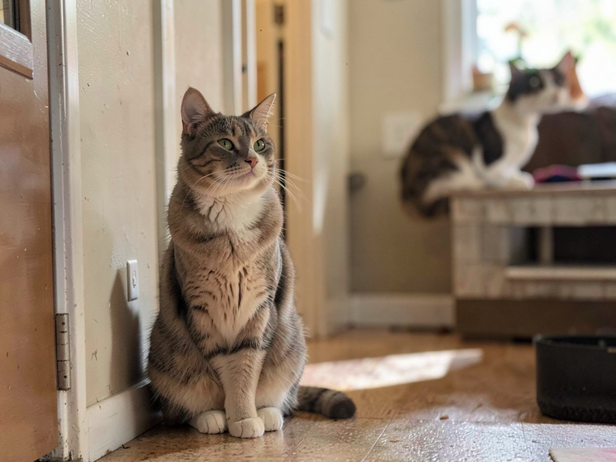
My cats relax in the afternoon sun. One is near the doorway, the other on a shelf. I wonder if they'd cover their litter if they had more space.
Health reasons that change litter behaviour
A cat that suddenly changes its litter habits, covering when it never did, or stopping when it always did, deserves a second look. Pain is a common driver. Arthritis in the hips or spine makes the crouching and scratching motion uncomfortable, and a cat in pain will often rush out of the box to cut the discomfort short. Older cats and heavier cats are most affected. If your cat is also moving more slowly elsewhere, jumping less, or reacting when touched along its back, that combination is worth a vet visit.
Urinary tract issues can also change box behaviour abruptly. A cat that is straining, visiting the box repeatedly, or producing very little urine needs a vet the same day, this is not a behaviour question.
What you can actually change
Start with the physical variables before drawing conclusions about personality. Larger box, deeper litter, scooped twice daily, placed somewhere the cat can approach from more than one direction. If those changes produce no shift in two weeks, the behaviour is almost certainly temperament or social, and temperament you learn to live with rather than correct. A cat that has never covered and is otherwise healthy, eating well, and using the box consistently is simply a cat that does not cover. There is no training intervention that reliably installs a behaviour this deeply instinctual.
The litter on the floor is a nuisance. A mat outside the box catches most of it. What the behaviour is telling you is almost always more interesting than the scatter itself, and usually easier to address once you know which question you are actually answering.