The moment you stand up, your pet is already moving. It is one of those behaviours that seems almost comic in its consistency, and owners tend to explain it in one of two ways: the animal is being cheeky, or the animal loves them. Both explanations carry some truth, but neither is the whole picture.
The warm spot is the obvious answer, and it is a real one
![Cat's Warm Cushion Comfort]()
Cat's Warm Cushion Comfort
Image credit : AI
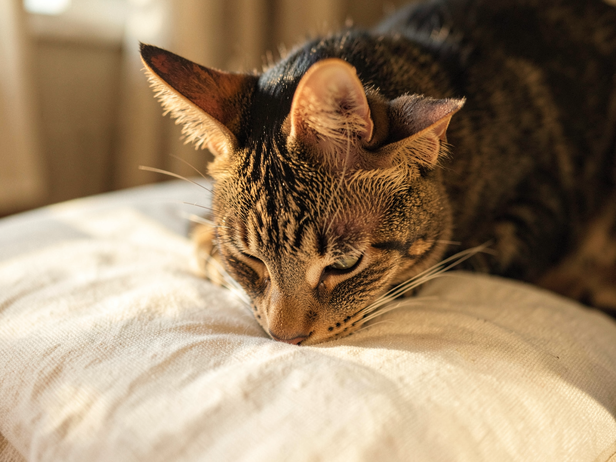
A tabby cat finds comfort, perhaps a familiar scent, on a warm cushion. This behavior is common, with pets often taking our spots.
Your body leaves behind heat. A cushion or mattress retains it for several minutes after you leave, and for an animal whose comfort-seeking is not filtered through self-consciousness, a warm surface is simply a better place to lie than a cold one. Dogs and cats both regulate body temperature through their environment more actively than people do, and a pre-warmed spot costs them no effort at all. This is not cunning. It is the same logic that puts a cat on a laptop or a dog pressed against a radiator. The heat is there; the animal takes it.
Scent matters as much as warmth, and possibly more
Your pet lives in a world built from smell in a way that is genuinely difficult for humans to appreciate. A dog's nose carries roughly 300 million olfactory receptors against a human's 6 million. A cat's sense of smell is estimated to be roughly 14 times sharper than ours. Your seat holds a concentrated imprint of your scent, and for an animal that uses smell to track social relationships, resting in that scent is a form of closeness. It is not a replacement for your presence so much as a way of staying connected to it. When your pet takes your spot, it is, in a real chemical sense, sitting with you.
Social position plays a role, but not the way dominance theory describes it
![Dog's Cozy Sofa Haven]()
Dog's Cozy Sofa Haven
Image credit : AI
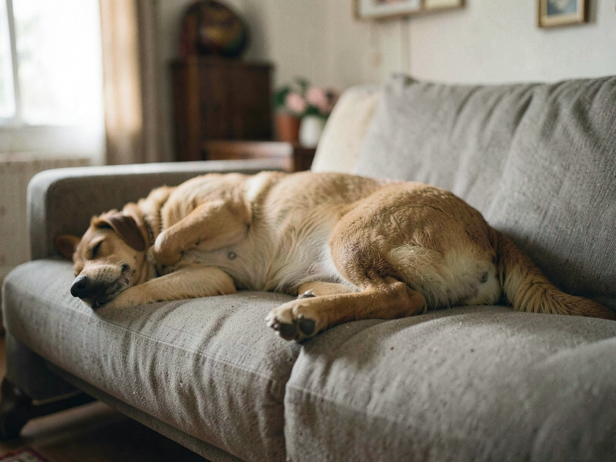
This dog's relaxed pose on the sofa highlights why pets steal your spot. A quiet moment of canine contentment.
An older idea in pet behaviour held that a dog taking the alpha's seat was making a power move, asserting rank in the household hierarchy. The research that underpins dominance theory in domestic dogs has been substantially revised over the past two decades. Dogs are not running constant status calculations in the way that model implied, and the same logic never applied cleanly to cats. What is more likely happening is something simpler: your spot is the most socially significant place in the room because you use it most. It smells the most like you, it is warm from you, and it is the place where you are usually present. For an animal oriented toward you, that spot is the centre of the social world. Claiming it is less about rank and more about proximity to the person they are attached to.
Anxiety and attachment can intensify the behaviour
For some pets, particularly dogs with separation anxiety or those who are strongly bonded to one person, taking the vacated spot is not casual comfort-seeking. It is a response to the mild stress of your absence, even if you have only gone to the kitchen. The scent-rich, warm seat functions as a kind of anchor. If your dog does this consistently, follows you between rooms, and shows other signs of distress when you leave the house, pacing, vocalising, destructive behaviour, the spot-stealing is one data point in a larger pattern worth discussing with a vet or a qualified behaviourist. On its own, it means nothing clinical. In combination with other signs, it is worth paying attention to.
When it is just habit, and when it is something else
Most of the time, this behaviour is exactly what it looks like: an animal finding the most comfortable, most familiar-smelling, warmest available surface and settling into it. It requires no intervention. If the spot-stealing is accompanied by growling, stiffening, or snapping when you ask the animal to move, that is a separate issue. Resource guarding behaviour around resting places, particularly in dogs, benefits from the guidance of a qualified trainer or veterinary behaviourist rather than a confrontational approach at the moment it happens. The behaviour itself is not the problem; the response to being asked to move is what needs addressing, and that is a job for a professional. For the vast majority of pets, though, the calculation is uncomplicated. You made the spot good. They want the good spot. The fact that it also smells like you is, for them, the best part.