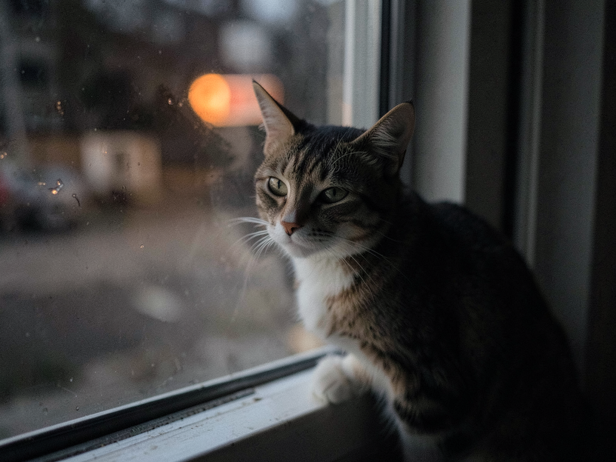
A cat meowing at a closed window at night is not confused or bored in the way a person gets bored. It is responding to something specific, and the window is simply the wall between the cat and whatever that something is.
What the cat is actually detecting
Cats have a hearing range that extends well beyond what a person can pick up, and their sense of smell passes through a closed glass pane more than most owners expect, especially if the window seal is imperfect or the frame carries residual scent. What looks like a cat meowing at nothing is usually a cat that has detected another animal outside. A neighbourhood cat marking territory on the ledge, a gecko on the outer wall, a moth circling a streetlight, or a rat moving through a drain below, any of these can trigger a focused, sustained vocalisation. The meowing is not distress. It is the sound a cat makes when it wants to get to something and cannot.
![Night Watcher at the Glass]()
Night Watcher at the Glass
Image credit : AI
I'm a cat meowing at the window, my senses tuned to the night. This indoor cat night behaviour is a mystery to some.
The crepuscular drive that does not switch off indoors
Cats are crepuscular by nature, meaning their activity peaks around dawn and dusk. In an outdoor or semi-outdoor life this energy gets spent on actual hunting. In a flat with no garden, the drive does not disappear, it just has nowhere to go. The hours between ten at night and four in the morning are precisely when this restlessness peaks for many indoor cats. The window becomes the point of maximum interest because it is where the outside world is most legible: scent, sound, movement, the occasional reflection of something passing. The meowing directed at the window during these hours is often the cat's hunting impulse meeting a hard boundary. It is vocalising at prey it cannot reach, which is a behaviour observed in cats watching birds through glass during the day, the same chattering, chirping sound, sometimes escalating to a full meow when the animal outside lingers.
When another cat is the cause
If the meowing has a particular urgency, or if your cat is unspayed or unneutered, the most likely explanation is a cat outside in or near reproductive condition. A female in heat produces a call that carries a significant distance, and a male cat indoors will respond with persistent, loud vocalisation even through a closed window. Neutered cats can still respond to the presence of an unfamiliar cat outside, particularly if that cat has been spraying near the building. The meowing in this case is territorial rather than reproductive, but it sounds similar. If you have noticed a new stray or colony cat in the area and the window behaviour started around the same time, that is the connection.
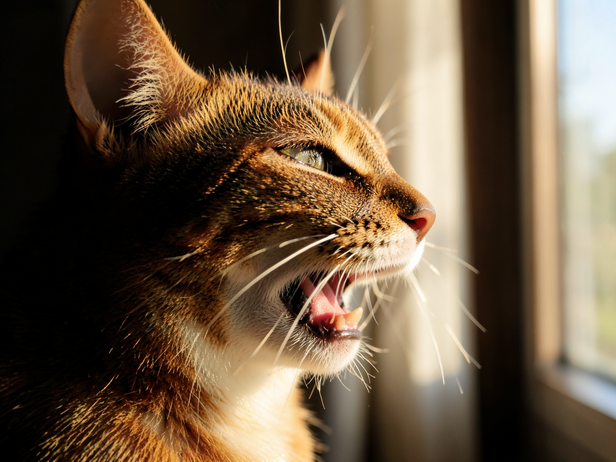
![Cat's Profile Mid-Meow]()
Cat's Profile Mid-Meow
Image credit : AI
My cat vocalises at night, looking out the window.
Pain and cognitive change are worth ruling out
A cat that has started vocalising at night after years of silence, particularly one that is older than ten, deserves a vet visit before any behavioural explanation is accepted. Hyperthyroidism is common in older cats and produces increased vocalisation, restlessness, and apparent confusion, including meowing at walls and windows at night. Cognitive dysfunction, which is the feline equivalent of dementia, also presents as nighttime vocalisation that seems directionless. High blood pressure, which often accompanies kidney disease or thyroid problems in older cats, can cause disorientation and vocal distress at night. If the cat also seems to be losing weight, drinking more water than usual, or appears to look through rather than at things, those are the signs that warrant a vet appointment rather than a behavioural adjustment.
What actually helps
For a young or middle-aged cat with no health concerns, the window meowing is a management problem rather than a medical one. A play session in the hour before the cat's usual window-calling time burns some of the crepuscular energy before it becomes vocalisation. A perch positioned so the cat can see outside without being directly at the glass sometimes reduces the urgency, the cat can monitor the territory without hitting the barrier. If another cat outside is the trigger, blocking the lower portion of the window with an opaque panel removes the visual stimulus while leaving ventilation. For cats responding to sound rather than sight, this helps less, but it is worth trying. The behaviour rarely disappears entirely in a cat with a strong prey drive. The goal is reducing its frequency and duration, not eliminating what is, from the cat's point of view, a completely reasonable response to the world outside.